The 1-10-100 Rule: Why a $1 Problem Becomes a $100 Disaster
Rahul I
The 1-10-100 Rule: Why a $1 Problem Becomes a $100 Disaster
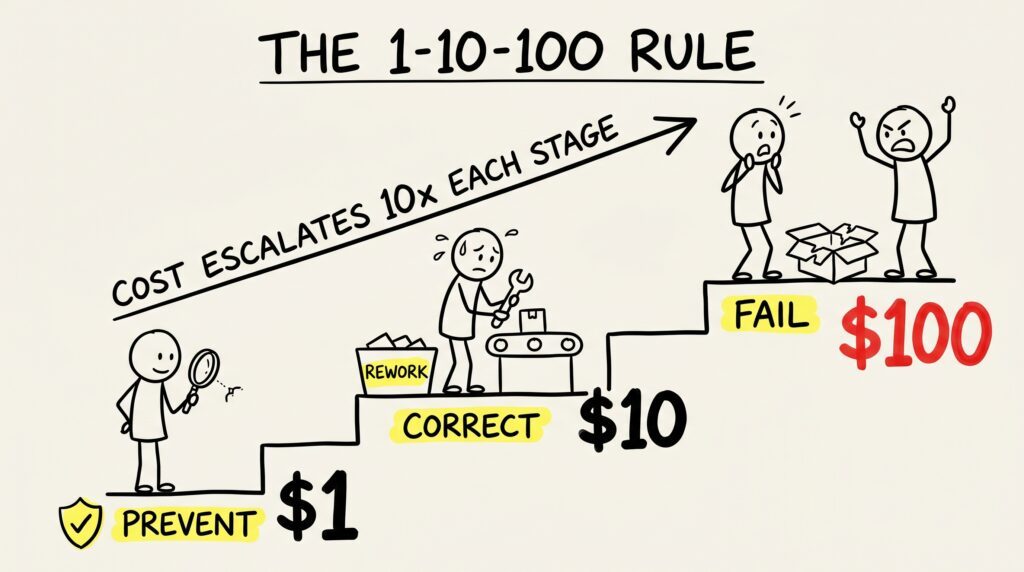
The 1-10-100 rule: the same defect gets roughly ten times more expensive at every stage it survives.This article expands on ideas I share on LinkedIn, where readers are already swapping their own stories of a tiny mistake that turned into a huge bill. Add yours to the conversation there, then read the full breakdown below.
You catch a typo in a customer’s address. Fixing it would take five seconds. You are slammed, so you let it go. Three weeks later a shipment is sitting at the wrong address, the customer is on the phone, and four people are pulled onto a call to untangle it. Same mistake. The only thing that changed was how far it was allowed to travel.
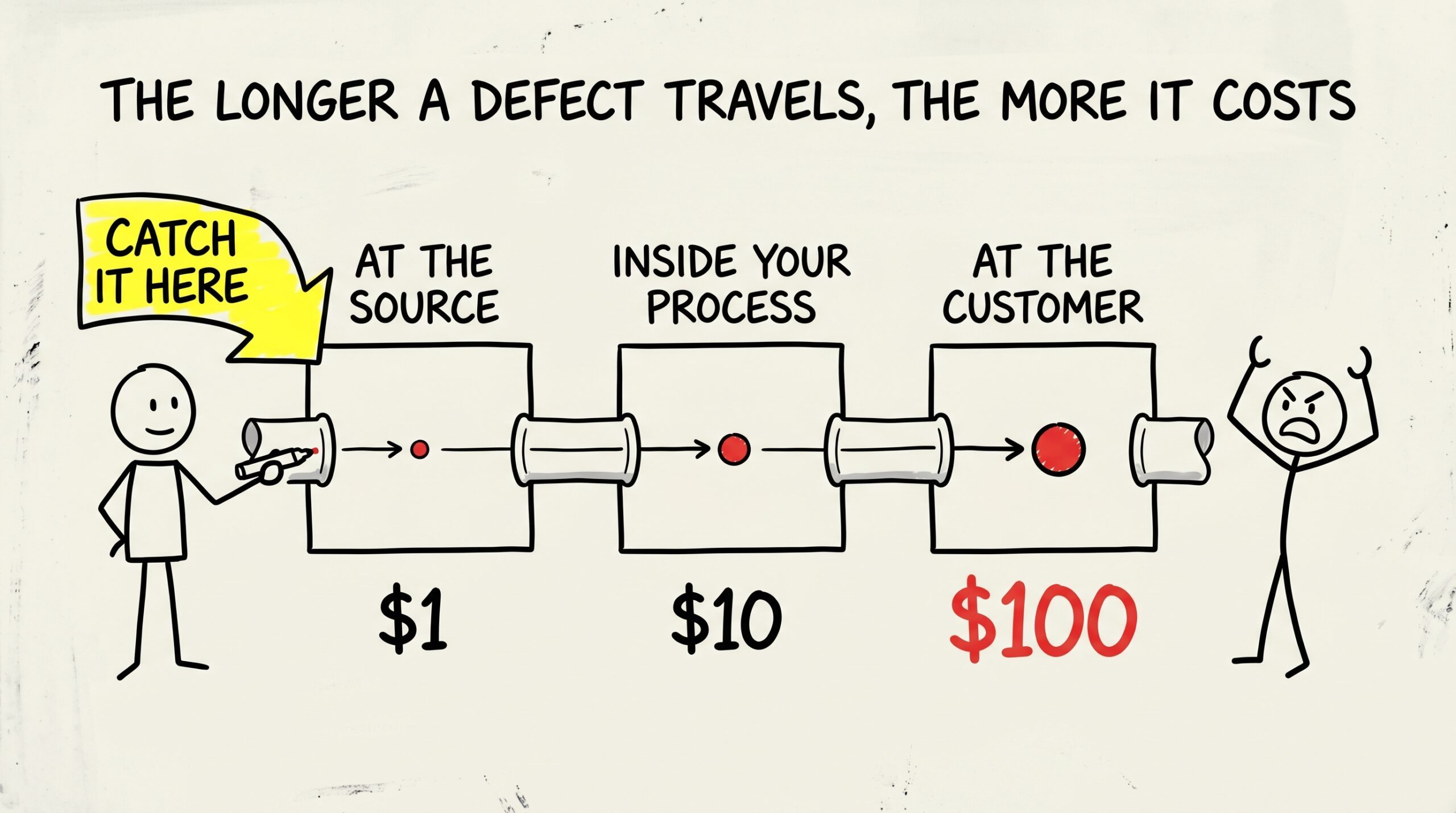
That quiet escalation has a name and a number. The 1-10-100 rule says a problem caught at the source costs about $1, the same problem caught later inside your process costs about $10, and that same problem once it reaches the customer costs about $100. It is one of the most useful ideas in quality, and one of the most ignored, because the cheapest moment to act is also the moment the problem looks least urgent.
The 1-10-100 Rule in 90 Seconds: 5 Things Worth Remembering
If you only have ninety seconds, here are the five things worth keeping.
The cost of a defect climbs in leaps, not inches. Roughly ten times at each stage it survives: $1 to prevent, $10 to correct internally, $100 to fix after it reaches the customer.
The numbers are a rule of thumb, not an accounting law. The 1, 10, and 100 are an order-of-magnitude pattern. In high-stakes industries the tail can stretch to 1,000 or far beyond.
Most organizations bleed at the $100 end without feeling it. Rework and firefighting get normalized, so prevention looks like an expense instead of the cheapest insurance available.
It is a system problem, not a people problem. The fix is to design the cheap correction in early, not to tell people to try harder.
AI raises the stakes, it does not change the logic. Automating a process that produces defects simply produces those defects faster, which makes prevention more valuable, not less.
The 1-10-100 rule is a quality and cost principle stating that the money, time, and effort needed to fix a defect multiply by roughly ten at each stage it is allowed to advance. Prevent it at the source and it costs about one unit. Catch it later inside your own process and it costs about ten. Let it escape to the customer and it costs about a hundred. The unit of analysis is a single defect or record, not a whole department, and the dollar signs stand in for an order of magnitude rather than a literal invoice.
The one line to remember: A defect never gets cheaper to fix. The longer it travels, the more it costs, and it climbs in leaps. Spend the $1 now, or pay the $100 later.
Key Facts at a Glance
Attribute
Detail
Common name
The 1-10-100 rule (cost of poor quality escalation)
Core claim
A defect costs ~$1 to prevent, ~$10 to correct internally, ~$100 after it reaches the customer
Codified by
George Labovitz and Yu Sang Chang (with Victor Rosansky)
Primary source
Making Quality Work: A Leadership Guide for the Results-Driven Manager (1992)
Software cousin
Barry Boehm’s “Rule of Ten” for defect cost in software (1976)
Underlying framework
Prevention-Appraisal-Failure (PAF) cost-of-quality model
Nature of the numbers
An illustrative order-of-magnitude heuristic, not a literal accounting law
Where the Rule Came From
The version most quality and data professionals quote was put on paper in 1992 by George Labovitz and Yu Sang Chang in their book Making Quality Work. They used a simple example: a single wrong customer address entered at one desk becomes far more expensive to fix once it has rippled through billing, shipping, and service. The cost did not rise gently. It jumped.
The idea has an older cousin in software engineering. In 1976, Barry Boehm published research showing that a defect caught during requirements was trivial to fix, while the same defect caught after release could cost up to a hundred times more. Engineers came to call this the “Rule of Ten.” Two communities, two names, one phenomenon: the longer an issue hides in a system, the harder and more expensive it is to remove.
The Three Tiers, in Plain Numbers
The same defect grows more expensive at every stage it survives. The cheapest place to catch it is the first one.
Each tier maps cleanly onto the classic cost-of-quality model, where prevention and appraisal are the cost of good quality, and internal and external failure are the cost of poor quality.
Tier
Stage
What it looks like
Everyday example
$1
Prevent at the source
Design reviews, mistake-proofing, validation at data entry
A drop-down field that blocks an invalid postcode
$10
Correct inside your process
Rework, scrap, sorting, re-testing, delay
Catching a wrong part during in-line inspection
$100
Fail at the customer
Recalls, warranty, returns, lawsuits, lost trust
A recall after the product is already in homes
The mechanism is not mysterious. At the source, a fix touches one item and one person. Inside the process, it touches batches, schedules, and other departments. At the customer, it touches your reputation, your legal exposure, and every future sale that trust would have earned.
Why the Real Damage Stays Hidden
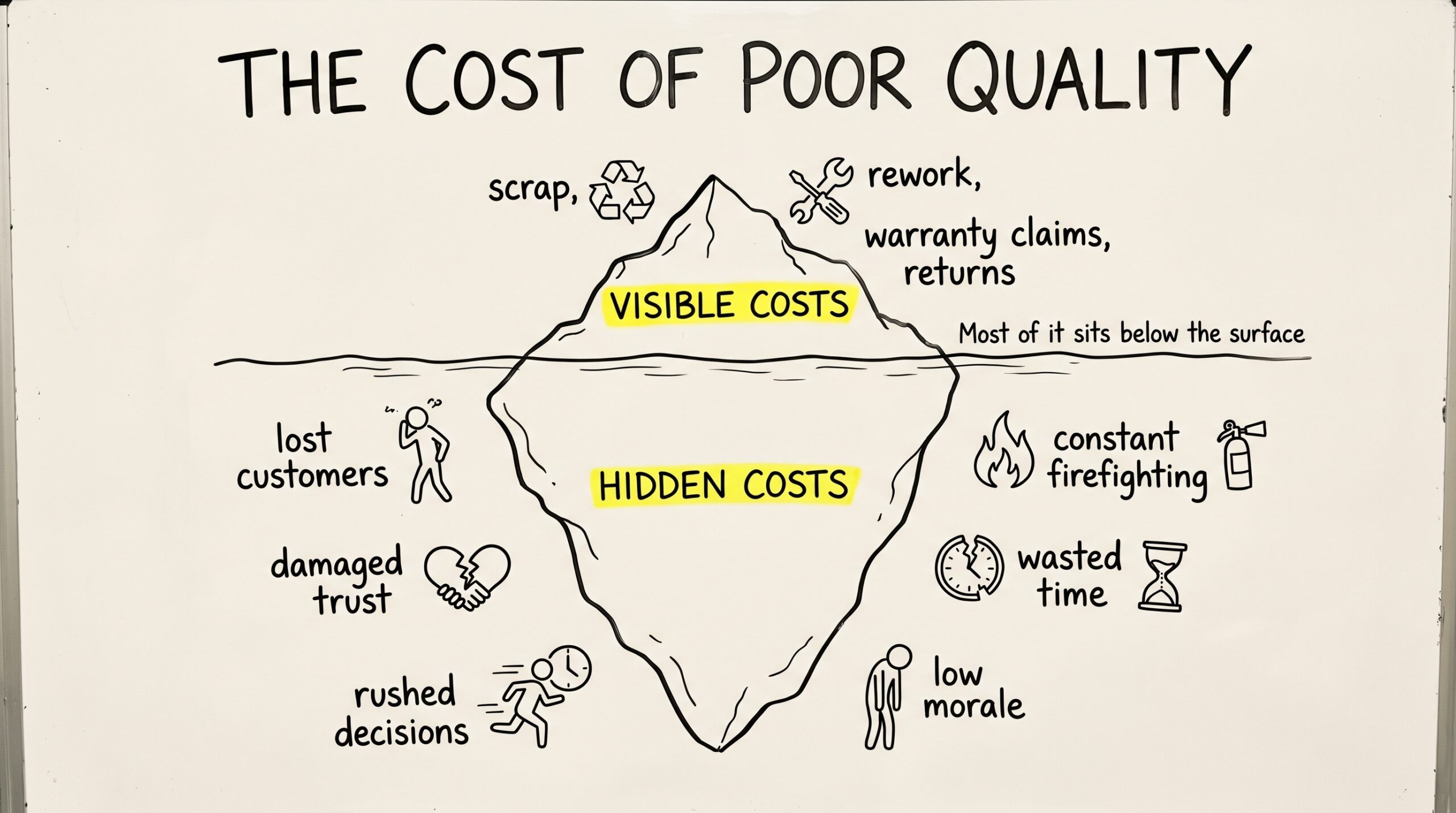
The costs you can see are the tip. The expensive part, lost trust and lost customers, sits below the waterline.
Here is the uncomfortable part. Most organizations are losing money at the $100 end and cannot feel it, because the worst costs are invisible on any standard report. Scrap and rework show up in a ledger. Lost trust, a rushed decision made on bad data, the customer who quietly never returns, those do not. They sink below the waterline.
The scale is not trivial. In manufacturing, the cost of poor quality routinely consumes an estimated 15 to 25 percent of total sales revenue. On the data side, one widely cited Harvard Business Review assessment found that 47 percent of newly created records contain at least one critical error. We stop noticing these losses because they get absorbed into “how things are.” Rework becomes Tuesday. Firefighting becomes the job. And prevention, the one move that would drain the swamp, gets treated as an optional expense.
Visible costs (above the line)
Hidden costs (below the line)
Scrap and rework
Lost customers and churn
Warranty claims and returns
Damaged brand and trust
Inspection and re-testing
Decisions made on bad data
Expedited shipping to fix errors
Constant firefighting and low morale
This is the heart of Philip Crosby’s argument in Quality is Free: prevention always costs less than failure. We just pay for failure in instalments and stop reading the bill.
Is It a Law, or a Rule of Thumb?
Honesty matters here, because this blog is read by people who check the math. The 1-10-100 ratio is a powerful teaching tool, not a measured constant. The pattern of escalation is real and well documented; the exact 1:10:100 multiplier is illustrative.
The most rigorous modern challenge is worth knowing. In 2016, researchers led by Tim Menzies and William Nichols analysed time-tracking data from 171 agile software projects and found no evidence of an exponential rise in the time it took to fix defects across phases. Their conclusion was nuanced: the steep escalation curve was largely an artifact of older, slow-release ways of working. Modern practices like continuous integration and automated testing can flatten it. The escalation still bites hardest in rigid legacy systems and high-assurance work, but it is not an iron law in every setting.
So treat 1-10-100 as a compass, not a calculator. It points reliably in the right direction, encouraging you to invest upstream, even though the precise gradient depends on your system.
The Rule Across Four Industries
The tiers translate differently depending on where you work, but the shape holds.
Industry
$1: Prevent
$10: Correct
$100: Fail
Manufacturing
Design reviews, supplier audits, mistake-proofing
In-line rework, batch sorting, scrap
Recalls, warranty, line-stoppage penalties
Software
Unit tests, code review, secure coding standards
Bugs caught in QA and system testing
Production outages, data loss, SLA penalties
Healthcare
Validated intake fields, barcode scanning
Discrepancies caught in secondary review
Adverse events, malpractice exposure
Financial services
Identity and data validation at onboarding
Untangling duplicate or wrong records
Mis-funded loans, regulatory fines
Different vocabulary, same lesson: the cheapest defect is the one that never leaves the desk it was created on.
How to Put the 1-10-100 Rule to Work
The practical move is to shift your effort and budget upstream, toward the $1 column. Five steps make that concrete.
Map the process first. You cannot prevent a defect you cannot see. A clear process map shows where errors are born.
Design the mistake out. Wherever possible, use poka-yoke (mistake-proofing) so the wrong action is physically hard to take. This is the purest form of spending the $1.
Anticipate failure before it happens. A Failure Mode and Effects Analysis (FMEA) ranks where prevention will pay back the most, so you engineer out the most likely and most severe failures first.
Stabilize, then watch. A stable process and a simple control chart catch the $10 problem before it becomes the $100 one.
Never let a known defect ship. Put a human checkpoint at the last gate before the customer. That is where the cost, and the trust, falls off a cliff.
Notice that none of this is about telling people to be more careful. It is about building the system so the cheap fix is also the easy one. That is the entire philosophy behind Lean and Six Sigma: build quality in, rather than inspect it in.
The 1-10-100 Rule in the Age of AI
Automation does not repeal the rule. It amplifies it. Point an AI system at a process that produces defects and it will produce those defects faster and at greater scale. A bad upstream record no longer corrupts one report; it can ripple through hundreds of models and dashboards in seconds. Some analysts now stretch the heuristic to 1-10-100-1,000,000 to capture how a single unchecked anomaly can compound once an algorithm starts acting on it. That figure is rhetorical rather than measured, but the direction is sound.
The defensive move is the same one quality professionals have practiced for decades: validate at the source, and keep a human in the loop on high-stakes decisions. Routing low-confidence AI output to a person for a quick check is simply spending the $1 to avoid the $100. For anyone applying these methods, an AI-powered approach to root-cause analysis pairs the speed of automation with the judgment that keeps it honest.
Audit Your Own Quality Costs
Before your next “we will fix it later” meeting, run your situation through these five questions. They turn the rule from a poster into a decision.
#
Question
What a bad answer reveals
1
Where is this defect being created, exactly?
You are inspecting at the end instead of preventing at the source
2
Could a simple design change make the error impossible?
A missed poka-yoke opportunity sitting in plain sight
3
What does one escaped defect actually cost us downstream?
You are managing the $1 and ignoring the $100
4
Are we counting hidden costs, or only scrap and rework?
The real loss is below your waterline and unmeasured
5
Is prevention funded, or treated as an optional expense?
The cheapest insurance you have is the first thing cut
Most quality failures are not failures of effort or ethics. They are failures of design. Fix the design, and the cost takes care of itself.
Build the Skills That Catch Defects Early
Understanding the 1-10-100 rule is step one. Building the operational skill to prevent defects, map flow, and design quality in is the next. AIGPE offers globally accredited, project-based certifications at the intersection of Process Excellence and Artificial Intelligence.
It is the principle that a defect costs about $1 to prevent at the source, about $10 to correct once it is inside your process, and about $100 once it reaches the customer. The cost rises by roughly ten times at each stage the defect survives.
Who created the 1-10-100 rule?
It was codified by George Labovitz and Yu Sang Chang, with Victor Rosansky, in their 1992 book Making Quality Work. A closely related idea, the “Rule of Ten” for software defects, was demonstrated earlier by Barry Boehm in 1976.
Are the 1, 10, and 100 figures literal dollar amounts?
No. They are an order-of-magnitude rule of thumb that communicates how steeply remediation cost rises. The exact multiplier varies by industry and system, and in high-stakes settings the escalation can run far beyond 100.
How does the 1-10-100 rule relate to the cost of poor quality?
It is a simple way to express the Prevention-Appraisal-Failure model. The $1 tier is prevention, the $10 tier is internal appraisal and failure, and the $100 tier is external failure. Together the $10 and $100 tiers make up the cost of poor quality.
Is the 1-10-100 rule scientifically proven?
The general pattern of escalating cost is well supported, but the precise 1:10:100 ratio is illustrative rather than a measured law. A 2016 study of 171 agile projects found modern engineering practices can flatten the curve, so the rule is best used as a directional guide for investing in prevention.
How does the rule apply to AI and automation?
Automation scales whatever process it is given, so an unprevented defect is reproduced faster and wider once AI acts on it. That makes upstream validation and human-in-the-loop checks more valuable, not less. Spending a little to verify data at the source avoids large, automated failures downstream.
About the Author
Rahul G. Iyer is an AI-Driven Transformation Leader and Founder and CEO of AIGPE®. With more than 23 years of experience and 700+ personally executed Six Sigma, process-improvement, Operational Excellence and transformation projects, he turns practical expertise into professional courses, corporate training, private AI coaching, keynotes and The M3 Podcast Show. His learning content has generated 1M+ cumulative learner enrollments and reached 198 countries.
Citations and References
Labovitz, G., Chang, Y. S., and Rosansky, V. (1992). Making Quality Work: A Leadership Guide for the Results-Driven Manager.Google Books
Loqate. “The 1-10-100 rule: the real impact of poor data.” loqate.com
Matillion. “The 1:10:100 rule of data quality: a critical review.” matillion.com
Code Intelligence. “Rule of Ten: How to Cut Your Software Development Costs.” code-intelligence.com
Chuniversiteit. “Are bugs more expensive to fix in production?” (Menzies, Nichols, Shull, Layman, 2016). chuniversiteit.nl