


AI-Powered Six Sigma White Belt: 7 Reasons It’s the Smartest Career Move of 2026

This article expands on a conversation I started on LinkedIn about why beginners, not Black Belts, may gain the most from AI. Readers there are already swapping their own takes. Add yours to that thread, then read the full breakdown below.
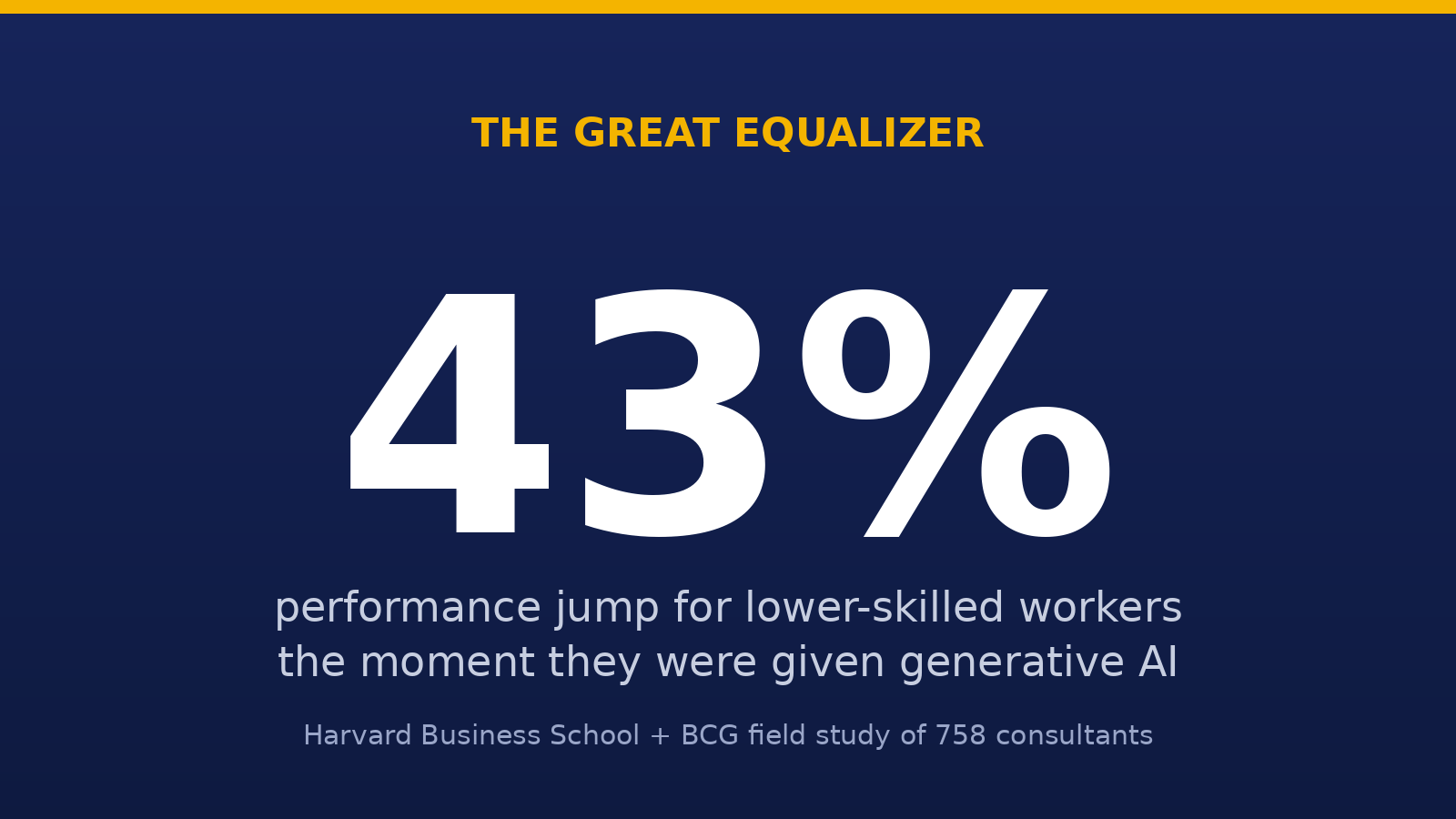
Here is the uncomfortable truth most certification providers will not tell you: a complete beginner armed with ChatGPT can now produce process-improvement work that used to require months of Green Belt training. That is not hype. In a Harvard and Boston Consulting Group field study of 758 consultants, the workers in the lower half of measured skill saw their performance jump by a remarkable 43% the moment they were given generative AI. The gap between novice and expert narrowed almost overnight.
That single finding reframes the whole question of where to start in Lean Six Sigma. For years the entry-level White Belt was treated as a vocabulary test, a polite nod before the “real” belts began. The arrival of accessible AI changes the math entirely. The frontline employee who understands the DMAIC framework and knows how to direct an AI assistant is suddenly one of the most useful people in any improvement project. This is the gap our new AI-Powered Six Sigma White Belt was built to fill, and below is the data, the workflow, and the honest caveats behind it.
7 Insights at a Glance
If you only have ninety seconds, here are the seven things worth remembering about the AI-powered White Belt in 2026.
- AI is a great equalizer for beginners. In the Harvard/BCG study, lower-skill workers gained 43% in performance with generative AI, while top performers gained 17%. The on-ramp to skilled analytical work has never been shorter.
- The demand is hiding in plain sight. An estimated 413,330 US jobs ask for Six Sigma skills, and roughly half are filled by people with no formal credential. That is a 200,000-person gap a White Belt can step into.
- Nobody is teaching beginners the AI version. Existing AI-plus-Six-Sigma training targets Green and Black Belts. Entry-level AI training is a genuine blue-ocean gap, which is exactly where this course sits.
- Six Sigma now governs AI, not just factories. Engineers are applying DMAIC control logic and three-sigma limits to keep AI “hallucinations” in check. Structured problem-solving is becoming more relevant in the AI era, not less.
- The salary story is real but nuanced. Certified Six Sigma professionals earn an average premium of $16,411, though that is an all-belts average skewed by Black Belts. For a White Belt, the payoff is visibility and project access, not an instant raise.
- No math and no Minitab required. The AI handles the calculation and charting. Your job is to frame the problem, write a clear prompt, and check the output. That removes the single biggest barrier beginners report.
- It is accredited and stackable. Professional-credit eligibility and values vary by activity. Confirm any current SHRM PDC value in the SHRM provider directory before relying on it for recertification.
Table of Contents
- What Is an AI-Powered Six Sigma White Belt?
- Key Facts at a Glance
- 1. The Market Is Moving Faster Than the Syllabus
- 2. The 43% Equalizer: Why Beginners Win With AI
- 3. AI-Powered DMAIC, Phase by Phase
- 4. The Twist: Six Sigma Now Keeps AI Honest
- 5. Is It Actually Worth It? An Honest Look
- 6. Where the White Belt Fits in the Hierarchy
- 7. What I’m Watching in 2026
- Get Certified: The AI-Powered Six Sigma White Belt
- Frequently Asked Questions
- About the Author
- Citations and References
What Is an AI-Powered Six Sigma White Belt?
A Six Sigma White Belt is the entry point into the world of operational excellence. It gives you the language, the history, and the core framework, namely the difference between Lean (the elimination of waste) and Six Sigma (the reduction of variation), plus the five-phase DMAIC roadmap: Define, Measure, Analyze, Improve, Control. Traditionally, a White Belt is a supportive contributor who spots waste, gathers data, and participates in projects without leading them.
The “AI-powered” part is what makes this version different. Instead of stopping at definitions, you learn to pair every classic tool, the project charter, the process map, the fishbone diagram, the Pareto chart, the control chart, with a practical AI assistant like ChatGPT, Gemini, or Claude. You are not learning to code or to run statistics by hand. You are learning to direct AI to do the heavy lifting while you supply the judgment.
The one line to remember: AI lowers the barrier to doing the work; Six Sigma gives you the structure to do it right. The White Belt is where those two skills finally meet for beginners.
Key Facts at a Glance
| Attribute | Detail |
|---|---|
| Who it’s for | Complete beginners: frontline, operations, quality, admin, and support staff. No prior Lean, Six Sigma, or AI experience needed. |
| Core framework | DMAIC (Define, Measure, Analyze, Improve, Control), the 8 wastes (DOWNTIME), and the Lean vs Six Sigma distinction. |
| AI tools used | ChatGPT, Google Gemini, and Claude. Free tiers are sufficient. No Minitab or paid software required. |
| Math required | None. AI performs the calculations and visualizations; you frame and verify. |
| Accreditation | AIGPE® programs carry CPD accreditation through the CPD Standards Office (Provider 50735), and AIGPE® is a PMI Authorized Training Partner (Provider 5573). AIGPE® is recognized by SHRM to offer Professional Development Credits (PDCs) for SHRM-CP® or SHRM-SCP® recertification activities (Provider RP9220). |
| Career role | The “Voice of the Frontline”: spotting hidden waste, gathering data, and bridging management strategy with daily reality. |
1. The Market Is Moving Faster Than the Syllabus
Continuous-improvement skills are no longer a manufacturing-only ask. Job postings citing Lean Six Sigma now span call-center managers, clinical-research coordinators, accounting managers, property managers, and document specialists. Organizations are trying to build an enterprise-wide improvement culture, and that means they need frontline people who can speak the language of process.
The numbers behind that shift are striking. There are an estimated 413,330 US jobs requesting Six Sigma competency, and roughly half are filled by professionals with no credential on their resume. Meanwhile, leading analysts project the Lean Six Sigma services market to grow at a compound annual rate of somewhere between 8.7% and 13.6% into the next decade, comfortably outpacing the roughly 5.3% growth of the broader corporate-training market. Demand for the skill is rising, and the supply of credentialed beginners has not caught up.

2. The 43% Equalizer: Why Beginners Win With AI
The most important piece of evidence for an AI-powered entry point comes from a Harvard Business School and Boston Consulting Group field experiment involving 758 consultants. With access to generative AI, participants completed 12.2% more tasks, finished 25.1% faster, and produced work rated more than 40% higher in quality than a control group working without it.
The detail that matters for beginners is the distribution of those gains. Consultants in the top half of baseline skill improved by about 17%. Those in the lower half improved by 43%. AI compressed the distance between novice and expert. For someone just entering process improvement, that is the whole argument: the tool that used to reward only the highly trained now lifts the newcomer fastest.
The researchers also named a warning, which we take seriously in the course. They described a “jagged technological frontier.” When workers used AI for tasks beyond its real capability and trusted the output blindly, performance dropped by roughly 19 percentage points. The lesson is not “let AI do everything.” It is “know where the edge is and keep your judgment switched on,” which is precisely what a structured framework teaches.
3. AI-Powered DMAIC, Phase by Phase
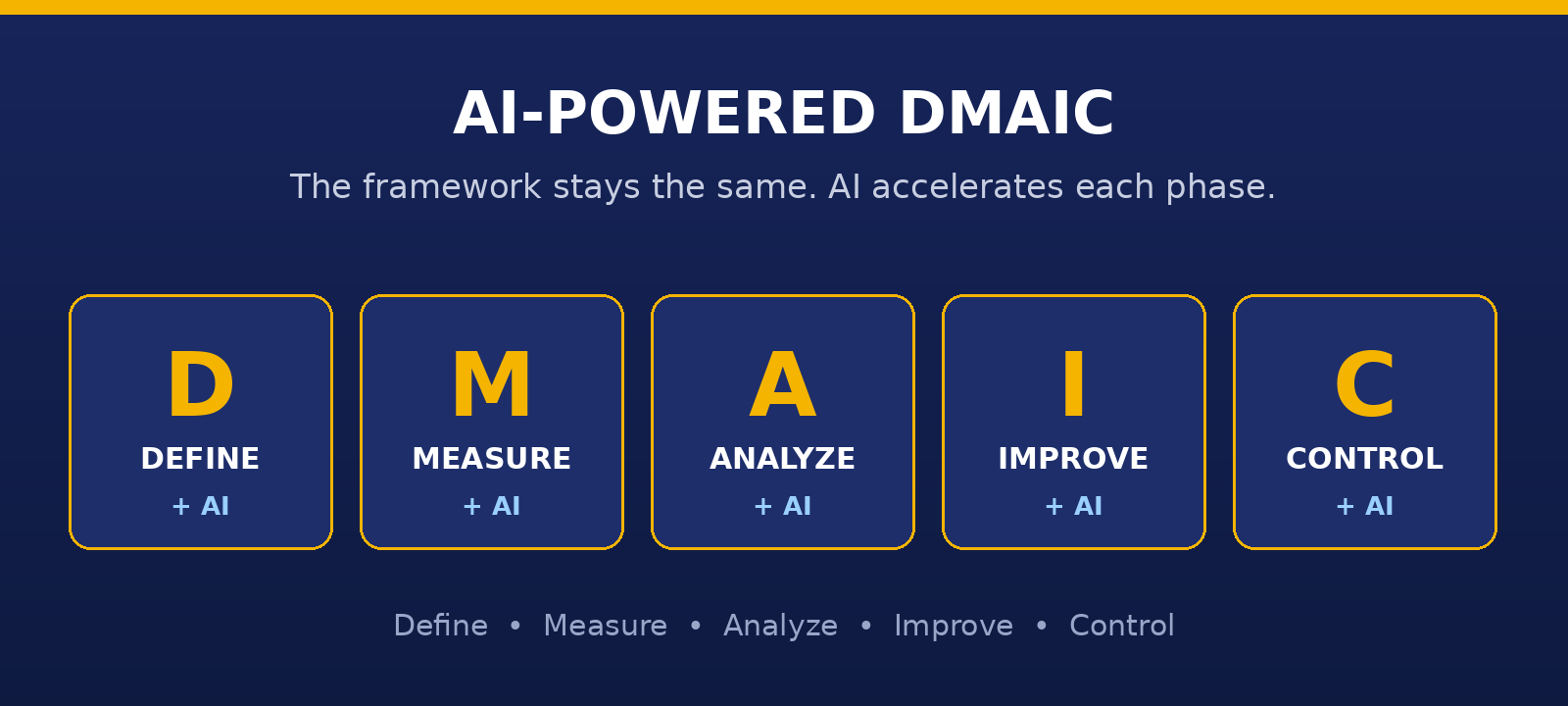
The fastest way to understand the course is to see how a White Belt uses AI across the five DMAIC phases. The framework stays exactly as it always was. The AI simply accelerates the slow, manual parts.

| DMAIC Phase | The White Belt’s job | How AI helps |
|---|---|---|
| Define | Understand the project charter and capture the real problem. | Decode a dense charter into plain English; organize a messy process description; compile raw Voice of the Customer comments. |
| Measure | Document how work actually happens and gather baseline data. | Draft a process map from a written description; build and read a histogram or run chart from a data table. |
| Analyze | Help the team find likely causes. | Brainstorm a fishbone diagram of root causes; build a Pareto chart to surface the “vital few” issues. |
| Improve | Support solution selection and standardization. | Pressure-test candidate solutions; draft a clear standard operating procedure so the fix actually sticks. |
| Control | Help the process stay fixed. | Build a control chart; draft a response plan and log so the team reacts before the alarm, not after. |
In every case the rule is the same one we repeat throughout the program: the AI drafted it, and you made it yours. You always review before you send or act. That review step is not a formality; it is the difference between a helpful draft and an embarrassing mistake.
4. The Twist: Six Sigma Now Keeps AI Honest
Here is the angle almost no beginner course covers, and the reason structured problem-solving is becoming more valuable, not less. AI’s biggest weakness is the “hallucination,” a confident, articulate, and completely fabricated answer. In a multi-step automated workflow, small errors compound viciously. A model that is 99% accurate on a single step drops to a roughly 36.6% success rate across 100 sequential steps. Reliability collapses quietly.
So how are serious engineering teams fixing it? By treating AI errors as process defects and applying the exact Six Sigma logic you learn as a White Belt. They monitor AI output on statistical control charts, set three-sigma control limits on the hallucination rate, run the same task across multiple models and take a consensus vote, and trigger a human-review guardrail the moment output drifts out of control. The Control phase of DMAIC has found a brand-new home inside enterprise AI, as documented by practitioners writing for Google Cloud.
The brand belief, applied to AI: don’t blame the tool when it fails. Fix the system around it. Build quality in with structure and review instead of inspecting errors out after the fact. Prevention beats detection, even when the “worker” is an algorithm.
This is why organizations cannot simply unleash AI on a broken process. They first need people who can frame problems clearly, define what “good” looks like, and put guardrails in place. A White Belt workforce is the foundation that makes safe automation possible.
5. Is It Actually Worth It? An Honest Look
We would rather you trust us than be sold to, so here is the straight version. Certified Six Sigma professionals earn an average premium of $16,411 over uncertified peers, according to the 2025 ASQ salary survey. But that is an aggregate across all belts, and it is heavily pulled up by Black Belts running multi-million-dollar portfolios. A freshly minted entry-level belt will not command that premium on day one. Anyone who promises you a $16,000 raise from a White Belt is misleading you.
The real value of the White Belt is positional. It signals a process-oriented mindset, gets you invited onto improvement projects, and lets you follow the charts and vocabulary in a room full of Black Belts. That visibility is the recognized prerequisite for moving into management and analyst tracks. Add fluent AI skills on top, and you become the person who can actually move the work forward.
| Common concern | The reality |
|---|---|
| “It’s too theoretical to use at work.” | With AI, you can map a messy SOP or draft a problem statement on your first day back. Theory becomes a same-week deliverable. |
| “I’m not good at math or statistics.” | You never calculate a standard deviation by hand. You define the problem and direct the AI; it does the computation and charting. |
| “Will AI just replace these jobs?” | Evidence points the other way. AI automates the data crunching but increases the need for humans who can govern it and validate outputs. |
| “Is a White Belt respected?” | On its own it is a starting signal, not a leadership credential. Stacked toward Yellow and Green Belt, it is the first rung of a recognized ladder. |
6. Where the White Belt Fits in the Hierarchy
Six Sigma uses a martial-arts belt system to show depth of training and project responsibility. Knowing where the White Belt sits helps you set expectations and plan your next step.
| Belt | Typical role | Statistics needed |
|---|---|---|
| White Belt | Supportive contributor; spots visible waste, gathers basic data. Does not lead projects. | None. Awareness and definitions. |
| Yellow Belt | Active team member; helps map local processes and use basic tools. | Minimal. |
| Green Belt | Part-time project lead for departmental projects. | Intermediate data analysis. |
| Black Belt | Full-time change agent leading cross-functional strategy; mentors others. | Advanced; statistical modeling. |
One honest note for buyers comparing options: the American Society for Quality (ASQ), the field’s most prestigious body, does not actually offer a White Belt exam; its formal track begins at Yellow Belt. The Council for Six Sigma Certification (CSSC) does define a White Belt body of knowledge. Be skeptical of any provider claiming an “ASQ White Belt,” because it does not exist. You can read our fuller primer in the Six Sigma White Belt beginner’s guide, and browse the full ladder on our Six Sigma certifications page.

7. What I’m Watching in 2026
A few signals tell me the AI-plus-Six-Sigma convergence is only accelerating, and why an entry-level credential is well timed.
- AI adoption inside quality teams. Industry analyses suggest a majority of organizations using Lean Six Sigma will have folded AI tools into their workflows during this cycle, with reported operational-efficiency gains in the 20% to 30% range.
- The “AI orchestrator” role. As automation spreads, expect demand for people who validate AI output and set guardrails, the natural growth path from a White Belt foundation.
- Quality 4.0 going mainstream. Computer-vision inspection and AI-assisted analysis are moving from pilot to standard practice, raising the value of anyone who understands both the method and the machine.
- Credential stacking. Professionals are bundling short, AI-specific certifications for continuous learning; credit eligibility and values should be confirmed with each credentialing body.
Get Certified: The AI-Powered Six Sigma White Belt
The complete program is now live. It assumes zero background in Lean, Six Sigma, or AI, walks you through DMAIC with a hands-on AI demo for every tool, and leaves you able to contribute to real improvement work, and to read the room in any quality meeting, from week one.
Start here: Enroll in the AI-Powered Six Sigma White Belt Certification.
Continue on the Six Sigma track
- Certified Lean Six Sigma Yellow Belt
- Certified Lean Six Sigma Green Belt
- Lean Six Sigma Black Belt: Phase 0 and 1
Build your AI-for-quality skills (Quality 4.0)
- ChatGPT and Six Sigma: AI Visualization Beginner
- Certified AI-Powered Root-Cause Analysis Specialist
- Browse all AI (Quality 4.0) certifications
Frequently Asked Questions
What is a Six Sigma White Belt?
A Six Sigma White Belt is the foundational, entry-level credential in Lean Six Sigma. It confirms you understand the basic history, vocabulary, and structure of the methodology, including the difference between Lean and Six Sigma and the five phases of DMAIC. White Belts support improvement teams by spotting waste and gathering data rather than leading projects.
Do you need math for a Six Sigma White Belt?
No. The White Belt focuses on concepts and awareness, not calculation. In the AI-powered version, tools like ChatGPT and Gemini handle any computation and charting. Your role is to frame the problem clearly, prompt the AI well, and verify the result.
Is a Six Sigma White Belt worth it?
For beginners, yes, as a positioning move rather than an instant raise. It signals a process-improvement mindset, helps you get selected for high-visibility projects, and lets you follow technical discussions led by senior belts. Adding AI skills on top makes you measurably more useful from day one.
How long does it take to get a Six Sigma White Belt?
Most learners complete an online White Belt in a matter of hours to a few days, depending on pace. Because the AI-powered course is self-paced and assumes no prior knowledge, you can move through it in a weekend and start applying the tools the following week.
How is AI used in Lean Six Sigma?
AI accelerates the manual parts of each DMAIC phase: decoding charters, compiling Voice of the Customer feedback, drafting process maps, building histograms and Pareto charts, and writing SOPs and response plans. Advanced teams also use Six Sigma logic in reverse, applying control charts and three-sigma limits to keep AI outputs reliable.
Will AI replace continuous-improvement jobs?
The evidence suggests the opposite. AI automates data crunching, but its tendency to “hallucinate” means organizations need more people, not fewer, who can govern it, validate outputs, and apply structured frameworks. Six Sigma skills become more relevant as automation spreads.
About the Author
Rahul G. Iyer is an AI-Driven Transformation Leader and Founder and CEO of AIGPE®. With more than 23 years of experience and 700+ personally executed Six Sigma, process-improvement, Operational Excellence and transformation projects, he turns practical expertise into professional courses, corporate training, private AI coaching, keynotes and The M3 Podcast Show. His learning content has generated 1M+ cumulative learner enrollments and reached 198 countries.
Citations and References
- Dell’Acqua, F., et al. “Navigating the Jagged Technological Frontier: Field Experimental Evidence of the Effects of AI on Knowledge Worker Productivity and Quality.” Harvard Business School Working Paper 24-013, 2023 (study of 758 BCG consultants).
- American Society for Quality (ASQ), 2025 Quality Progress Salary Survey. https://asq.org/quality-resources/salary-survey
- “Revolutionizing Manufacturing with AI-Powered Quality Management” (McKinsey data via Praxie), 2024. https://praxie.com/revolutionizing-manufacturing-with-ai-powered-quality-management/
- “The Six Sigma Approach to Enterprise Agentic AI: Improving Multi-Agent Reliability,” Google Cloud (Medium), 2024. Read the article
- AIGPE, “Six Sigma White Belt: A Beginner’s Guide.” https://aigproexcellence.com/blog/six-sigma-white-belt-beginners-guide/
- Council for Six Sigma Certification (CSSC), White Belt Body of Knowledge. https: