AI Doesn’t Fix Broken Processes, It Multiplies Them: 5 Hard Truths Before You Automate
Rahul I
AI Doesn’t Fix Broken Processes, It Multiplies Them: 5 Hard Truths Before You Automate
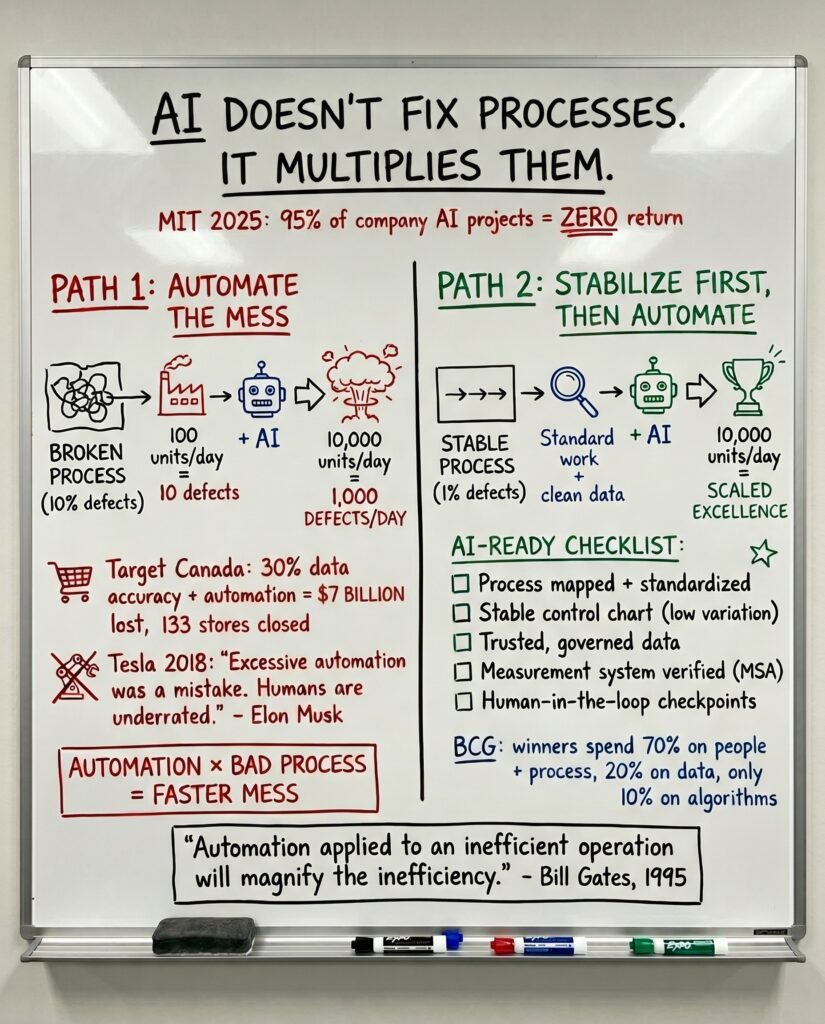
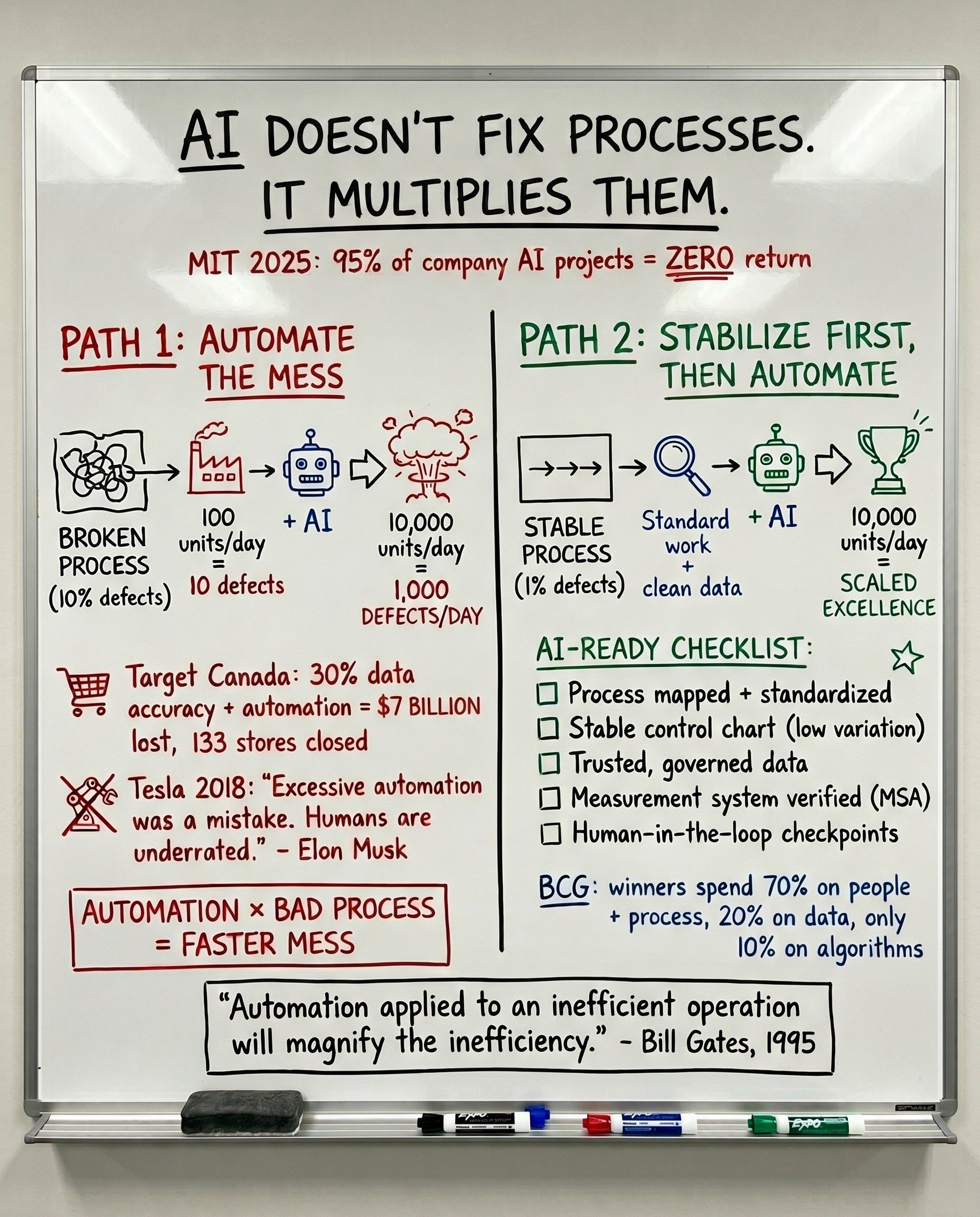
The whole argument on one whiteboard: AI multiplies whatever process you give it, good or bad.This article expands on a short post I shared on LinkedIn about AI making bad processes faster. Readers there are already swapping their own automation war stories. Add yours to that thread, then read the full breakdown below.
In the winter of 2015, shoppers walked into Target stores across Canada and found something strange: aisle after aisle of bare metal shelving, while distribution centers a few kilometers away overflowed with unsold inventory. Behind the scenes, a state-of-the-art automated supply chain system was executing flawlessly. The problem was what it was executing. The product data feeding it was only about 30% accurate, and the system scaled that bad data with perfect precision. Two years after launch, Target Canada was gone: $7 billion lost, 133 stores closed.
A decade later, companies are repeating the same mistake with far more powerful technology. AI process improvement has become the most searched phrase in operations, and the most misunderstood. The data from 2023 to 2026 is now unambiguous: AI does not fix broken processes. It multiplies them. This post lays out the evidence, the Six Sigma mechanics behind it, and the five gates your process must pass before you let AI anywhere near it.
5 Hard Truths at a Glance
If you only have ninety seconds, here are the five things worth remembering.
Most enterprise AI returns nothing. MIT’s 2025 study of 300+ deployments found 95% produced zero measurable P&L impact. Not low return. Zero.
The algorithm is almost never the problem. Failures trace back to unready data, unmapped workflows, and undefined outcomes, not to the model.
Automation multiplies your defect rate by your volume. A 10% defect process at 100 units a day makes 10 defects. Automate it to 10,000 units and you manufacture 1,000 defects a day.
The winners spend backwards. BCG’s “future-built” 5% allocate 70% of AI effort to people and process, 20% to data, and only 10% to algorithms.
Stability is a prerequisite, not a luxury. Process capability, clean measurement systems, and standard work decide whether AI scales excellence or scales the mess.
What Does “AI Amplifies Your Process” Actually Mean?
AI and automation are deterministic force multipliers. They take whatever workflow you hand them and execute it at enormous speed and volume, without judgment about whether that workflow is any good. A stable, capable, well-measured process becomes dramatically more productive. An unstable, undocumented, variation-riddled process produces the same errors it always did, just thousands of times faster. Bill Gates wrote it down in 1995, in The Road Ahead: “automation applied to an inefficient operation will magnify the inefficiency.” Michael Hammer said it more bluntly in 1993: “Automating a mess yields an automated mess.”
The one line to remember: AI is an amplifier, not a fixer. It multiplies whatever you feed it.
Key Facts at a Glance
Attribute
Detail
The core principle
Technology amplifies existing process conditions; it does not correct them
Headline statistic
95% of GenAI deployments produced zero measurable P&L return (MIT, 2025)
Root cause of failures
Data readiness, workflow integration, and undefined outcomes, not the model
Famous failure
Target Canada: 30% data accuracy + automated SAP supply chain = $7B lost
Famous confession
Elon Musk, 2018: “Excessive automation at Tesla was a mistake. Humans are underrated.”
What winners do differently
70% effort on people and process, 20% on data, 10% on algorithms (BCG)
The Six Sigma connection
Process capability (Cpk), MSA, and standard work determine AI readiness
The Scoreboard: What Five Major Studies Found
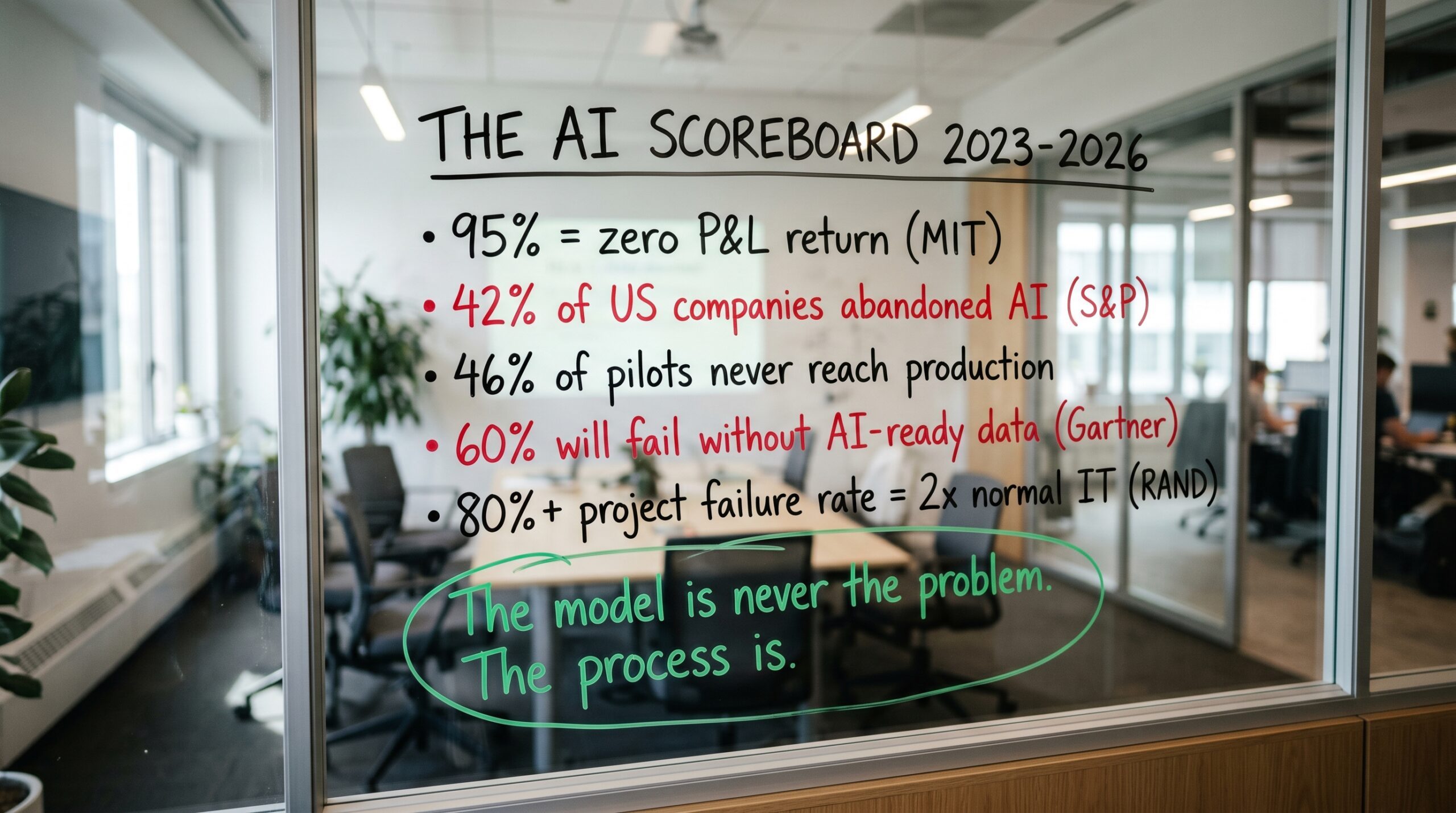
Five independent research houses, one conclusion: the model is never the problem. The process is.
One bad study can be dismissed. Five independent research organizations converging on the same conclusion cannot. Between 2024 and 2026, MIT, McKinsey, S&P Global, Gartner, RAND, BCG, and Deloitte all measured enterprise AI outcomes. Their numbers tell one story.
Finding
Figure
Source and date
GenAI deployments with zero measurable P&L return
95%
MIT Project NANDA, July 2025
U.S. companies that abandoned most AI initiatives
42% (up from 17% a year earlier)
S&P Global, 2025
AI proofs of concept scrapped before production
46%
S&P Global, 2025
AI projects without AI-ready data predicted to be abandoned through 2026
60%
Gartner, February 2025
AI project failure rate (about double that of standard IT projects)
80%+
RAND Corporation, 2024-2025
Organizations reporting no meaningful enterprise-wide EBIT impact
80%+
McKinsey Global AI Survey, November 2025
Companies struggling to achieve and scale AI value
74%
BCG, October 2024
The MIT researchers were explicit about the diagnosis. Failure was almost never the model. It was the absence of data readiness, workflow integration, and a defined operational outcome before the build began. In other words: the process was not ready, and the AI faithfully proved it.
The $7 Billion Lesson Nobody Wanted
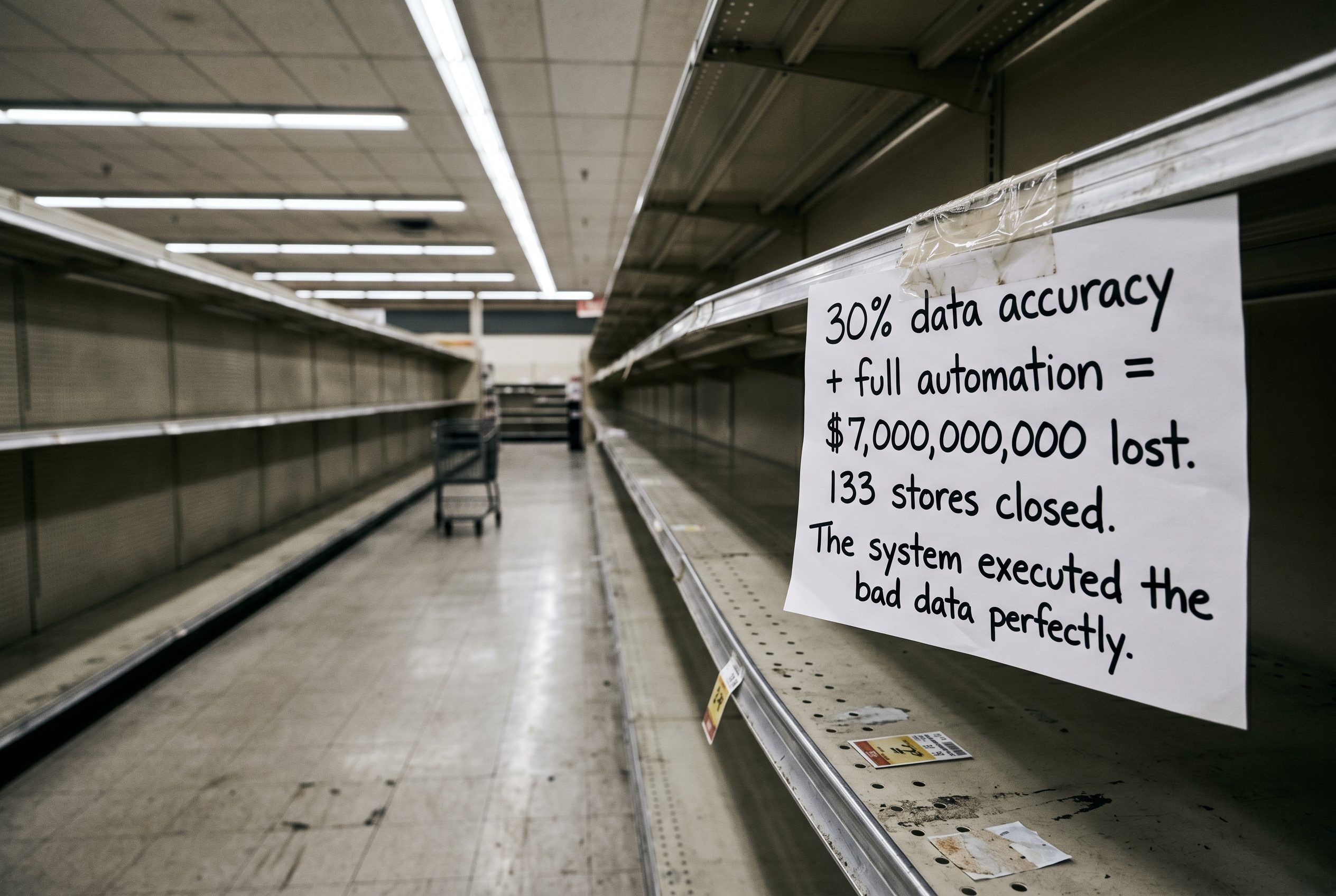
Empty shelves, full warehouses: what happens when automation executes 30% accurate data perfectly.
Target Canada remains the cleanest case study of premature automation ever documented. The company entered Canada in 2011 with an ambitious automated SAP supply chain managing inventory, distribution, and supplier payments. The technology was sound. The process underneath it was not.
Product master data, the foundational input for everything the system did, was estimated at roughly 30% accuracy, against the 98 to 99% accuracy Target maintained in its established U.S. operations. Dimensions were wrong. Weights were wrong. Currency conversions were wrong. And because the system shipped without adequate quality gates, it digested the flawed data and executed on it with total precision. Forecasting algorithms ordered excesses of the wrong products. Distribution centers jammed while shelves sat empty. At one point the entire merchandising division stopped for a week to manually verify every data record in the system.
Here is the detail most retellings miss: the manual process Target ran in the U.S. was being quietly protected by what Six Sigma calls a hidden factory, the invisible layer of experienced people catching and correcting errors before they propagated. Automation removed those people. Nobody had documented what they actually did. The result was $7 billion lost and all 133 stores liquidated within two years.
“Humans Are Underrated”: Tesla’s Expensive Confession
Manufacturing offers the same lesson with robots instead of databases. To hit aggressive Model 3 production targets, Tesla built what Elon Musk described as a “crazy, complex network of conveyor belts” and leaned on extreme robotic automation before the underlying assembly process was stable. The robots could not adapt to the natural variation of an unrefined process. Defects scaled faster than humans could repair them, and rework swamped the Fremont factory.
By April 2018, Musk publicly reversed course, putting humans back on the line in “burst builds” and tweeting the sentence that should hang in every operations war room: “Yes, excessive automation at Tesla was a mistake. To be precise, my mistake. Humans are underrated.” Note what he did not say. He did not say automation was a mistake. He said automating before the process was capable was a mistake. That distinction is the entire point.
The Six Sigma Mechanics: Why Amplification Happens
None of this is bad luck. It is arithmetic, and Lean Six Sigma gives us the exact vocabulary for it.
Process capability scales with volume
Process capability indices (Cp and Cpk) measure how reliably a process produces output within specification. Automation changes neither the process mean nor its standard deviation. It changes only volume and speed. A process producing 10% defects at 100 units a day yields 10 defects. The same process automated to 10,000 units a day yields 1,000 defects. The inefficiency is not resolved; it is multiplied by a factor of 100, and it now arrives faster than your containment can react.
Your data pipeline is a measurement system
In the Measure phase of DMAIC, no Six Sigma practitioner trusts process data until Measurement Systems Analysis confirms the measurement itself is reliable. An AI model’s data pipeline is exactly that: a measurement system. Feed it ungoverned, untraceable data and it operates on pure measurement error, at scale, with confidence. Gartner estimates poor data quality already costs organizations an average of $12.9 million per year, before AI multiplies it.
Errors compound across automated steps
Multi-step automation compounds reliability the way interest compounds debt. In a six-step automated workflow where each step succeeds 95% of the time, the end-to-end success rate is just 74%. Humans absorb that gap invisibly. Removing them without first raising step reliability converts hidden rework into visible failure.
Stabilize First, Then Automate: Proof It Works
Lean first, then automate: the sequence that turned RFID into a 95% stock accuracy improvement.
The mirror image of these failures is just as well documented. Industrial manufacturer PT BAP wanted RFID-driven warehouse automation integrated with its warehouse management system. Instead of layering the technology over its existing manual chaos, the team first ran value stream mapping, stripped out every non-value-added step (manual counting, double data entry, unnecessary movement of goods), and stabilized the physical flow. Only then did they switch on the automation. The result: a 95% improvement in stock accuracy, from a technology that would have simply digitized the old mess had it been installed first.
BCG’s research on the elite performers explains why this sequencing wins. The “future-built” 5% of companies generating real AI value follow what BCG calls the 70-20-10 principle: 70% of effort on people and process, 20% on data and technology infrastructure, 10% on the algorithms themselves. Process discipline outweighs model selection by a factor of seven. The companies failing with AI spend in exactly the opposite order.
The AI-Ready Checklist: 5 Gates Before You Automate
Distilled from Gartner, McKinsey, Deloitte, and the Lean Six Sigma body of knowledge, these are the five gates a process should pass before AI or automation touches it. Treat them as sequential. A process that fails gate one is not a candidate for gate five.
#
Gate
What it requires
Six Sigma tool
1
Process standardized
Mapped, documented, executed consistently; no informal workarounds or tribal knowledge holding it together
Process mapping, standard work
2
Statistically stable
Output in control with low variation; capability meets the customer specification
Control charts, Cp/Cpk
3
Data trusted and governed
Quality-gated pipelines, traceable lineage, governed at asset level (“AI-ready data” per Gartner)
Data audit, CTQ definition
4
Measurement system verified
You can accurately measure inputs, outputs, and defect rates before and after automation
MSA, Gage R&R
5
Human-in-the-loop designed in
Validation gates where experts review AI output; graceful degradation when the model fails
FMEA, poka-yoke
This is the brand belief AIGPE teaches in every program, applied to the newest technology on the block: do not blame the people, and do not expect the tool to do the fixing. Fix the system first. Build quality in, then scale it.
When “Move Fast and Iterate” Is Actually Right
Fairness demands the counterargument. A vocal school holds that waiting for process perfection is its own failure mode, that you should automate fast, watch it break, and iterate. There are conditions where that approach is legitimate: when the cost of a defect is near zero (an internal chatbot, document summarization, marketing copy drafts), when observability is tight enough to catch failures in minutes, and when the architecture is modular enough to swap out failing components without collateral damage.
But none of those conditions hold for physical operations, supply chains, financial compliance, or anything regulated. Target Canada could not “iterate” its way out of empty stores. Tesla could not A/B test a jammed assembly line. The rule of thumb: fail fast where failure is cheap, stabilize first where failure compounds.
What I Am Watching in 2026
Three signals will tell us whether organizations are learning the lesson or rhyming with history.
Gartner’s 60% prediction coming due. Through the end of 2026, Gartner expects organizations to abandon 60% of AI projects unsupported by AI-ready data. Watch whether your industry’s casualties cluster exactly there.
Agentic AI meeting compounding error math. As companies chain AI agents into longer autonomous workflows, the six-step 74% problem becomes a twelve-step problem. Step reliability, not model quality, will decide who wins.
Process skills quietly becoming AI skills. The 70-20-10 allocation means the scarce talent is not prompt engineers. It is people who can map a value stream, run an MSA, and make a process capable before the algorithms arrive. That is precisely the Lean Six Sigma + AI combination we built our newest programs around.
Build the Skills That Matter in the AI Era
If this post changed how you think about automation, the next step is building the capability to act on it. These AIGPE certification tracks map directly to the five gates above.
Not because of the models. MIT’s 2025 research found failures trace overwhelmingly to unready data, poor workflow integration, and the absence of a defined operational outcome before building. The process was never prepared for automation.
What does it mean for a process to be AI-ready?
The process is mapped and standardized, statistically stable with acceptable capability, fed by trusted and governed data, supported by a verified measurement system, and designed with human-in-the-loop checkpoints. Gartner adds that the data must be use-case aligned and quality-gated.
Will AI replace Six Sigma?
The evidence points the other way. AI raises the stakes of process discipline because it scales whatever it is given. Capability analysis, MSA, standard work, and root cause thinking are what make AI investments pay off, which is why winning companies put 70% of their AI effort into people and process.
Should we fix the process first or just automate and iterate?
Iterate-fast is valid only where failure is cheap, observable, and reversible, such as internal chatbots or content drafts. For physical operations, supply chains, and regulated work, stabilize first. Target Canada and Tesla’s Model 3 line show what iteration costs in those environments.
What is the 70-20-10 rule in AI adoption?
BCG found the most successful 5% of AI adopters allocate 70% of effort to people and process change, 20% to data and technology infrastructure, and only 10% to algorithms. Most struggling companies invert that ratio.
About the Author
Rahul G. Iyer is an AI-Driven Transformation Leader and Founder and CEO of AIGPE®. With more than 23 years of experience and 700+ personally executed Six Sigma, process-improvement, Operational Excellence and transformation projects, he turns practical expertise into professional courses, corporate training, private AI coaching, keynotes and The M3 Podcast Show. His learning content has generated 1M+ cumulative learner enrollments and reached 198 countries.