

AI Value Stream Mapping: The Ultimate 2026 Guide to Replace Whiteboards

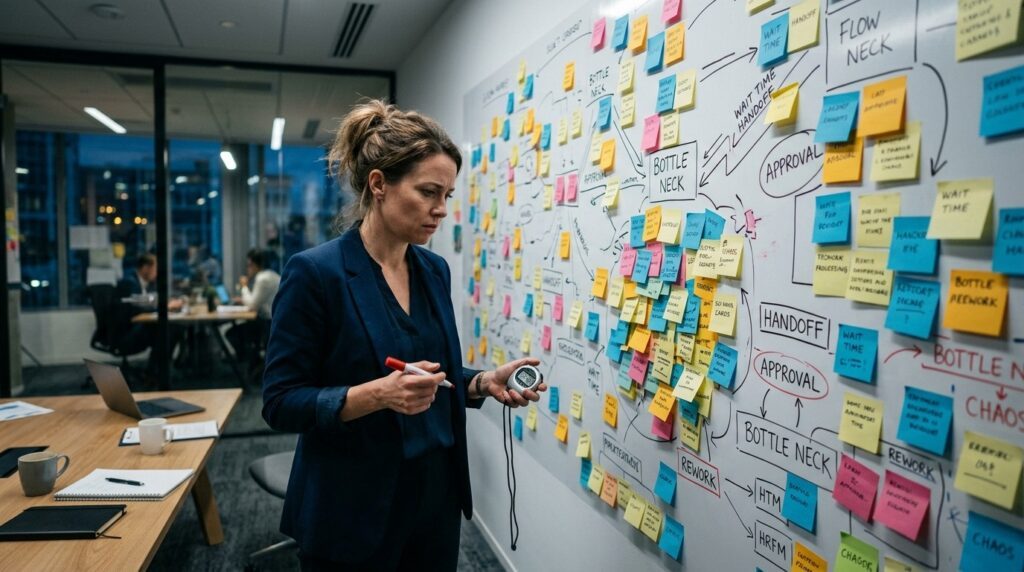
Table of Contents
Prologue
If you are a continuous improvement professional, you know the traditional mapping drill intimately. You gather your cross-functional team in a massive conference room. You pull out a giant whiteboard. Then, you spend three agonizing days mapping out a process using hundreds of colorful sticky notes, stopwatches, and subjective memory.
You argue over cycle times. You debate handoff delays. Finally, you step back and admire your massive, wall-to-wall “as-is” process map.
But here is the brutal reality. By the time you uncap your dry erase marker to draw the final process box, your business has already changed. That beautiful map is obsolete the moment you finish it.
In a modern, digital-first enterprise, relying on manual observation to track workflow is corporate negligence. Characterized by time-intensive workshops, subjective data collection, and siloed tribal knowledge, manual maps simply cannot keep pace with the speed of global business.
Every week, operational leaders reach out to me on LinkedIn expressing this exact frustration. They know the old way is broken, and they are desperately looking for a faster, data-driven alternative.
So, the massive question facing operational leaders in 2026 is this: Can AI value stream mapping automatically map your processes?
The answer is an absolute, undeniable yes. We are officially entering the era of the Intelligent Value Stream.

The Anatomy of a Dying Practice: Why Manual Mapping Fails
Before we explore the AI revolution, we must understand the foundational cracks in the traditional system. Mapping is a lean management framework originally derived from the Toyota Production System. It is designed to oversee all the steps, materials, and information required to deliver a product or service to a customer.
The primary objective is the identification and elimination of waste, known as “muda” in lean methodology. Lean defines value as anything the customer is willing to pay for. Everything else is categorized as Business Value Add or pure No Value Add waste.
In a traditional 20th-century manufacturing setting, identifying this waste required a physical “gemba walk.” Managers would physically visit the factory floor. They would use stopwatches to calculate cycle times and Takt time. They were looking for the seven classic physical wastes: overproduction, inventory, motion, defects, over-processing, waiting, and transport.
However, modern enterprises do not just move physical pallets of steel. They move massive datasets, code deployments, and complex financial approvals. In these digital environments, waste is almost completely invisible to the naked eye.
You cannot use a stopwatch to calculate how long a piece of code sat in a Quality Assurance queue before a developer finally reviewed it. You cannot physically observe the shadow IT workarounds a procurement team uses to bypass a broken ERP system. Therefore, sifting through inaccurate data, waiting on executive decisions, or uncovering hidden system redundancies simply cannot be achieved with a clipboard.
The Evolution to Digital Twins: AI Value Stream Mapping
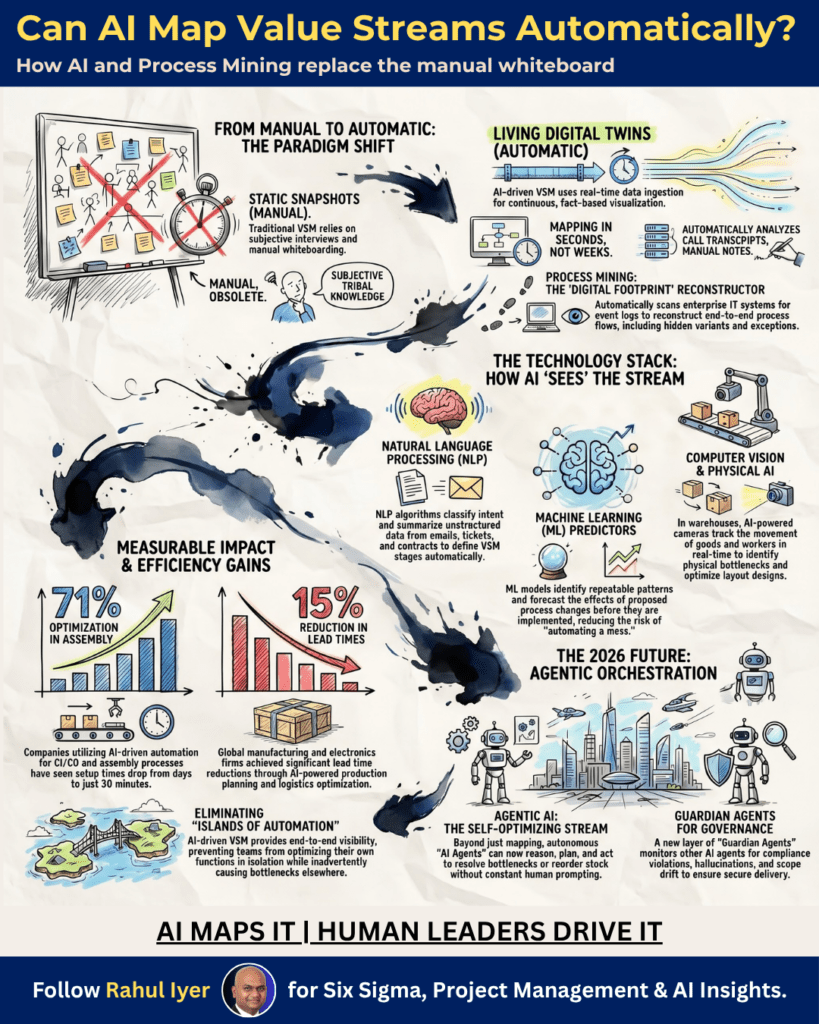
The shift to AI value stream mapping represents a massive move from physical observation to data-driven reconstruction. Today, artificial intelligence synthesizes multiple advanced technologies to create a living, breathing “digital twin” of your enterprise workflow.
Here are the four core technologies that make automated mapping possible:
1. Process Mining: The Automated Foundation
At the core of this operational transformation is process mining. Traditional process models only describe how executives intend for work to happen. Process mining exposes the brutal truth of how work actually happens.
Process mining algorithms extract digital footprints, known as event logs, directly from your enterprise systems like SAP, Salesforce, or ServiceNow. These logs require just three core elements to function: a Case ID, an Activity, and a Timestamp.
By analyzing millions of these digital traces, process mining automatically reconstructs end-to-end process flows. It instantly generates the visual model of the process without requiring a single manual workshop. It maps every hidden variant, every unauthorized workaround, and every painful bottleneck. Furthermore, it continuously compares the actual system execution against your compliance rules to flag deviations in real time.
Check out the complete discussion on ChatGPT, Gemini, and Claude in DMAIC: The 5-Phase Proven AI Framework here.
2. Natural Language Processing (NLP): Extracting Tribal Knowledge
A massive amount of enterprise workflow is not stored in neat database logs. It is buried in unstructured “tribal knowledge.” This includes meeting transcripts, email chains, customer support tickets, and scribbled manual notes.
Natural Language Processing allows systems to digest this human language instantly. In an AI-powered workshop, an intelligent copilot can listen to an hour-long stakeholder interview transcript. Within seconds, it will extract the key actors, identify the undocumented activities, pinpoint the emotional frustrations of the staff, and integrate that qualitative data directly into your structured current-state map.
3. Computer Vision: The Eyes of the Physical Gemba
While process mining handles the digital flow, Computer Vision serves as the eyes of the operation for the physical world.
In warehousing, manufacturing, and logistics, advanced cameras track physical inventory movement in real time. Rather than relying on staff to perform manual barcode scanning, computer vision systems continuously digitize the state of your inventory as forklifts and personnel navigate the facility. This automatically detects physical bottlenecks, monitors spatial traffic to ensure worker safety, and dynamically updates your map without human intervention.
4. Machine Learning: Predictive Flow Analytics
Traditional mapping is purely historical. It only tells you what happened yesterday. Machine Learning acts as the predictive engine of the modern value stream.
ML algorithms forecast the downstream effects of proposed process changes before you ever implement them. For instance, if you adjust a resource allocation in Step 2 of your process, the Machine Learning model will instantly quantify how that change impacts the delivery timeline in Step 14. This allows leaders to run thousands of complex “what-if” scenarios in a risk-free virtual environment.
The Ultimate Comparison: Manual vs. AI Mapping
To understand the sheer magnitude of this upgrade, look at how the two methodologies compare across critical operational metrics:
| Operational Metric | Traditional Manual VSM | AI Value Stream Mapping |
|---|---|---|
| Creation Time | Weeks or months of workshops. | Minutes to hours via system data extraction. |
| Data Accuracy | Highly subjective, reliant on human memory. | 100 percent objective, based on actual system event logs. |
| Update Frequency | Static. Obsolete upon completion. | Dynamic. Updates in real time as new data flows. |
| Scope of Visibility | Limited to the specific team in the room. | Enterprise-wide, capturing every cross-functional variant. |
| Optimization Focus | Historical analysis of past failures. | Predictive forecasting of future bottlenecks. |
The AI Illusion: Why Automating a Mess is Dangerous
With these incredible tools available, a critical mistake many organizations make is attempting to apply automation directly to a broken, unmapped process. The fundamental rule of operational excellence remains unchanged. Automating a mess simply yields a faster mess.
Extensive industry research highlights that artificial intelligence primarily acts as an amplifier. It magnifies the strengths of high-performing, organized companies, and it violently magnifies the dysfunctions of struggling ones.
If your current process relies on undefined quality gates, hidden constraints, and messy handoffs, inserting an automated agent into the mix will only scale that waste to unprecedented levels.
This is exactly why AI value stream mapping is your missing superpower. It allows organizations to see the entire macro flow. This prevents the deadly trap of local optimization causing global degradation.
For example, imagine you deploy an expensive coding assistant that makes your software developers 30 percent faster at writing code. Your development metrics look fantastic. However, if that newly generated code sits in a Quality Assurance queue that is completely overwhelmed and understaffed, you have not improved the system at all. You have just spent money to make the waiting queue longer.
Technology adoption is only effective when it is paired with strong lean practices that identify exactly where the tool can alleviate true, system-wide bottlenecks.
Integrating AI with the Generative DMAIC Framework
To safely deploy advanced technology across your operations, you cannot rely on guesswork. You need a rigid framework. This is where the AIGPE® Generative DMAIC Framework becomes the ultimate operating system for the modern enterprise.
Here is how intelligent tools integrate into the classic Lean Six Sigma phases to map and optimize your flow:
Define: Instead of guessing customer requirements, sentiment analysis scrapes thousands of customer interactions to define the exact Critical to Quality (CTQ) metrics. The system scopes the project boundaries automatically based on historical success rates.
Measure: As discussed, process mining replaces the stopwatch. It instantly extracts system logs to establish a flawless, objective baseline of your current state performance. There is no human bias in the measurement phase.
Analyze: Instead of spending weeks building fishbone diagrams, ML algorithms instantly identify the root causes of variation. The system highlights exactly which process variants lead to defects and which paths yield the highest yield.
Improve: Before physically changing a workflow, Generative models simulate thousands of potential solutions. It stress-tests your future-state map to ensure the proposed improvements will actually work at scale.
Control: Once the process is optimized, technology steps in to maintain the gains. Autonomous “Guardian Agents” continuously monitor the new flow. If the process begins to drift out of control limits, the system instantly alerts leadership or autonomously corrects the parameter before a defect occurs.
The Reality Check: Can We Actually Validate This Data?
When I discuss these capabilities with veteran Black Belts, they always ask the exact same skeptical question. How much of this generated information can actually be validated in the real world?
The answer lies strictly in your data source.
The data produced by Process Mining is inherently validated because it is completely objective. The algorithm is not guessing. It is pulling timestamped event logs directly from your ERP servers. It is the undeniable mathematical ground truth of what actually happened.
However, when we move into predictive analytics and Natural Language Processing, the system is not perfect. It lacks deep enterprise context. A model might flag a process delay as a “defect,” when in reality, that delay was an intentional, manual compliance check required by federal law.
These models can identify patterns, but they cannot interpret nuance. They require rigorous human validation to ensure the data aligns with business reality.
(For more insights on establishing objective data truth, read Harvard Business Review’s foundational piece on What Process Mining Is, and Why Companies Should Do It).
The Human Aspect: Why Technology Will Never Replace You
This brings us to the single most critical component of the entire operation. The human being.
AI value stream mapping can build an incredibly complex diagram in seconds. But if humans do not work together, all of this technological capability is completely impossible.
An intelligent agent can identify a major bottleneck in a workflow, but it cannot walk into an executive boardroom and negotiate a budget increase to fix it. A system can flag a highly toxic handoff between your engineering and marketing departments, but it cannot navigate the sensitive office politics required to repair that human relationship.
Continuous improvement has always been a people driven initiative. Technology is simply your Cognitive Co-Pilot. It strips away the tedious administrative data gathering so you can focus entirely on the human element. You need human empathy, leadership, and change management to actually implement the solutions the data recommends.
If your team culture is broken and your stakeholders refuse to collaborate, the most advanced map in the world is nothing more than a highly accurate picture of your failure.
Stop Guessing and Start Automating
Mapping has transcended its origins on the factory floor. It has become the digital nervous system of the modern enterprise. By harnessing the massive power of process mining, natural language processing, and agentic AI, organizations can finally shine a blinding light on the hidden inefficiencies stalling their growth.
Integrating AI value stream mapping into your management systems guarantees that your optimization efforts are based on objective, mathematical reality rather than subjective executive guesswork. It bridges the massive gap between organizational strategy and daily execution.
For enterprises seeking to maintain a competitive edge, embracing these tools is no longer just an interesting lean management exercise. It is the ultimate prerequisite for survival.
What is Your Next Step?
Stop tracking your multi-million dollar processes with sticky notes. It is time to upgrade your methodology and start leading true organizational transformation.
🚨 FREE DOWNLOAD: The Six Sigma AI Playbook
Before you attempt to map another process, make sure you are maximizing your Cognitive Co-Pilot. I have put together a highly tactical, free 50-page PDF playbook designed specifically for continuous improvement professionals.
Click here to download The Six Sigma AI Playbook instantly.
Unlock 50 custom prompts to automate your DMAIC projects, instantly map complex workflows, and strip administrative busywork out of your daily routine today.
Master Operational Excellence Today
If you are ready to stop managing enterprise chaos and start leading true organizational excellence, it is time to build your foundational CI skills. Join over one million professionals and start your journey today with our globally recognized Lean Six Sigma programs.
Master the Six Sigma Analytics Track:
About the Author
Rahul G. Iyer is an AI-Driven Transformation Leader and Founder and CEO of AIGPE®. With more than 23 years of experience and 700+ personally executed Six Sigma, process-improvement, Operational Excellence and transformation projects, he turns practical expertise into professional courses, corporate training, private AI coaching, keynotes and The M3 Podcast Show. His learning content has generated 1M+ cumulative learner enrollments and reached 198 countries.