


Table of Contents
- Prologue
- What Is the American Society for Quality (ASQ)?
- Key Facts at a Glance
- 1946: How the American Society for Quality Was Founded
- The Founding Numbers, Verified
- The Deming and Juran Era: 1947 to 1967
- 1968: ASQ Codifies the Profession With the CQE
- 1987: The Baldrige Award and the American Quality Crisis
- 1997: From “Control” to “Quality”
- The Six Sigma Era: Standardizing the Black Belt, 1998 to 2001
- ASQ at 80: The 2026 World Conference on Quality and Improvement
- Why ASQ History Still Matters in the AI Era
- Take the Next Step: Build Your Quality and Six Sigma Foundation
- Build the Six Sigma foundation:
- Preparing for the ASQ CSSBB exam specifically?
- Frequently Asked Questions
- When was the American Society for Quality (ASQ) founded?
- Why did ASQ change its name in 1997?
- What was ASQ’s first professional certification?
- What is ASQ’s role in the Malcolm Baldrige National Quality Award?
- What is the difference between the ASQ CSSBB and a corporate Black Belt?
- What is ASQ doing for its 80th anniversary in 2026?
- About the Author
Prologue
This deep dive into the history of the American Society for Quality grew out of a shorter post I shared on LinkedIn, where readers are already adding their own memories and corrections. Join that conversation, then read the full timeline below.
There is a photograph I keep coming back to. It is the cover of Industrial Quality Control, May 1950, a modest journal with Milwaukee City Hall on the front and the words “American Society for Quality Control” running along the bottom. Next to it sits a portrait of George D. Edwards, the organization’s first president.

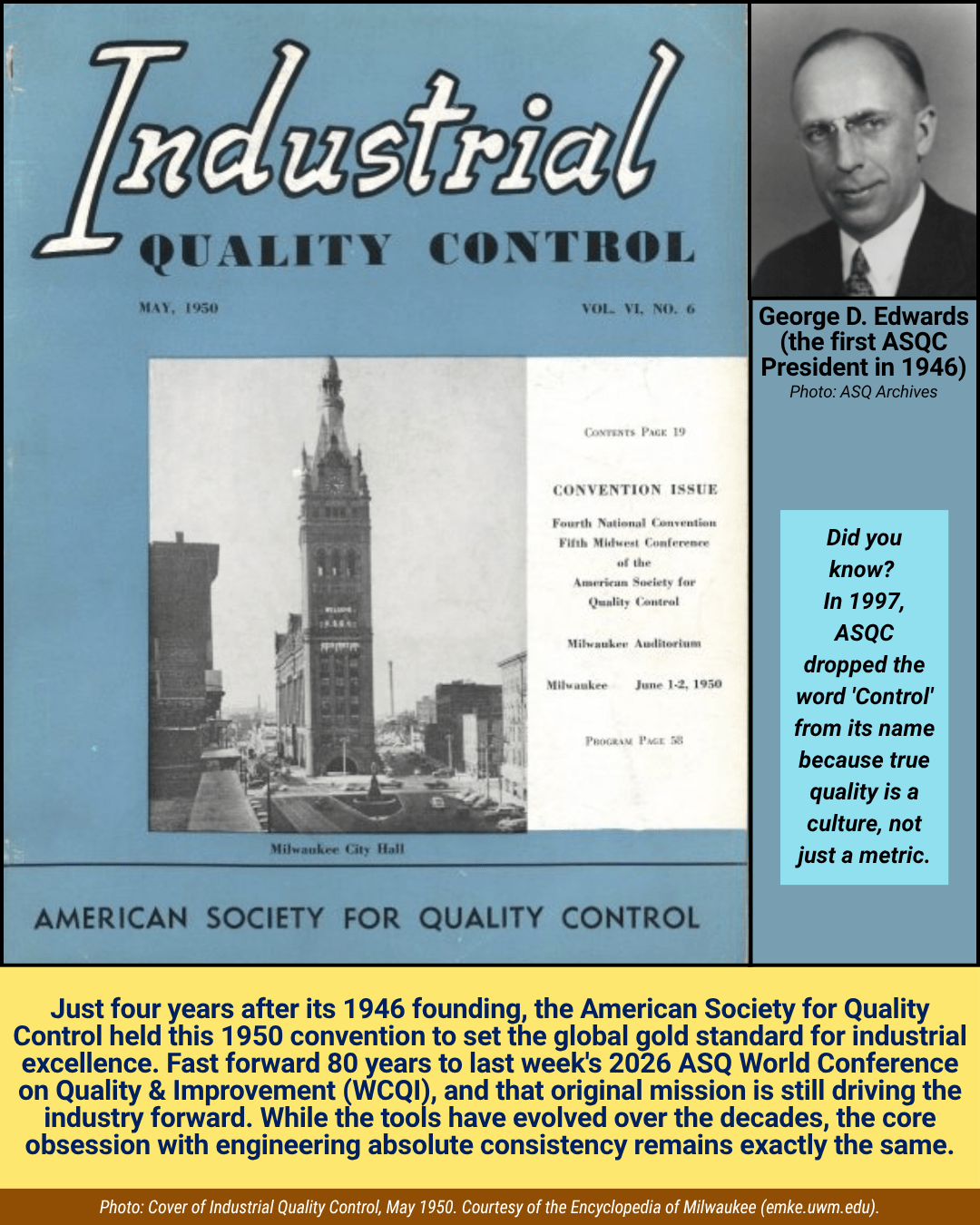
I look at that cover and I see a profession deciding to exist.
Because in 1946, quality was not yet a discipline. It was a scattered set of wartime techniques held in the heads of a few hundred statisticians and engineers who were terrified those techniques would be forgotten the moment the factories switched from making munitions to making refrigerators. They were right to be terrified. Some companies were already throwing out their control charts.
So they did something quietly radical. Seventeen rival regional societies, groups that had every reason to protect their own turf, agreed to merge into one body. Eighty years later, that body sets the global standard for what “quality” even means, and in May 2026 it celebrated its 80th anniversary in Orlando.
This is the complete story of the American Society for Quality, from that 1950 magazine cover to the AI-driven present. I have checked the dates, resolved the discrepancies, and laid out the milestones in order. Let me walk you through it.
What Is the American Society for Quality (ASQ)?
The American Society for Quality (ASQ) is the world’s leading professional association for quality management, founded on February 16, 1946, and headquartered in Milwaukee, Wisconsin. It was originally called the American Society for Quality Control (ASQC) and dropped the word “Control” from its name in 1997. ASQ creates the bodies of knowledge behind globally recognized credentials such as the Certified Quality Engineer (CQE) and the Certified Six Sigma Black Belt (CSSBB), and it administers the Malcolm Baldrige National Quality Award on behalf of the U.S. government.
If you remember one thing, remember this: ASQ is the institution that turned quality from a set of factory inspection tricks into a recognized global profession.
Key Facts at a Glance
| Attribute | Detail |
|---|---|
| Founded | February 16, 1946 |
| Original name | American Society for Quality Control (ASQC) |
| Renamed | American Society for Quality (ASQ) in 1997 |
| Founders | 253 members from 17 regional quality societies |
| First president | George D. Edwards, of Bell Telephone Laboratories |
| Headquarters | Milwaukee, Wisconsin |
| First flagship journal | Industrial Quality Control (later Quality Progress) |
| First certification | Certified Quality Engineer (CQE), 1968 |
| 80th anniversary | 2026 World Conference on Quality and Improvement (WCQI), Orlando |
1946: How the American Society for Quality Was Founded
The American Society for Quality Control was born from the urgent industrial demands of World War II. Wartime training courses in statistical quality control (SQC) had pulled statisticians, engineers, and production managers into one community of practice. When the war ended in 1945, that community feared the discipline would evaporate in the rush to mass-produce consumer goods.
The profession was also fragmented. Two umbrella groups competed for control: the Society for Quality Control, which wanted a single centralized national body, and the Federation of Quality Control Societies, a coalition that wanted to preserve local independence.
The man who bridged the divide was George DeForest Edwards, head of quality assurance at Bell Telephone Laboratories and the direct supervisor of control-chart pioneer Walter A. Shewhart. Edwards is widely credited with coining the term “quality assurance.” When he was offered the presidency, he set one condition. He would not lead a fragmented minority. As he later recalled, “I told them that I did not wish to be part of a small clique.” His vision was a decentralized organization that “would do for many small units only those things that no individual unit could do nearly so well for itself.” That philosophy still defines ASQ’s section-based structure today.
The Founding Numbers, Verified
There is a well-known discrepancy in early membership tallies, so it is worth getting right. The official record is below.
| Founding Metric | Verified Record | Note |
|---|---|---|
| Date of formation | February 16, 1946 | Official ASQC formation date |
| Founding societies | 17 regional societies | Included Buffalo, Central Illinois, and Milwaukee |
| Founding members | 253 members | The official ASQ figure |
| First president | George D. Edwards | Quality assurance director, Bell Telephone Labs |
| First section outside the U.S. | Toronto Section | Chartered December 15, 1946 |
The reason some 1947 publications cite numbers like 183 or 243 is administrative, not historical. The young society let early joiners upgrade to “Founding Member” status for an extra fee, so the paid count shifted month to month. The validated consensus number is 253.
The Deming and Juran Era: 1947 to 1967
ASQC’s early decades were shaped by founding members who became legends. W. Edwards Deming, who had trained under Shewhart, found his most receptive audience not in postwar America but in Japan, where he taught statistical process control to Japanese engineers rebuilding their industry. He famously refused royalties from his Japanese lectures, asking that the proceeds benefit the Japanese people instead.
Joseph M. Juran carried the management side of the message, and Armand V. Feigenbaum, ASQC president from 1961 to 1963, pushed the idea of “Total Quality Control” as a business-wide method rather than a purely statistical one. In 1948 the society adopted a formal Code of Ethics. In 1956 it consolidated headquarters operations in Milwaukee. In 1959 it partnered with the American Statistical Association to launch the journal Technometrics. The profession was maturing from a technical club into a self-governing body.
1968: ASQ Codifies the Profession With the CQE
For two decades, “quality engineer” was a loose job title that meant whatever an employer wanted it to mean. In 1968, the American Society for Quality changed that permanently by holding its first professional certification examination: the Certified Quality Engineer (CQE). It was the world’s first quality engineering certification, and since then more than 120,000 people have earned it.
The CQE created a standardized, peer-reviewed Body of Knowledge. For the first time, a quality professional carried a portable, verifiable credential that proved competence in process improvement and statistical methods. That single move turned quality management into a distinct profession. The certifications that followed built on this foundation.
| Certification | Abbreviation | Introduced | Purpose |
|---|---|---|---|
| Certified Quality Engineer | CQE | 1968 | Established the foundational quality engineering Body of Knowledge |
| Certified Quality Auditor | CQA | 1988 | Standardized internal and external quality auditing |
| Certified Manager of Quality / Organizational Excellence | CMQ/OE | 1995 (originally CQM) | Shifted focus to strategic organizational leadership |
| Certified Six Sigma Black Belt | CSSBB | 2001 (first exam) | Validated advanced mastery of the DMAIC model |
1987: The Baldrige Award and the American Quality Crisis
By the early 1980s, U.S. manufacturers were losing market share to Japanese competitors who had spent thirty years perfecting the principles Deming and Juran taught. American business schools had even taught the false idea that higher quality meant higher cost.
The response was national. After the death of Secretary of Commerce Malcolm Baldrige in 1987, President Ronald Reagan signed the Malcolm Baldrige National Quality Improvement Act of 1987, creating the Malcolm Baldrige National Quality Award (MBNQA), the highest U.S. presidential honor for performance excellence. ASQC was named co-administrator alongside the National Institute of Standards and Technology (NIST) from the start, and in 1991 it became the sole administrator supporting the Baldrige Program at NIST, a role it still holds.
The first awards were presented on November 13, 1988, to Motorola, the Commercial Nuclear Fuel Division of Westinghouse, and Globe Metallurgical. The framework later expanded to education and healthcare in 1999, and to government and nonprofit categories in 2007.
1997: From “Control” to “Quality”
By the late 1990s, quality work had spread far beyond the factory floor into healthcare, education, software, and services. The word “Control,” with its echo of end-of-line inspection and tolerance checking, no longer described the profession.
In 1997, the membership voted to drop it. The American Society for Quality Control became the American Society for Quality. This was not cosmetic. It was a declaration that quality had become a proactive, organization-wide management philosophy, what the field had come to call Total Quality Management. In plain terms, the rename admitted a truth practitioners had known for years: real quality is a culture, not just a metric.
The Six Sigma Era: Standardizing the Black Belt, 1998 to 2001
The late 1990s brought the explosive rise of Six Sigma, a data-driven defect-reduction methodology created by Bill Smith at Motorola in 1986 and popularized by Jack Welch at General Electric. At first, Six Sigma training was proprietary, locked inside large corporations.
The American Society for Quality democratized it. The rollout came in two steps, which is why dates sometimes get muddled in the wider literature.
| Year | Milestone | What It Meant |
|---|---|---|
| 1998 | ASQ rolled out formal Six Sigma Black Belt training | Brought the methodology out of corporate silos into the public domain |
| 2001 | ASQ launched the Certified Six Sigma Black Belt (CSSBB) exam | Created the independent global benchmark for Six Sigma mastery |
The CSSBB turned “Black Belt” from a subjective internal title into a transferable credential. To earn it, professionals must pass a rigorous exam covering the full DMAIC model (Define, Measure, Analyze, Improve, Control) and, in most cases, submit signed affidavits proving completed real-world projects. The bar is deliberately high, which is exactly why preparation matters. If you are working toward the ASQ CSSBB exam itself, a structured, exam-aligned course such as this ASQ CSSBB Six Sigma Black Belt exam prep program can shorten the path from studying to passing.
ASQ at 80: The 2026 World Conference on Quality and Improvement
The clearest sign that the American Society for Quality’s 1946 mission still holds is its flagship event, the World Conference on Quality and Improvement (WCQI). The 2026 edition, held May 17 to 20 at the Marriott Orlando World Center in Orlando, Florida, explicitly celebrated ASQ’s 80th anniversary.
The 2026 theme was “When Purpose and Quality Meet, Magic Happens.” Where the 1946 founders faced the shift from wartime munitions to peacetime goods, the 2026 imperative is the shift from traditional statistical tools to artificial intelligence, data science, and automation, the world of Quality 4.0 and 5.0. The program centered on harnessing AI to strengthen classic quality tools, redefining the quality professional as part data scientist, and building resilient supply chains. The tools have changed. The obsession with engineering consistency has not.
Why ASQ History Still Matters in the AI Era
It would be easy to treat all this as a museum tour. It is not. The reason the 1946 story matters in 2026 is that the core lesson keeps repeating.
AI is an amplifier. Point it at an unstable, poorly defined process and it will scale the chaos faster. The discipline that stabilizes and cleans a process before automation, the discipline the American Society for Quality has codified for eighty years through DMAIC, control charts, and operational definitions, is exactly what makes AI deliver instead of disappoint. Quality professionals are not being retired by AI. The ones who understand the methodology ASQ built are the people deciding whether AI works at all.
That is the throughline from George Edwards in 1946 to the WCQI stage in 2026. Design a system that tells the truth about itself, then trust the people closest to the work to act on it.
Take the Next Step: Build Your Quality and Six Sigma Foundation
The American Society for Quality wrote the bodies of knowledge. The next move is to build the skills behind them. AIGPE® offers globally accredited, project-based certifications designed at the intersection of Process Excellence and Artificial Intelligence.
Build the Six Sigma foundation:
- Certified Six Sigma White Belt (Accredited)
- Certified Six Sigma Yellow Belt (Accredited)
- Certified Six Sigma Green Belt (Accredited)
- Certified Six Sigma Black Belt (Accredited)
Preparing for the ASQ CSSBB exam specifically?
A focused, exam-aligned study program can make the difference between sitting the exam and passing it. This ASQ CSSBB Six Sigma Black Belt exam prep course maps directly to the DMAIC Body of Knowledge ASQ tests.
Frequently Asked Questions
When was the American Society for Quality (ASQ) founded?
ASQ was founded on February 16, 1946, as the American Society for Quality Control (ASQC). It was created by 253 members from 17 regional quality societies, and George D. Edwards of Bell Telephone Laboratories was elected its first president.
Why did ASQ change its name in 1997?
In 1997, members voted to drop the word “Control” from the name, changing American Society for Quality Control to American Society for Quality. The change reflected that quality had grown beyond end-of-line inspection into an organization-wide management philosophy applied across healthcare, education, software, and services.
What was ASQ’s first professional certification?
The Certified Quality Engineer (CQE), first examined in 1968. It was the world’s first quality engineering certification and established the standardized Body of Knowledge that turned quality management into a recognized profession. More than 120,000 people have since earned it.
What is ASQ’s role in the Malcolm Baldrige National Quality Award?
The American Society for Quality was named co-administrator of the Malcolm Baldrige National Quality Award alongside NIST when the award was created in 1987, and in 1991 it became the sole administrator supporting the Baldrige Program at NIST, a role it continues to hold.
What is the difference between the ASQ CSSBB and a corporate Black Belt?
A corporate Black Belt is an internal title defined by a single company. The ASQ Certified Six Sigma Black Belt (CSSBB), first examined in 2001, is an independent, globally recognized credential that requires passing a rigorous exam on the full DMAIC model and, in most cases, proving completed real-world projects through signed affidavits.
What is ASQ doing for its 80th anniversary in 2026?
The American Society for Quality marked its 80th anniversary at the 2026 World Conference on Quality and Improvement (WCQI), held May 17 to 20 at the Marriott Orlando World Center in Orlando, Florida, under the theme “When Purpose and Quality Meet, Magic Happens,” with a strong focus on AI and Quality 4.0.
About the Author
Rahul G. Iyer is an AI-Driven Transformation Leader and Founder and CEO of AIGPE®. With more than 23 years of experience and 700+ personally executed Six Sigma, process-improvement, Operational Excellence and transformation projects, he turns practical expertise into professional courses, corporate training, private AI coaching, keynotes and The M3 Podcast Show. His learning content has generated 1M+ cumulative learner enrollments and reached 198 countries.
Citations and References
- American Society for Quality. “ASQ: Who We Are, History.” https://asq.org/about-asq/how-we-do-it/history
- Wikipedia. “American Society for Quality.” https://en.wikipedia.org/wiki/American_Society_for_Quality
- American Society for Quality. “About: George D. Edwards.” https://asq.org/about-asq/honorary-members/edwards
- Encyclopedia of Milwaukee. “American Society for Quality.” https://emke.uwm.edu/entry/american-society-for-quality/
- American Society for Quality. “Certified Quality Engineer (CQE) Certification.” https://www.asq.org/cert/quality-engineer
- American Society for Quality. “History of the Malcolm Baldrige National Quality Award.” https://asq.org/quality-progress/articles/history-of-the-malcolm-baldrige-national-quality-award
- Wikipedia. “Malcolm Baldrige National Quality Award.” https://en.wikipedia.org/wiki/Malcolm_Baldrige_National_Quality_Award
- American Society for Quality. “2026 World Conference on Quality and Improvement.” https://asq.org/conferences/wcqi
- Quality Digest. “ASQ’s WCQI 2026: Why This Year Is Different.” https://www.qualitydigest.com/inside/improvement-tools-article/asqs-wcqi-2026-why-year-different-042926.html
- Peoria Magazine. “The History of Modern Quality.” https://www.peoriamagazine.com/archive/ibi_article/2009/history-modern-quality/