


Shigeo Shingo and Poka-Yoke: The Engineer Who Refused to Blame the Worker

This article expands on a short post we shared on LinkedIn. If Shingo’s story sparks a memory from your own shop floor, add it to that thread, then read the full breakdown below.
A part-time worker on an automotive seat line burst into tears and went home. Her supervisor had just told her the plant installed a new device so she could not weld the seat parts backward. He called it a “fool-proofing” device. She heard one thing: Have I really been such a fool?
When Shigeo Shingo heard what happened, he did not defend the word. He changed it. That small act of empathy, in 1963, renamed an entire discipline — turning baka-yoke into poka-yoke, the mistake-proofing method now taught in factories, hospitals, and software teams worldwide. And it points straight at the idea behind everything he built: stop blaming people for being human, and design the work so their unavoidable slips never reach the customer.
Mistakes are inevitable. The defects that come from them are not. That gap is where Shingo spent his career.
First, who was Shigeo Shingo?
He was not a professor or a Toyota executive. He was a methodical industrial engineer (1909–1990) who started out fixing railway timetables in Taipei, doubled a wartime factory’s output with nothing but motion study, and then spent the 1960s turning shop-floor common sense into a teachable science. The quickest way to know him is to follow the dates.
| Year | What happened |
|---|---|
| 1909 | Born in Saga City, Japan. |
| 1930 | Graduates in mechanical engineering; works as a railway technician in Taipei. |
| 1943 | Doubles output at the Amano plant in Yokohama using flow and motion analysis. |
| 1955 | Begins teaching the “P-Course” in industrial engineering to Toyota staff. |
| 1961 | Builds the first true poka-yoke: the dish-and-springs fix at Yamada Electric. |
| 1963 | Renames baka-yoke (fool-proofing) to poka-yoke (mistake-proofing). |
| 1969 | Cuts a 1,000-ton Toyota press changeover from four hours to about three minutes. |
| 1988 | Honored by Utah State University; the Shingo Prize is founded in his name. |
| 1990 | Dies in Tokyo at the age of 80. |
Why did a tiny dish beat years of scolding?
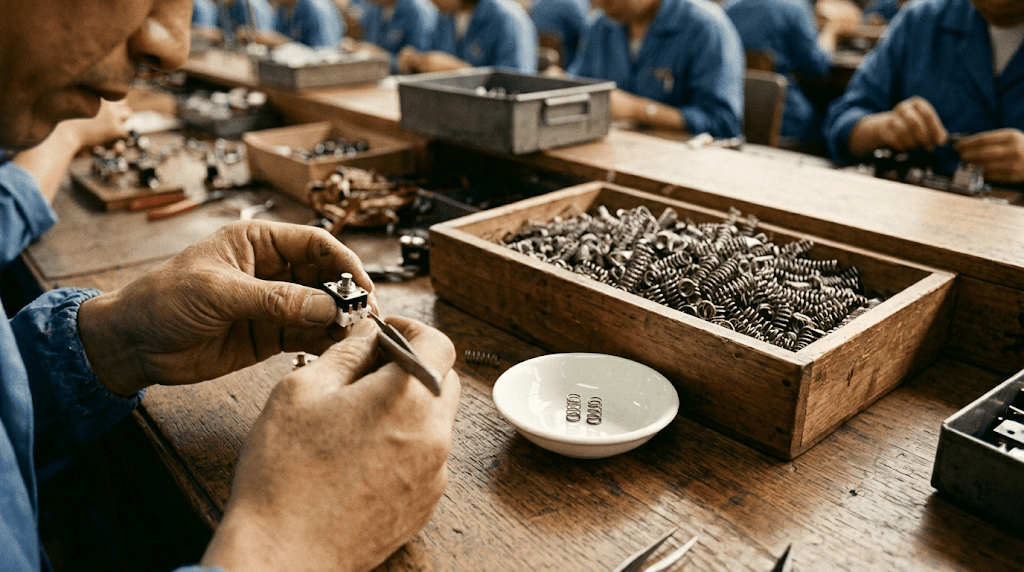
In 1961 Shingo visited the Yamada Electric plant in Nagoya. It built a small push-button switch for Matsushita (now Panasonic). Each switch needed a spring placed under each of two buttons before the case was closed.
Operators sometimes forgot a spring. The case closed over the mistake, so it stayed invisible until the switch failed testing at the customer’s site in Kyushu — at which point the factory had to send an engineer to open it, drop in the missing spring, and reassemble it. For years the response had been the usual one: tell people to concentrate harder. It never worked, because the problem was not carelessness. It was ordinary, predictable human fatigue.
Shingo changed one thing. He put a small dish in front of the parts box and made the worker’s first move each cycle simple: take exactly two springs from the box, place them in the dish, then build the switch from the dish. Now a leftover spring in the dish screamed “you missed a step” before the unit ever left the bench. The defect vanished — not through willpower, but through a sequence that made the error reveal itself.
Worth knowing: you will often see the Yamada defect rate quoted as exactly 1.38%. That number is borrowed from unrelated lab and cup-molding studies. Shingo’s own writing says the rate fell to zero; it never records a 1.38% starting point.
Why did Shingo rename his own invention?
He first called these devices baka-yoke — literally “fool-proofing.” The seat-line worker who cried at Arakawa Auto Body ended that. Shingo saw the harm the word did, scolded the managers who used it, and switched to poka-yoke, “mistake-proofing.”
It sounds like a cosmetic change. It was the opposite. Tie the method to respect for people and a practical thing follows: workers who are not treated as the problem will tell you where the real problems hide. They report near-misses and help redesign the work. A blaming culture buries exactly the information a quality system needs. At AIGPE we say it plainly — don’t blame the people, fix the system. Build quality in instead of inspecting it in. Shingo gave that belief its proof.
How do you actually build a mistake-proof step?
Shingo turned clever shop-floor tricks into a method by asking two questions of every device. First: how does it detect the error? Second: what does it do the moment it catches one? There are three ways to detect.
| How it detects | What it checks | An example you have met |
|---|---|---|
| Contact | Shape, size, weight, or orientation of a part. | A USB plug or 3-pin outlet shaped so it cannot go in upside down. |
| Fixed-value | That a set number of actions or parts happened. | The Yamada dish, proving exactly two springs were used. |
| Motion-step | That steps happen in the right order. | A press that fires only when both safety buttons are pressed together. |
Then there are two ways to react. A control poka-yoke physically stops the process until the error is fixed; it needs no human vigilance at all, which makes it the stronger choice. A warning poka-yoke just flashes a light or sounds a buzzer — cheaper, but weaker, because someone still has to notice and choose to stop. Underneath it all sits Shingo’s real target: source inspection, which checks the conditions before the machine acts, rather than sorting good from bad afterward.
Why did he pick a fight with the statisticians?
Stack 100% source inspection on top of poka-yoke and you get Shingo’s bigger idea: Zero Quality Control. Here he broke, sharply, with the Statistical Process Control that W. Edwards Deming had made gospel in post-war Japan. Shingo had once been an SPC enthusiast. Then he saw a flaw he could not unsee.
Sampling, by design, leaves most of the product untested, and the idea of an “acceptable quality level” quietly blesses a few defects. A plant shipping a million parts at 99.9% is congratulated even as it knowingly sends out a thousand bad ones. Shingo’s objection was human: to the one customer who receives the defective unit, the defect rate is not 0.1%. It is 100%. ZQC hands inspection to cheap mechanical poka-yoke that never tire, which makes checking every single part affordable — and turns “zero defects” from a slogan into an engineering target.
How did four hours become three minutes?
Quality was only half of Shingo’s work. The other half was speed. SMED — Single-Minute Exchange of Die — is the craft of switching a machine from one product to another in under ten minutes.
His insight was to split a chaotic changeover into two buckets. Internal work can only happen with the machine stopped, like unbolting an old die. External work can happen while the machine still runs the last batch, like fetching and staging the next die. In ordinary plants the two were tangled, so a multi-million-dollar press sat idle while someone hunted for a wrench. Move work to external, streamline what is left, swap threaded bolts for quick-release clamps — and the clock collapses. At Toyota in 1969, Shingo helped cut a 1,000-ton press changeover from four hours to roughly three minutes, which is what makes just-in-time production possible at all.

Did Shingo really invent the Toyota Production System?
Western books, pushed hard by publisher Norman Bodek, often crown Shingo the co-inventor of TPS alongside Taiichi Ohno. The records are more careful. Isao Kato, a 35-year Toyota training veteran who personally coordinated Shingo’s visits, and former Toyota engineer Art Smalley both confirm that when Shingo arrived in 1955, the pillars of TPS — just-in-time and jidoka — were already running under Ohno.
Shingo was hired to teach industrial engineering, not to architect strategy. Over about 25 years he taught his course roughly 80 times to some 3,000 engineers, and rarely met Ohno. So the honest verdict is not that he built TPS. It is that he watched it, named its parts, and explained it so clearly that the rest of the world could finally copy it. That is a different gift — and a huge one.
| What people believe | What is actually true |
|---|---|
| Poka-yoke fixes broken machines. | It targets human error only; broken machines are the job of TPM and jidoka. |
| Shingo co-invented TPS. | He was hired to teach IE; the core of TPS predated his arrival. |
| “Baka-yoke” and “poka-yoke” mean the same thing. | One means “fool-proofing,” the other “mistake-proofing.” The 1963 change was deliberate. |
| ZQC just manages an acceptable defect level. | ZQC rejects sampling and aims at literal zero defects. |
| Any handy jig is a poka-yoke. | It only counts if it detects or prevents an inadvertent error. |
Where will you bump into Shingo today?
His idea left the factory long ago. The USB plug, the HDMI cable, and the UK three-pin plug all use contact-method poka-yoke so they cannot go in wrong. Your car asks for your foot on the brake before it leaves Park. Software disables the “submit” button until the form is complete and flags “see attached” when nothing is attached. In hospitals, enteral feeding-tube connectors are shaped so they physically cannot join an IV line, preventing a fatal mix-up.
The newest twist blends Shingo with AI. Vision systems now inspect car-door assemblies with more than 80 variable parts, adapting on the fly and cutting defect rates by 10 to 15 percent without rigid fixtures. The tool is new; the thinking is pure Shingo.
Put it to work this week
You do not need a factory to use any of this. Pick one repetitive task that bites you and try the Shingo move:
- Find the silent failure. Where does a small slip stay hidden until it reaches someone downstream? That is your target.
- Make the error visible at the source. Add a step, a checklist field, or a physical cue that announces a miss immediately — your version of the dish.
- Stop blaming, start redesigning. When something goes wrong, ask what about the process allowed it, not who to scold.
The takeaways
- Separate the mistake from the defect: slips are human, defects are preventable.
- Design the error out at the source instead of inspecting it out at the end.
- Respect for people is not soft — it is what surfaces the data quality needs.
- Shingo’s genius was clarity: he made hard-won practice teachable to the world.
Frequently Asked Questions
What is poka-yoke in plain English?
Poka-yoke, or mistake-proofing, means designing a task or product so a slip cannot happen, or is caught the instant it does, before it becomes a defect. A USB plug that only fits one way is the everyday example.
What is the difference between baka-yoke and poka-yoke?
Both are terms Shingo used. Baka-yoke means “fool-proofing,” which insulted workers; poka-yoke means “mistake-proofing.” He switched around 1963 to tie the method to respect for people.
What are the three ways a poka-yoke detects errors?
Contact (shape, size, orientation), fixed-value (a set count of parts or actions), and motion-step (steps done in the right sequence).
How is Zero Quality Control different from Statistical Process Control?
SPC samples and accepts a small defect rate as unavoidable. ZQC rejects sampling, inspects every part at the source with poka-yoke, and aims at literal zero defects.
Did Shigeo Shingo invent the Toyota Production System?
No. The core of TPS existed before he arrived in 1955. He taught industrial engineering and later documented the system so clearly that it spread worldwide.
Build the skills behind the story
Want to turn Shingo’s thinking into results you can measure? These AIGPE certifications go deep on the exact tools above, and on applying them with modern AI.
Lean and mistake-proofing
- Certified Mistake-Proofing (Poka-Yoke) Specialist
- Certified Lean Specialist
- Certified Just-In-Time (JIT) Specialist
Quality and problem-solving
AI-powered track for Quality 4.0
About the Author
Rahul G. Iyer is an AI-Driven Transformation Leader and Founder and CEO of AIGPE®. With more than 23 years of experience and 700+ personally executed Six Sigma, process-improvement, Operational Excellence and transformation projects, he turns practical expertise into professional courses, corporate training, private AI coaching, keynotes and The M3 Podcast Show. His learning content has generated 1M+ cumulative learner enrollments and reached 198 countries.
Citations and References
- Shigeo Shingo – Wikipedia
- Poka-yoke – Wikipedia
- What is Poka-Yoke? Mistake & Error Proofing – ASQ
- The Shingo Model – Shingo Institute
- Shigeo Shingo on Mistake-Proofing – Lean Blog
- Mr. Shigeo Shingo’s P-Course and Contribution to TPS – Art of Lean
- Shingo Prize – Wikipedia
- Zebra Technologies Helps Sentinel Cut Defect Rates by Up to 15% – Zebra Newsroom