


W. Edwards Deming: 7 Powerful Lessons From a Quality Legend
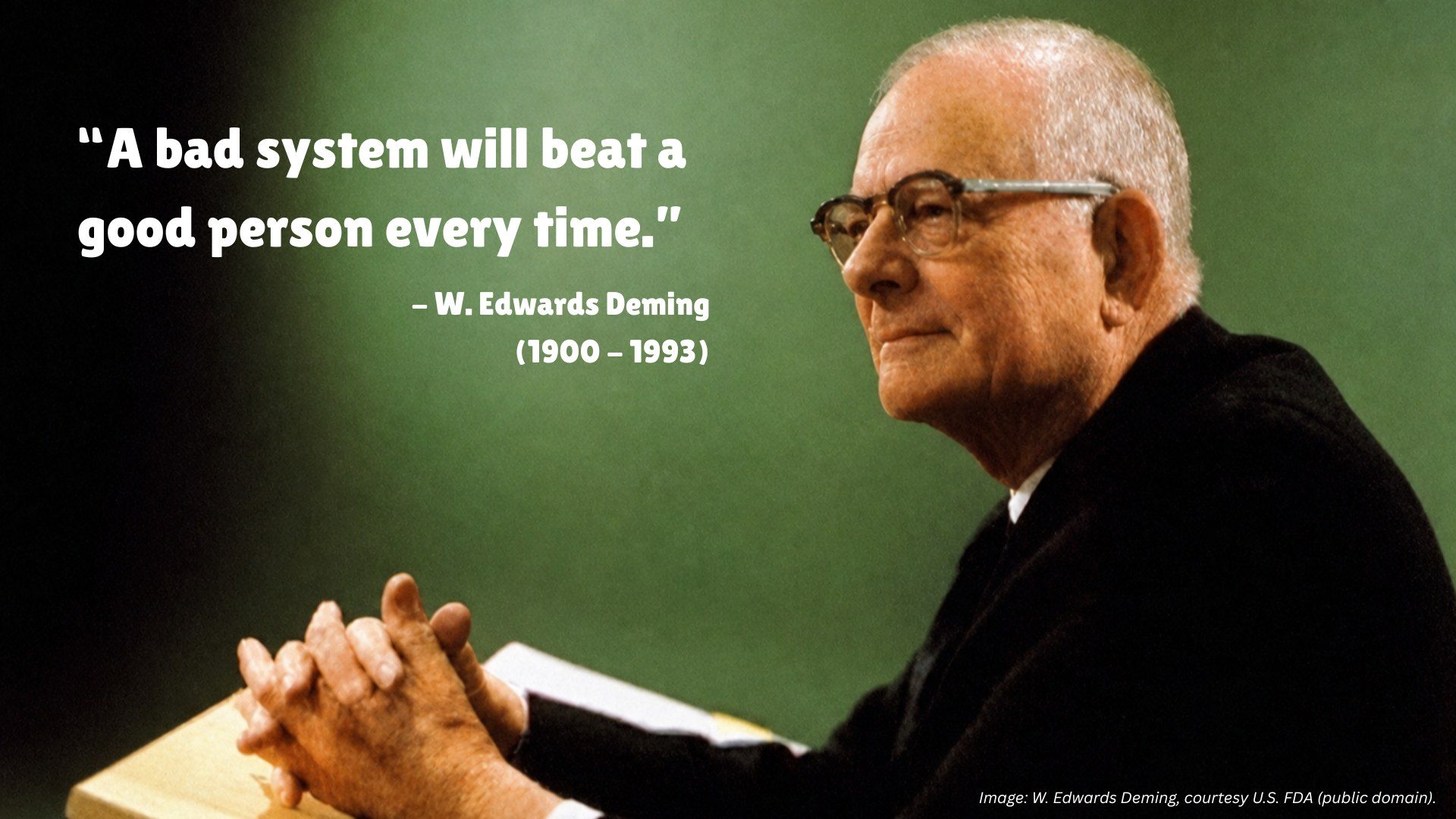

Dr. W. Edwards Deming spent his life proving that quality is built into a system, not inspected into it at the end.
This article expands on a post I shared on LinkedIn about W. Edwards Deming. Readers there are already swapping their own reflections. Add yours to that thread, then read the full breakdown below.
Most people in quality have heard the name W. Edwards Deming. Far fewer can say what he actually taught, and some of what gets quoted in his name is the opposite of what he believed. He was a statistician who reshaped how the world thinks about variation, systems, and the role of management in quality, yet he spent decades in near-obscurity in his own country while Japan treated his ideas as the blueprint for an industrial comeback.
This is the story of the man, the methods, and the myths. It is also a working toolkit, because almost everything Deming argued in the 1950s still decides whether a modern improvement effort succeeds or quietly fails.
7 Insights at a Glance
If you only have ninety seconds, here are the seven things worth remembering about W. Edwards Deming.
- Quality lowers cost, it does not raise it. Cutting scrap, rework, and warranty claims is cheaper than producing defects and catching them later.
- Most defects belong to the system, not the worker. Deming put the figure at 85 to 94 percent, which is why blaming individuals rarely fixes anything.
- You cannot inspect quality in. Quality has to be designed and built into the process from the start.
- Variation has two sources, and confusing them makes things worse. Reacting to normal, common-cause variation as if it were a special event is called tampering.
- His System of Profound Knowledge ties it together. Systems thinking, knowledge of variation, theory of knowledge, and psychology form one lens for managing.
- The 14 Points are still a management roadmap. Constancy of purpose, ending dependence on inspection, and driving out fear remain live issues.
- He is widely misquoted. He never said “if you can’t measure it, you can’t manage it.” He wrote that believing it is a costly myth.
Table of Contents
- Who Was W. Edwards Deming?
- Key Facts at a Glance
- The Idea That Shaped Him: Variation
- Japan, and the Story Told Honestly
- The Message: Quality Costs Less
- How America Finally Noticed
- The Frameworks He Left Behind
- Myths Worth Correcting
- How to Apply Deming Today
- Frequently Asked Questions
Who Was W. Edwards Deming?
W. Edwards Deming (1900 to 1993) was an American statistician, physicist, and management consultant widely regarded as a father of the modern quality movement. He took the statistics of variation, learned from his mentor Walter Shewhart, and expanded them into a complete philosophy of how to lead an organization. His thinking still sits underneath Lean, Six Sigma, and Total Quality Management.
The one line to remember: fix the system before you blame the person, and lead with knowledge and trust rather than fear and quotas.
Key Facts at a Glance
| Attribute | Detail |
|---|---|
| Full name | William Edwards Deming |
| Born | October 14, 1900, Sioux City, Iowa |
| Died | December 20, 1993, Washington, D.C., aged 93 |
| Education | BS, University of Wyoming (1921); MS, University of Colorado (1925); PhD in mathematical physics, Yale (1928) |
| Known for | System of Profound Knowledge, the 14 Points for Management, the PDSA cycle, the Red Bead Experiment |
| Japan work | Lectured for JUSE from June 1950; the Deming Prize was established in 1951 |
| Major honors | Order of the Sacred Treasure, 2nd Class (1960); U.S. National Medal of Technology (1987) |
| Key books | Out of the Crisis (1986); The New Economics (1993) |
The Idea That Shaped Him: Variation
W. Edwards Deming grew up poor on a farm in Powell, Wyoming, worked his way through a PhD in mathematical physics at Yale, and spent his early career in U.S. government statistics. The turning point came through Walter Shewhart, the Bell Labs physicist regarded as the father of statistical process control. Shewhart taught that variation in any process comes from two very different sources, and that telling them apart is the whole game.


Common cause variation lives in the system itself. Special cause variation comes from a specific, identifiable event.
| Type of variation | Where it comes from | What management should do |
|---|---|---|
| Common cause | Built into the system: design, materials, methods, standard conditions | Improve the system itself; do not punish individuals |
| Special cause | A specific, unusual event: a broken tool, a bad batch, a power surge | Investigate that specific event and remove it |
Treating a common cause as if it were a special cause is what Deming called tampering, and he proved it makes performance worse, not better. If you have ever adjusted a stable process after one bad data point and watched results swing wildly, you have met this lesson. Control charts, taught today in tools like SPC and Minitab training, exist precisely to keep managers from tampering.
Japan, and the Story Told Honestly
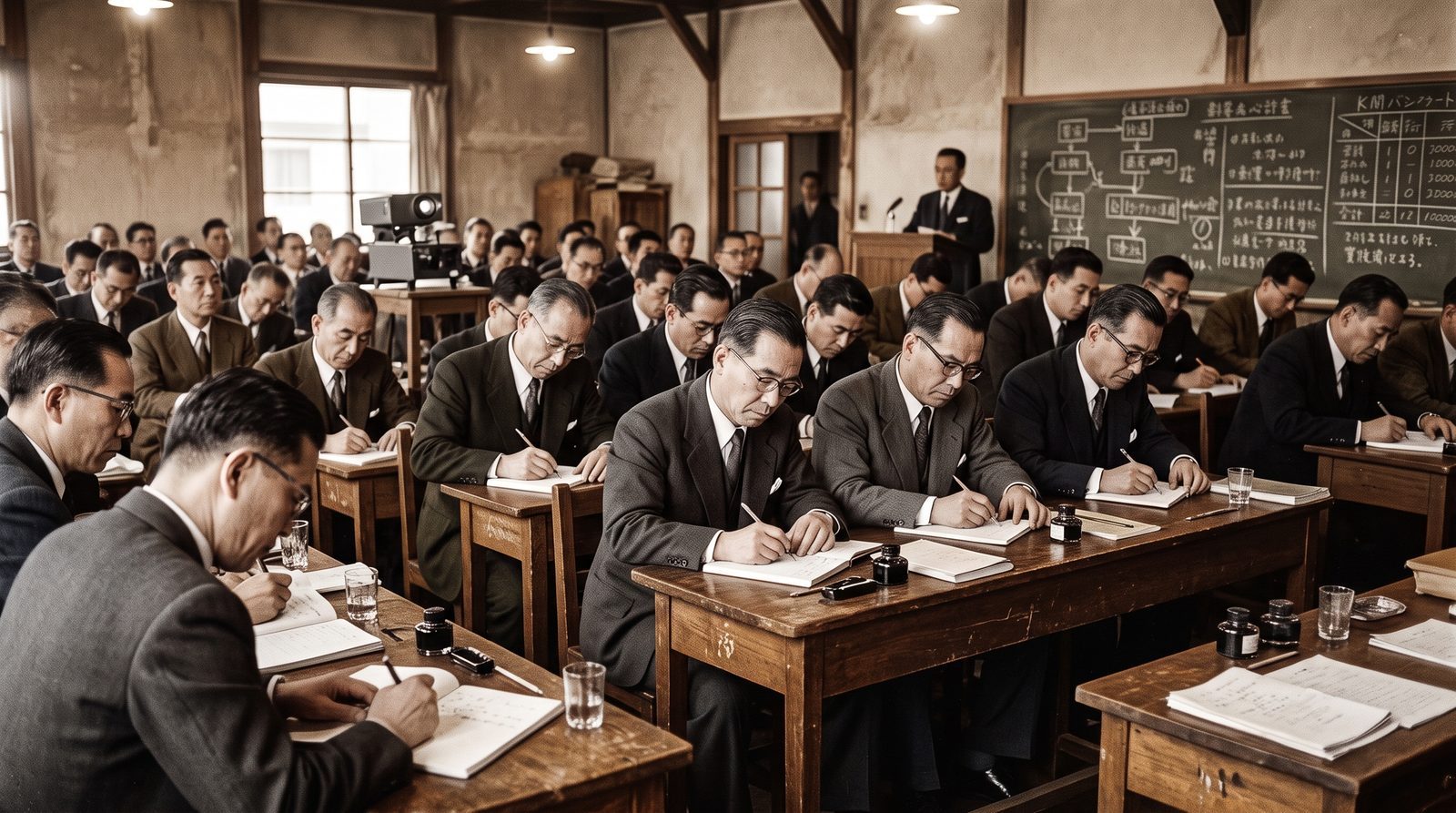
Japanese engineers at a 1950s quality control seminar. JUSE spread the methods across the country.
In June 1950, at the invitation of the Union of Japanese Scientists and Engineers (JUSE), Deming began teaching statistical quality control to Japanese engineers and executives. He met not only technical staff but senior leaders, and he delivered a blunt message: commit fully to quality and the world will demand your products within a few years.
Here is the part that often gets lost. Japan’s transformation was earned by the Japanese, not handed to them. JUSE organized and spread the training nationwide, Kaoru Ishikawa adapted the ideas into something distinctly Japanese, earlier American advisors had primed executives, and Joseph Juran arrived in 1954 to train management on the same mission. Deming was one important catalyst among many. He always insisted on telling it that way, and so should anyone who teaches his work.
In gratitude, JUSE used the royalties from his donated lecture notes to establish the Deming Prize in 1951, still one of the most prestigious quality honors in the world. In 1960, Japan awarded him the Order of the Sacred Treasure, Second Class.
The Message: Quality Costs Less
W. Edwards Deming’s central economic argument was counterintuitive for its time and still surprises managers today.
- Quality does not raise cost. Cutting scrap, rework, and warranty claims lowers cost and frees capacity.
- Defects are mostly systemic. By his estimate, 85 to 94 percent of problems come from the system that management owns.
- Inspection is too late. You cannot inspect quality into a product; it must be built in from the start, the same principle behind mistake-proofing (Poka-Yoke).
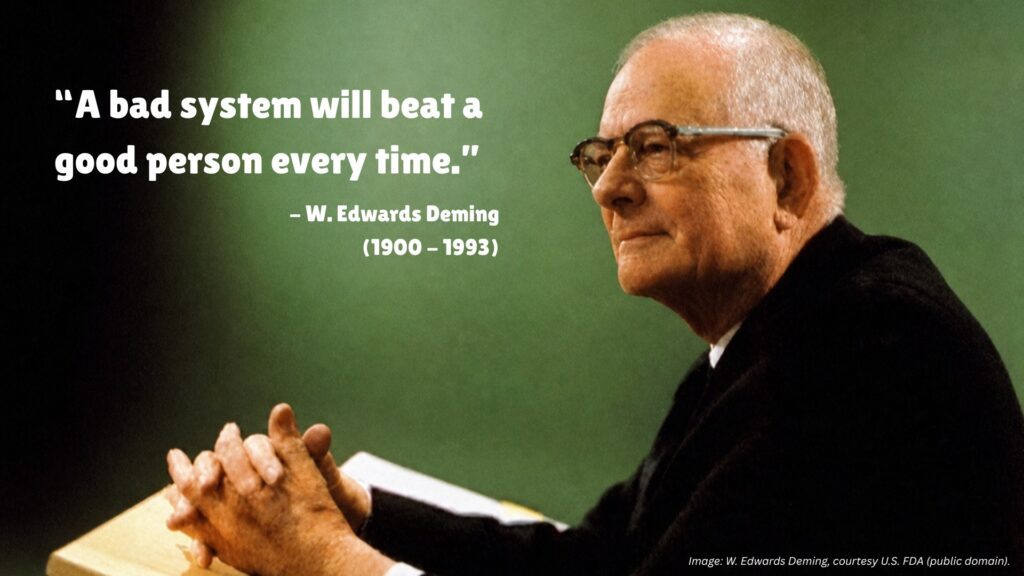
“A bad system will beat a good person every time.”
— W. Edwards Deming, Four Day Seminar, Phoenix, 1993
How America Finally Noticed
For three decades after the war, American industry dominated and grew complacent. That changed on June 24, 1980, when NBC aired a documentary called If Japan Can… Why Can’t We? and put a nearly 80-year-old W. Edwards Deming on screen telling executives their decline was a failure of management, not labor.

After the 1980 broadcast, American manufacturers raced to understand the methods Japan had used for thirty years.
Ford called soon after, having lost three billion dollars between 1979 and 1982. To the surprise of its executives, W. Edwards Deming refused to discuss the assembly line. He went straight at the culture and the leadership, placing the bulk of the responsibility for quality on management. That work fed into the Taurus line and Ford’s most profitable year in 1986. It is one of the clearest case studies in business history of fixing the system rather than the people.
The Frameworks He Left Behind
W. Edwards Deming formalized his life’s work into a small number of durable frameworks. Three matter most for practitioners.
The System of Profound Knowledge
His final synthesis described four interdependent lenses managers need at once: appreciation for a system, knowledge about variation, a theory of knowledge (you need a theory to learn from experience), and psychology (understanding what truly motivates people).

In the Red Bead Experiment, willing workers cannot beat the system no matter how hard they try, because the beads decide the outcome.
The 14 Points for Management
Detailed in Out of the Crisis, the 14 Points are a roadmap for transformation. A condensed view:
| # | Point | What it means |
|---|---|---|
| 1 | Constancy of purpose | Improve products and services for the long term, not the quarter |
| 2 | Adopt the new philosophy | Management must take responsibility and lead the change |
| 3 | Cease dependence on inspection | Build quality in instead of catching defects at the end |
| 4 | End price-tag-only buying | Choose suppliers on total cost and trust, not lowest bid |
| 5 | Improve constantly | Keep refining the system of production and service forever |
| 6 | Institute training | Train people properly on the job |
| 7 | Institute leadership | Help people do better work, do not just count output |
| 8 | Drive out fear | People who fear reprisal hide the very problems you need to see |
| 9 | Break down barriers | End silos between departments |
| 10 | Eliminate slogans | Systems produce quality, not posters and exhortations |
| 11 | Eliminate numerical quotas | Replace arbitrary targets with genuine leadership |
| 12 | Permit pride of workmanship | Remove barriers, including the annual merit rating, that rob pride |
| 13 | Encourage education | Invest in ongoing self-improvement for everyone |
| 14 | Take action | Make the transformation everyone’s job |
The PDSA Cycle
W. Edwards Deming championed the Plan-Do-Study-Act cycle and deliberately kept the word “Study” rather than “Check.” A check is a quick audit. Study means predicting an outcome from a theory, comparing results against the prediction, and generating new knowledge before acting. It is learning, not just verifying.
Myths Worth Correcting
Few thinkers are misquoted as often as W. Edwards Deming. Setting the record straight is part of honoring the work.
| The myth | The reality |
|---|---|
| “If you can’t measure it, you can’t manage it” is Deming’s rule | He wrote the opposite in The New Economics, calling that belief a costly myth, because the most important figures are often unknown and unknowable |
| Deming single-handedly rebuilt Japan | He was one catalyst; JUSE, Ishikawa, earlier advisors, Juran, and Japanese industry did the work |
| Deming created Total Quality Management | He did not coin the term and actually disliked it as a hollow buzzword |
| Quality is mainly the factory floor’s job | He placed the large majority of responsibility on management and the system it designs |
“It is wrong to suppose that if you can’t measure it, you can’t manage it, a costly myth.”
— W. Edwards Deming, The New Economics (1993)
How to Apply Deming Today
You do not need a time machine to use this. Four moves translate directly to a modern team.
- Separate common cause from special cause before you react. Plot the data over time. If the process is stable, improve the system; do not chase individual data points.
- Audit your fear level. Ask whether people feel safe reporting a defect or a near miss. Hidden problems are the expensive ones.
- Move quality upstream. Replace end-of-line inspection with prevention, mistake-proofing, and better design.
- Pair the method with modern tools. The same prevention mindset now powers AI-driven quality (Quality 4.0), where analysis is faster but the system-first logic is unchanged.
Build the Skills That Matter in the Quality Era
W. Edwards Deming’s ideas are the foundation of every certification track at AIGPE. If his story resonates, here is where to turn the philosophy into a credential.
Six Sigma Certification Track
- Certified Lean Six Sigma White Belt
- Certified Lean Six Sigma Green Belt
- Lean Six Sigma Black Belt: Phase 0 and 1
Lean and Quality Track
- Seven Basic Tools of Quality Expert Certification
- Certified Mistake-Proofing (Poka-Yoke) Specialist
- Certified Minitab Proficient: SPC Control Charts
AI-Powered Certification Track for Quality 4.0
- Certified AI-Powered Root-Cause Analysis Specialist
- ChatGPT and Six Sigma: AI Visualization Beginner
Frequently Asked Questions
Why is W. Edwards Deming called the father of quality?
Because he turned the statistics of variation into a full management philosophy and helped trigger Japan’s postwar quality movement, his ideas became the foundation for Lean, Six Sigma, and Total Quality Management.
What are Deming’s 14 Points?
They are 14 management principles, from constancy of purpose to driving out fear, that describe how to transform an organization by improving the system rather than pressuring individuals.
Did Deming say “if you can’t measure it, you can’t manage it”?
No. He wrote the opposite in The New Economics, describing that belief as a costly myth, because many of the most important figures in a business are unknown and unknowable.
What is the difference between common cause and special cause variation?
Common cause variation is built into the system and is normal. Special cause variation comes from a specific, unusual event. Confusing the two and over-adjusting a stable process is called tampering and makes results worse.
What is the Deming Prize?
It is a prestigious quality award established by JUSE in Japan in 1951, funded by the royalties Deming donated, recognizing organizations for outstanding improvements in quality.
Which books should I read to learn Deming’s ideas?
Start with Out of the Crisis (1986) for the 14 Points and the diseases of management, then read The New Economics (1993) for the System of Profound Knowledge.
About the Author
Rahul G. Iyer is an AI-Driven Transformation Leader and Founder and CEO of AIGPE®. With more than 23 years of experience and 700+ personally executed Six Sigma, process-improvement, Operational Excellence and transformation projects, he turns practical expertise into professional courses, corporate training, private AI coaching, keynotes and The M3 Podcast Show. His learning content has generated 1M+ cumulative learner enrollments and reached 198 countries.
Citations and References
- The W. Edwards Deming Institute, Deming the Man
- The W. Edwards Deming Institute, Timeline
- Wikipedia, W. Edwards Deming
- National Academy of Engineering, Memorial Tribute
- If Japan Can… Why Can’t We? (1980 NBC documentary)
- National Science and Technology Medals Foundation, W. Edwards Deming
- The W. Edwards Deming Institute, “A bad system will beat a good person every time”