AI-Powered Six Sigma White Belt: The Complete Beginner’s Guide for 2026
Rahul I
AI-Powered Six Sigma White Belt: The Complete Beginner’s Guide for 2026
This article expands on a post we shared on LinkedIn about how the first step into quality is being rewritten. Readers there are already swapping their own stories about the manual era. Add yours to that thread, then read the full guide below.
Can you start a career in process improvement if you have never opened Minitab, never drawn a control chart, and never led a project? Until recently, the honest answer was “slowly.” You would learn the vocabulary, sit quietly through project meetings, and wait years for the interesting work.
The AI-Powered Six Sigma White Belt changes that answer. It takes quality’s most accessible certification, the classic White Belt, and rebuilds it around the AI tools that now do the heavy lifting of data collection and first-pass analysis. The foundation is the same one Motorola engineer Bill Smith laid in 1986. The power available to a beginner is unrecognizable. This guide explains what the credential covers, who it is for, what it costs in time and effort, and how to decide if the AI-Powered Six Sigma White Belt is your right first step.
Seven Takeaways at a Glance
If you only have ninety seconds, here is what matters.
The AI-Powered Six Sigma White Belt is the entry point of the belt ladder. It teaches the concepts, not the statistics. No Minitab, no regression, no calculus.
An AI-Powered Six Sigma White Belt adds a second skill set: working with AI safely. You learn DMAIC and SIPOC alongside the prompts, checks, and guardrails that make AI useful instead of dangerous.
The economics favor early movers. Workers with AI skills earned a 56% wage premium over peers in the same occupation in 2025, up from 25% the year before, according to PwC.
You do not need a technical background. If you can ask a clear question, you can complete a White Belt. That has not changed.
It is not just for manufacturing. HR, IT, finance, and healthcare professionals are drafted onto improvement projects constantly and benefit most from the shared language.
Even entry-level belts carry measurable career value. ASQ salary data shows a salary uplift at every belt level, starting with White and Yellow.
AI does not replace the human judgment the AI-Powered Six Sigma White Belt teaches. It generates hypotheses fast; validating them still belongs to people. The credential teaches both halves.
A Six Sigma White Belt is the foundation certification of the Lean Six Sigma hierarchy. It exists to give anyone, from a frontline operator to a CFO, a working literacy in how structured problem-solving works: what DMAIC means, why variation matters, how customer expectations become measurable requirements, and where their own daily work touches quality.
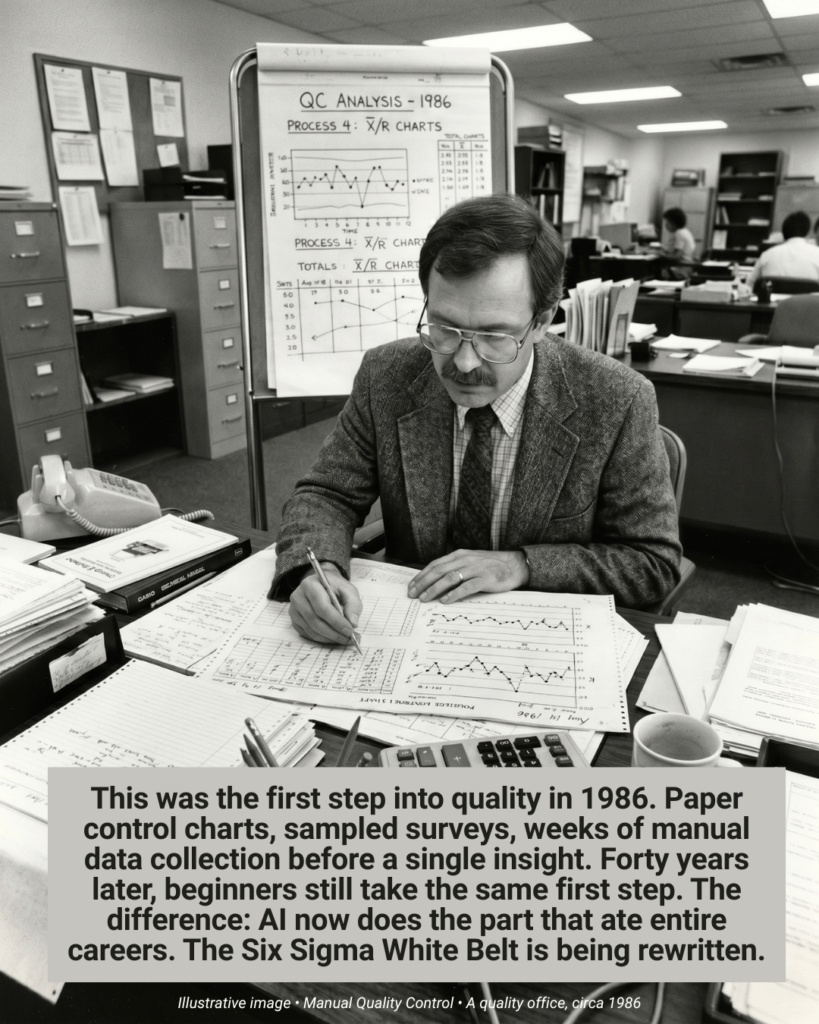
An AI-Powered Six Sigma White Belt teaches that same foundation with one major addition. Every phase of the methodology is taught together with the AI capability that now accelerates it. You do not just learn what a SIPOC diagram is; you learn to generate one with a large language model in minutes and then correct what the model got wrong. You do not just learn that the Voice of the Customer matters; you learn how AI can read 100% of customer feedback instead of a sampled survey, and what questions to ask it.
The one line to remember: the White Belt’s job is not to make you an expert. It is to make you fluent enough to ask the right questions, and now AI helps answer them in seconds instead of weeks.
Key Facts at a Glance
Attribute
Detail
Position in hierarchy
The AI-Powered Six Sigma White Belt sits at entry level, before Yellow, Green, Black, and Master Black Belt
Statistics required
None. Conceptual curriculum: DMAIC, SIPOC, VoC, CTQ, the eight wastes
Software required
No Minitab or SigmaXL. AI-powered versions use everyday AI assistants
Typical audience
Frontline staff, cross-functional SMEs, executives, career changers
Time commitment
Hours to a few days, versus weeks for Green Belt and months for Black Belt
Cost context
Green Belt programs often exceed $1,500; Black Belt $2,000 to $4,000; White Belt is a fraction of either
Career signal
ASQ data shows a measurable salary uplift even at entry belts
Where the White Belt Sits on the Belt Ladder
Six Sigma borrows its rank system from martial arts. Each belt expands both responsibility and statistical depth. The ladder matters because employers read it instantly: a belt on a resume tells them exactly what you can be trusted to do on an improvement project.
Belt
Role on Projects
Average Salary Uplift vs Non-Certified (ASQ/MSI)
White Belt
Informed team member; shared vocabulary; spots waste in own work
+$880 (White/Yellow tier)
Yellow Belt
Active project participant; assists data collection
Enterprise strategy; mentors Belts; owns the portfolio
+$26,123
Two things stand out in that table. The uplift starts at the very first rung, because even entry belts signal data-driven thinking. And the jumps between rungs are large, which is why the AI-Powered Six Sigma White Belt works so well as a low-risk test before you invest in a Green Belt or beyond.
The ladder, made visible: the AI-Powered Six Sigma White Belt journey starts at the white belt in front.
What a Traditional White Belt Teaches
The classic curriculum, standardized by bodies like the Council for Six Sigma Certification, is deliberately conceptual. In a traditional program you learn:
The DMAIC roadmap. Define, Measure, Analyze, Improve, Control: the five-phase discipline behind nearly every Six Sigma project.
Voice of the Customer and Critical to Quality. How vague customer expectations become specific, measurable requirements.
SIPOC mapping. Suppliers, Inputs, Process, Outputs, Customers: the one-page map that keeps projects from sprawling.
Lean’s eight wastes. The DOWNTIME framework for seeing waste hiding in everyday work.
The core philosophy. Fix the system, not the people. Prevention beats detection. Quality is built in, not inspected in.
What you will not find: statistical software, hypothesis testing, or project leadership hours. That is by design. The White Belt makes you a capable contributor, not a project leader.
What Changes When AI Enters the Curriculum
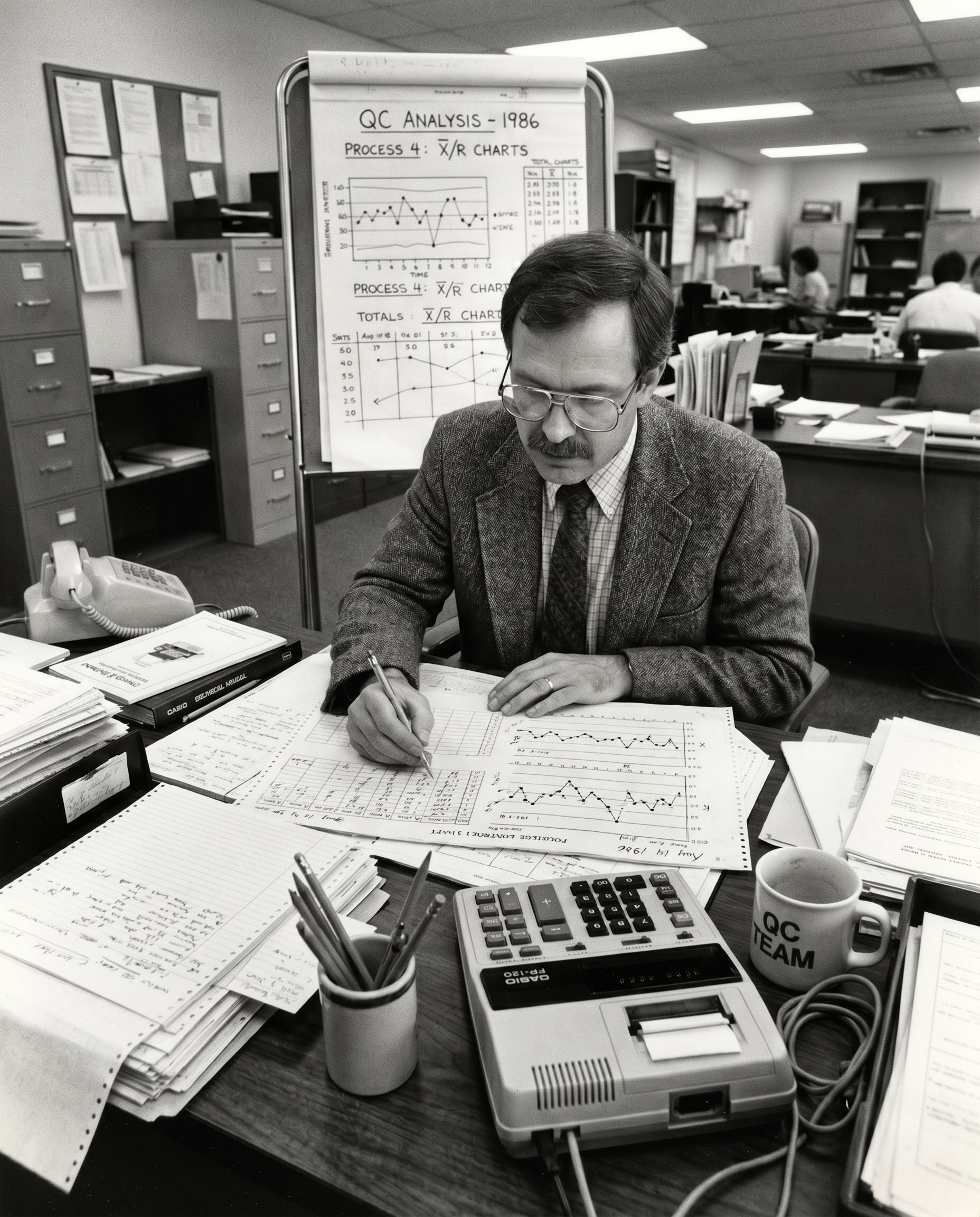
The honest answer: everything operational, nothing philosophical. The thinking discipline stays. The manual labor goes. Here is the phase-by-phase difference between the White Belt of 1986 and the AI-Powered Six Sigma White Belt of 2026.
DMAIC Phase
The 1986 Way
The AI-Powered Way
Define
Weeks of meetings; hand-drafted charters; sampled customer surveys
AI drafts the charter and SIPOC in minutes; NLP reads all customer feedback
Measure
Manual data sampling; clipboard time studies; sampling error
Continuous data pulled from systems; 100% of the population, not a sample
Analyze
Brainstormed fishbones; manual Pareto charts; weeks to a root-cause hypothesis
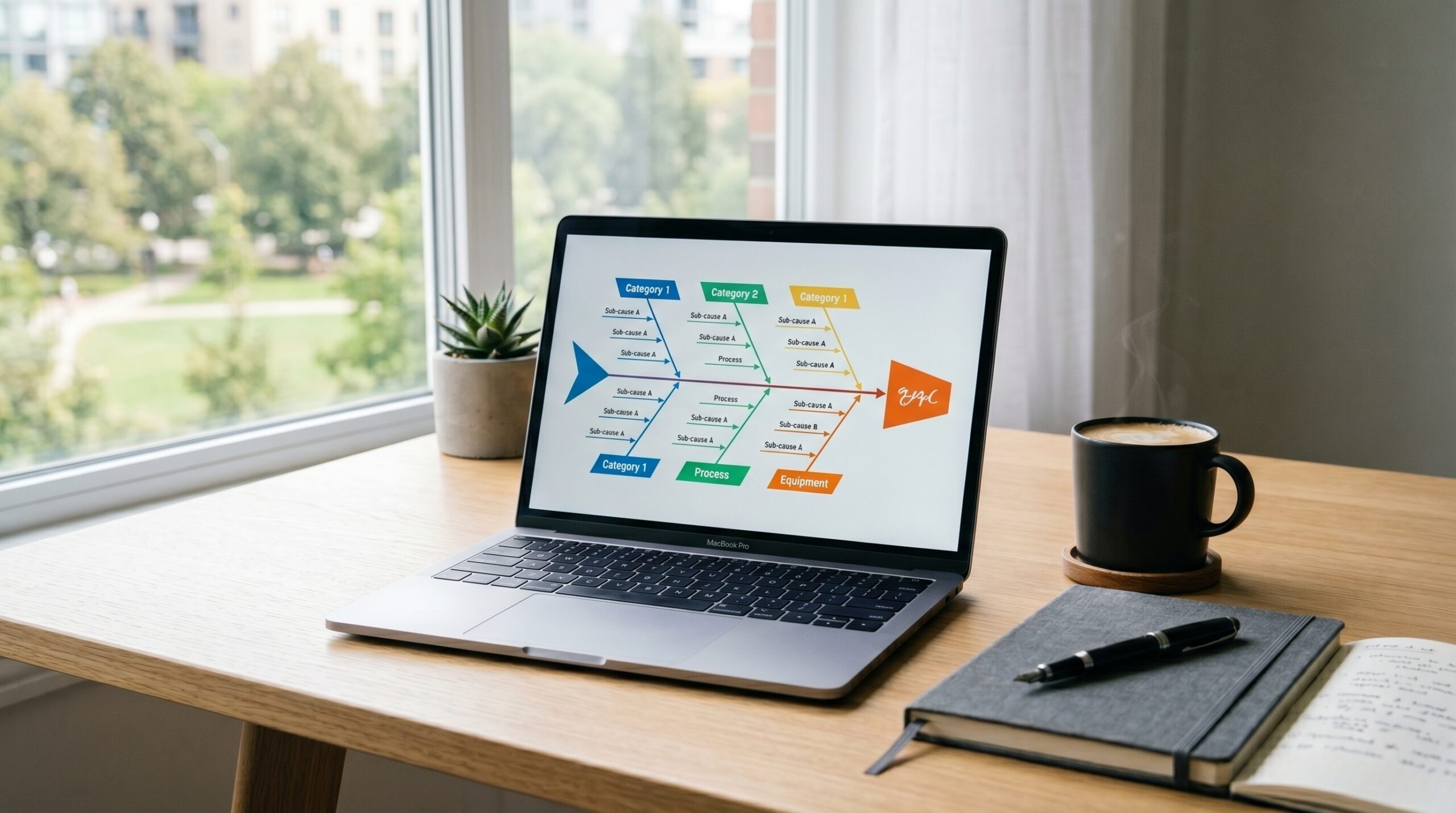
AI drafts a fishbone in 60 seconds with causes the team never considered; humans validate
Improve
Physical pilots with real disruption risk
Digital twins simulate thousands of fixes before anything touches the real process
Control
Control charts reviewed at month end
Real-time monitoring flags drift the moment it starts
An AI-powered curriculum also teaches something the 1986 version never needed: skepticism. Large language models hallucinate. They mistake correlation for causation. They sound most confident exactly when they are wrong. A well-built AI-Powered Six Sigma White Belt course spends real time on prompt structure, verification habits, and the boundary between what AI generates and what a human must validate. That judgment layer is the difference between a professional who uses AI and a professional who gets used by it.
The 60-second fishbone: AI drafts the cause-and-effect diagram, the human validates it.
Who Should Take It (and Who Can Skip It)
Four groups get outsized value from the AI-Powered Six Sigma White Belt.
Frontline and entry-level employees in operations, customer service, or administration, who want to understand how their daily tasks connect to quality metrics, and who want a credential that says “I think in data” on a first-job resume.
Cross-functional professionals in HR, IT, finance, and healthcare. These are the people most often drafted onto Green and Black Belt projects as subject matter experts, then left to decode the jargon alone. A White Belt turns those meetings from a foreign language into a working session.
Leaders and sponsors who will never run a regression but approve the budgets and clear the roadblocks for those who do. A conceptual grounding makes them dramatically better sponsors.
Career changers who suspect quality and process work might be their field but do not want to bet $1,500 to $4,000 on a Green or Black Belt to find out. The White Belt is the inexpensive aptitude test.
Who can skip it? Professionals with real project experience and analytical backgrounds who intend to lead improvement projects immediately. Many go straight to a Green Belt program, and that is a legitimate path. The ladder is a guide, not a law.
Three Misconceptions That Stop Beginners
“I need to be good at math.” The single most common reason people never start, and it is false at this level. The White Belt is concepts and frameworks. The statistics arrive at Green Belt, and even there, AI now writes the code that runs them.
“Six Sigma is a manufacturing thing.” It was born on a factory floor, but for two decades its fastest growth has been in services, healthcare, software, and finance. Process waste does not care what industry it lives in.
“Six Sigma is outdated in the AI era.” Exactly backwards. AI makes structured methodology more valuable, not less, because AI without governance amplifies chaos. As one training provider puts it: Lean Six Sigma provides structure for improvement, AI introduces speed and automation. Without integration, organizations either move too slowly or lose control. McKinsey’s 2025 research found that while nearly 90% of organizations now use AI somewhere, only 9% have reached real maturity with it. That 81-point execution gap is a hiring signal, and it points directly at people who hold both skill sets. The AI-Powered Six Sigma White Belt exists to close exactly that gap.
Why 2026 Is the Year to Start an AI-Powered Six Sigma White Belt
Three verified numbers explain the urgency better than any sales pitch.
56%. The wage premium workers with AI skills earned over peers in the very same occupation in 2025, up from 25% a year earlier, per the PwC Global AI Jobs Barometer. The premium more than doubled in twelve months.
3.5x. How much faster jobs with high AI exposure are growing compared with other occupations, from the same PwC research. The roles are not disappearing. They are transforming and multiplying.
1.1 billion. The number of jobs the World Economic Forum estimates will be radically transformed by technology in the coming decade, with AI affecting 86% of businesses by 2030.
Harvard Business School professor Karim Lakhani compressed all of this into one sentence: “AI is not going to replace humans, but humans with AI are going to replace humans without AI.” The AI-Powered Six Sigma White Belt is built for the second group: it produces beginners who learn the methodology and the AI together, from day one, instead of bolting AI onto twenty years of manual habits.
Learning the methodology and the AI together, from day one.
Your First 30 Days as an AI-Powered Six Sigma White Belt
The AI-Powered Six Sigma White Belt is the start, not the finish. Here is how new White Belts turn the certificate into visible value within a month.
Map one process you own. Build a SIPOC for a workflow you touch every day. Draft it with an AI assistant, then fix its mistakes. The fixing is where the learning lives.
Find one waste. Walk your own work using the eight wastes. Pick the most expensive one and write down what it costs per week.
Run one AI-assisted root-cause session. Take a recurring annoyance, feed the facts to an AI assistant, and ask for candidate causes. Then verify the top three the old-fashioned way: by looking.
Present one page. Show a colleague or manager the SIPOC, the waste, and the root-cause shortlist. One page, ten minutes. This is how White Belts get invited onto real projects.
Decide your next rung. If the month energized you, the Yellow Belt or Green Belt is the natural next step.
AIGPE’s own AI-Powered Six Sigma White Belt program opens next week, built across ten modules that pair every DMAIC phase with hands-on AI practice. Join the early access list to get the launch announcement, the full curriculum overview, and founding-member pricing before the public launch.
Build the Skills That Matter in the AI Era
AIGPE’s accredited programs cover the full ladder, from the AI-Powered Six Sigma White Belt to AI-powered specialization. AIGPE® programs carry CPD accreditation through the CPD Standards Office (Provider 50735), and AIGPE® is a PMI Authorized Training Partner (Provider 5573). AIGPE® is recognized by SHRM to offer Professional Development Credits (PDCs) for SHRM-CP® or SHRM-SCP® recertification activities (Provider RP9220).
Browse the full catalog, including the AI-Powered Six Sigma White Belt, on the AIGPE certifications page.
Frequently Asked Questions
What is the difference between a Six Sigma White Belt and a Yellow Belt?
An AI-Powered Six Sigma White Belt provides awareness-level literacy: vocabulary, DMAIC, and the philosophy. A Yellow Belt goes one step deeper, preparing you to actively participate in projects and assist with data collection. White is “I understand the language”; Yellow is “I can help do the work.”
Do I need statistics or coding for an AI-Powered Six Sigma White Belt?
No. The curriculum is conceptual, and the AI component uses everyday assistants like ChatGPT or Gemini through plain-language prompts. If you can write a clear question, you meet the technical bar.
How long does the AI-Powered Six Sigma White Belt take to complete?
Most White Belt programs take hours to a few days of study, compared with weeks for a Green Belt and months for a Black Belt. The AI-powered format tends to be hands-on, so expect activities, not just lectures.
Is a White Belt worth it if I do not work in manufacturing?
Often it is worth more. HR, IT, finance, and healthcare professionals are routinely pulled into improvement projects without any shared vocabulary. The AI-Powered Six Sigma White Belt fixes that in days, and ASQ data shows even entry belts correlate with a salary uplift.
Will AI replace Six Sigma professionals?
The evidence points the other way: AI-exposed roles are growing 3.5 times faster than other occupations, and AI-skilled workers in the same jobs earn a 56% premium. What AI does replace is the manual data-gathering that once consumed 80% of project time. The judgment work remains human, and it pays better than ever.
Can I skip the White Belt and go straight to Green Belt?
Yes, if you have project experience and an analytical background. The belts are not legally sequential. But if you are new to the field, the AI-Powered Six Sigma White Belt is the cheapest way to confirm the field fits you before you invest serious money and months of study.
About the Author
Rahul G. Iyer is an AI-Driven Transformation Leader and Founder and CEO of AIGPE®. With more than 23 years of experience and 700+ personally executed Six Sigma, process-improvement, Operational Excellence and transformation projects, he turns practical expertise into professional courses, corporate training, private AI coaching, keynotes and The M3 Podcast Show. His learning content has generated 1M+ cumulative learner enrollments and reached 198 countries.