
CSSBB First 60 Questions: Why They Feel Impossible (And Why You Are Not Failing)
In this article
She got to question 47 before her hands started shaking.
The first 46 felt like a totally different exam than the one she had studied 110 hours for. Three of the four answers looked right on every single question. By question 53, she was already running the math on a $385 retake. She passed. Comfortably.
If you are reading this because you just walked out of the testing center feeling crushed, or because you sit next month and the horror stories online are eating at you, this one is for you. The CSSBB first 60 questions experience is the most underprepared-for moment in the whole ASQ Black Belt journey, and almost every passing candidate I have coached has lived through it.
Are the CSSBB first 60 questions really impossibly hard?
Short answer: no. They are designed to feel that way. The panic is the failure mode, not the questions.
The ASQ CSSBB has 165 questions and 270 minutes on the clock. 150 are scored, 15 are unscored test items ASQ is trying out for future exams. Every scored question is worth the same. The exam is not adaptive, so your answers do not change the difficulty of what comes next. The CSSBB first 60 questions only feel impossible because three things hit at once, and nobody warned you.
What is going on in your first hour
- The hard ones come early. ASQ front-loads “best answer” questions where every option is technically right and you have to pick the most defensible one.
- Your stress response peaks. In the first 45 minutes, adrenaline is high, your reading speed actually drops, and your working memory narrows. Biology, not weakness.
- The scenarios are longer than your practice. Real ASQ scenarios run two to three times longer than the QCI Primer items you trained on. The concept is the same, the surface looks foreign, and you start second-guessing your prep.
That is the wall. It is real, predictable, and not a sign that you are failing the CSSBB first 60 questions.
Three myths that fuel the panic
| Myth candidates believe | What is actually true |
|---|---|
| The first questions count more, so I cannot afford to flag any | Every scored question is worth the same. Flagging is free. |
| If I do not recognize the scenario fast, I have not studied enough | Real ASQ scenarios are 2 to 3 times longer than QCI Primer items on purpose. Everyone is slow in the first hour. |
| Feeling like I am failing means I am failing | Most candidates I have coached said the first hour felt awful, and most of them passed. |
Once you really believe that table, the panic loses most of its grip on the CSSBB first 60 questions.
The AIGPE® First Hour Survival Protocol for the CSSBB First 60 Questions
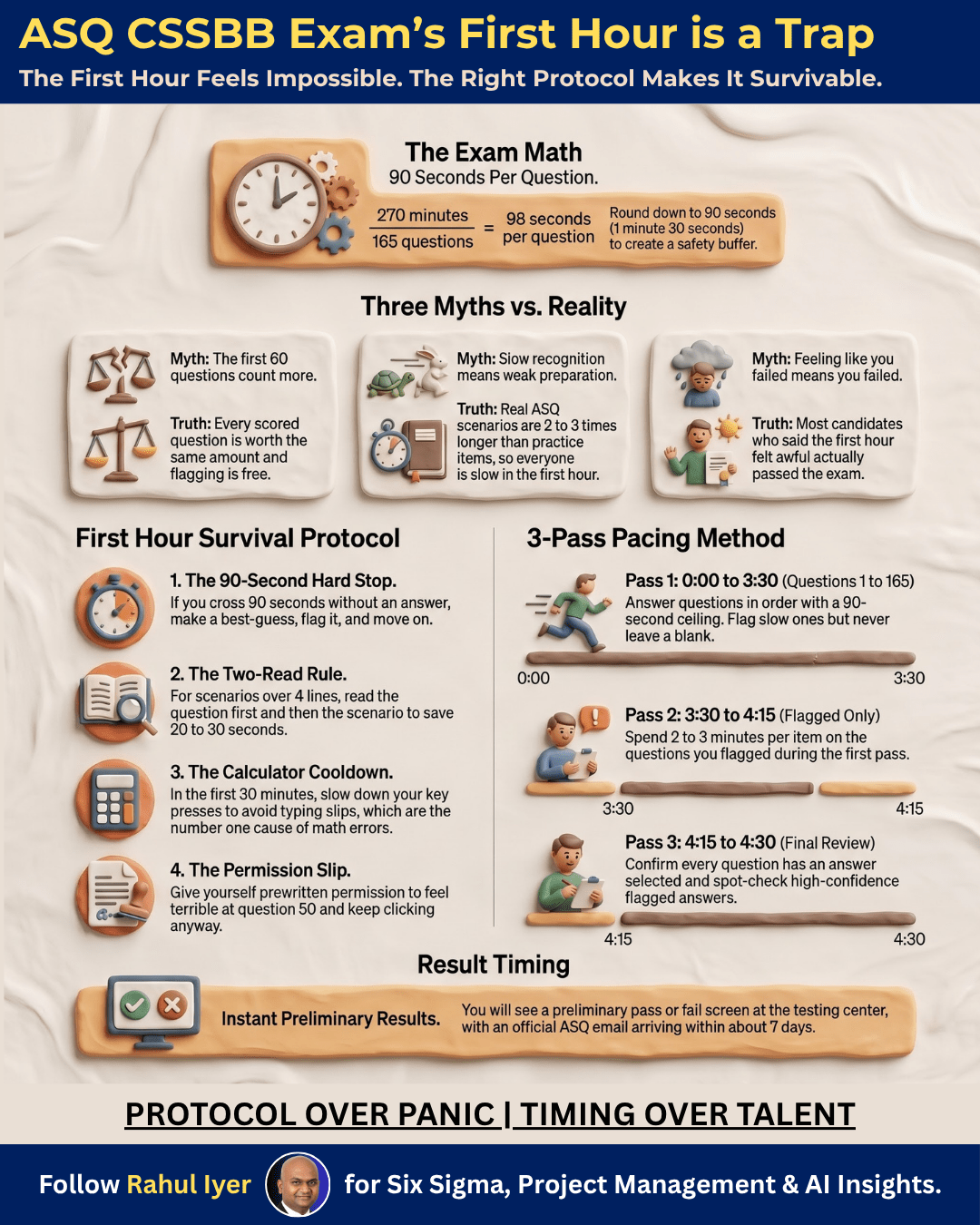
Quick math first. 270 minutes divided by 165 questions equals 98 seconds per question, or 1 minute 38 seconds. We round that down to 90 seconds (1 minute 30 seconds) on purpose, to leave a buffer for the long calculation questions later. The CSSBB first 60 questions are where that buffer is built or burned.
Four moves. In order.
- Move 1: The 90-Second Hard Stop. Write the number 90 on your scratch sheet before you start. That is your ceiling for every one of the CSSBB first 60 questions. Cross 90 seconds without a real answer? Pick your best guess so the question is not blank, flag it, move on.
- Move 2: The Two-Read Rule. For any scenario longer than four lines, read the actual question first, then the scenario. It feels backwards. It saves you 20 to 30 seconds per item.
- Move 3: The Calculator Cooldown. When a math question lands in the first 30 minutes, slow down on the keys, not the thinking. Cold fingers hit the wrong number, and that is the number-one math mistake in the first hour.
- Move 4: The Permission Slip. Give yourself permission, in writing if it helps, to feel terrible at question 50 and keep going anyway. The candidates who pass are not the ones who never panic. They are the ones who panic and keep clicking.
The AIGPE® 3-Pass Pacing Method
The Survival Protocol gets you through the wall. The 3-Pass Pacing Method gets you to the finish line.
| Pass | What you cover | Time budget | What you do |
|---|---|---|---|
| Pass 1 | All 165 questions in order | 0:00 to 3:30 (210 min) | Answer everything you can in under 90 seconds. Flag anything slower. Always pick a best guess before flagging. |
| Pass 2 | Only the flagged questions | 3:30 to 4:15 (45 min) | Go back to your flags. 2 to 3 minutes per item now that you know how many are left. |
| Pass 3 | Final review | 4:15 to 4:30 (15 min) | Confirm every one of the 165 questions has an answer selected. Spot-check the high-confidence flagged answers you changed in Pass 2. |
That schedule leaves you a real 15-minute buffer at the end. Almost every CSSBB failure I have reviewed in the last five years had at least eight questions left blank or rushed in the final 90 seconds.
Where the CSSBB sits in the Six Sigma belt ladder
The CSSBB first 60 questions test something different from every belt below it.
| Belt | What it teaches | Course size | Question type |
|---|---|---|---|
| Six Sigma White Belt | Vocabulary, Seven Basic Tools of Quality, DMAIC overview | 2 hrs, 35 lectures | Recall |
| Six Sigma Yellow Belt | 40+ tools, Minitab graphics, root cause analysis | 6.5 hrs, 216 lectures | Recognition |
| Six Sigma Green Belt | 100+ tools, Minitab mastery, runs DMAIC projects | 16.5 hrs, 503 lectures | Application |
| Six Sigma Black Belt | Leads enterprise programs, mentors Green Belts, deep statistics | Three-phase Black Belt program | Judgment |
Yellow Belt and Green Belt reward recognition, which is fast. CSSBB rewards judgment, which is slow. Your brain does not switch gears on demand. That is exactly why the CSSBB first 60 questions hit hardest, before you have settled into the new mode.
What the protocol actually changes
Quick reality check on the result. After you submit at the testing center, you see a preliminary pass or fail message right away, just like PMP. The official ASQ email lands within about 7 days.
Here is the truth about CSSBB candidates who fail. They almost never fail because they did not know the material. They fail because they panicked at question 47, surrendered ten questions they could have answered, and walked out replaying the wrong moment. Without a protocol, the CSSBB first 60 questions decide the exam, not at the screen, but in the moments you abandon work you could have done.
Use the AIGPE® First Hour Survival Protocol and the CSSBB first 60 questions stop being a panic trap and start being a procedure. The 90-Second Hard Stop keeps your inventory moving. The Two-Read Rule saves you 30 seconds on every long scenario. The Calculator Cooldown takes typing slips off the table. The Permission Slip stops the panic from running the show. Layer the AIGPE® 3-Pass Pacing Method on top and you protect a real 15-minute buffer at the end. Walk in with this and the CSSBB first 60 questions stop being a wall. They become a doorway.
Frequently asked questions
Is the CSSBB exam adaptive like the GMAT?
No. The CSSBB is fixed-form. Every candidate gets 165 questions, every scored question is worth the same, and the questions do not adjust to your performance. The CSSBB first 60 questions feel harder because of question clustering and stress, not adaptive scoring.
How many questions can I flag on the CSSBB without failing?
There is no flagging limit. Flagging is just a navigation tool, not a scoring penalty. Strong candidates routinely flag 25 to 40 items in Pass 1 and clean them up in Pass 2. Always pick a best guess before flagging.
When do I find out if I passed the CSSBB?
You see a preliminary pass or fail screen right after you submit, the same way PMP works. The official ASQ email follows within about 7 days. For the official process, see the ASQ Six Sigma Black Belt page.
Join the conversation on LinkedIn
I posted the short version of this CSSBB first 60 questions story on LinkedIn this morning. The comment thread is filling up with candidates sharing the question number where their own panic peaked. If you have sat for the CSSBB, drop your number. If you sit soon, read the comments before you go. Find the post here: LinkedIn.
Your next step and the AIGPE® CSSBB Masterclass waitlist
The CSSBB first 60 questions are not the exam. They are the test before the exam. Walk in with a protocol and the wall becomes a doorway.
The AIGPE® CSSBB Masterclass is in the final build phase. Here is what is actually being built, no fluff:
- Three opening sections: exam prerequisites, exam mechanics and strategy, and the ASQ Core Exam Philosophies that decide which answer is “best.”
- Nine Pillars mirroring the ASQ Body of Knowledge, one pillar at a time.
- 184 scenario-based practice questions, each with a full breakdown of why the right answer is right and why each wrong answer is wrong.
- Named exam traps you will see on the real test (Local Optimization, Complexity, Immediate Rollout, Tight Tolerance, and more).
- The Three-Bucket question-sorting system, the Momentum Rule, and the AIGPE® First Hour Survival Protocol you just read.
Join the waitlist: aigproexcellence.kit.com/210fb07003.
While you wait, grab the Six Sigma AI Playbook, our free PDF with 50 prompts for executing your Six Sigma projects with AI. To map the rest of your career path, the AIGPE® portfolio carries the full ladder: White Belt, Yellow Belt, Green Belt, and Black Belt, with professional-credit values assigned by activity. Confirm current SHRM PDC values in the SHRM provider directory before enrolling.
For the foundation read, see ASQ CSSBB Study Hours: The Ultimate 98-Second Rule, which pairs with this CSSBB first 60 questions playbook.
If you have sat for the CSSBB, what was your question number when the panic peaked? Drop it in the comments or in the LinkedIn thread, and tag a friend who is staring down the CSSBB first 60 questions next month.
About the Author
Rahul G. Iyer is an AI-Driven Transformation Leader and Founder and CEO of AIGPE®. With more than 23 years of experience and 700+ personally executed Six Sigma, process-improvement, Operational Excellence and transformation projects, he turns practical expertise into professional courses, corporate training, private AI coaching, keynotes and The M3 Podcast Show. His learning content has generated 1M+ cumulative learner enrollments and reached 198 countries.