
Google's AI Evolution: The Ultimate 2026 Complete Guide
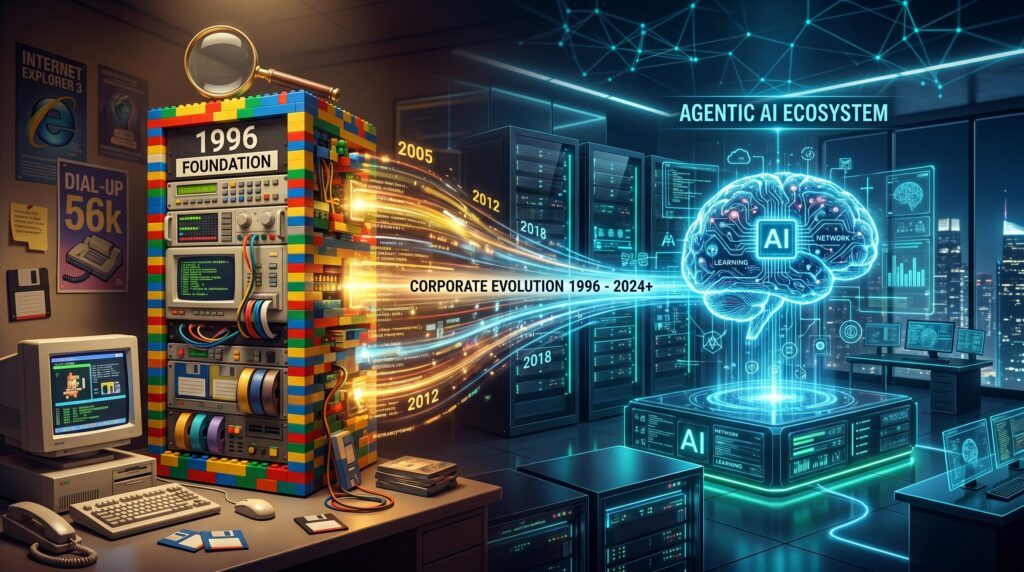
Table of Contents
Prologue
If you use the internet today, you interact with Google. It is that simple. However, the company we know today is completely different from the search engine we used twenty years ago.
The story of Google’s AI evolution is one of the most incredible corporate transformations in modern history. Over nearly three decades, the company has survived massive technological shifts and intense competitive threats.
To truly understand this journey, we cannot just look at Google as a simple search bar. The organization has systematically transitioned from indexing basic web pages to pioneering predictive models, and ultimately, to deploying autonomous artificial intelligence agents across the globe.
Let us sit down and map out exactly how Google evolved from a college research project into a global AI empire across four distinct eras.
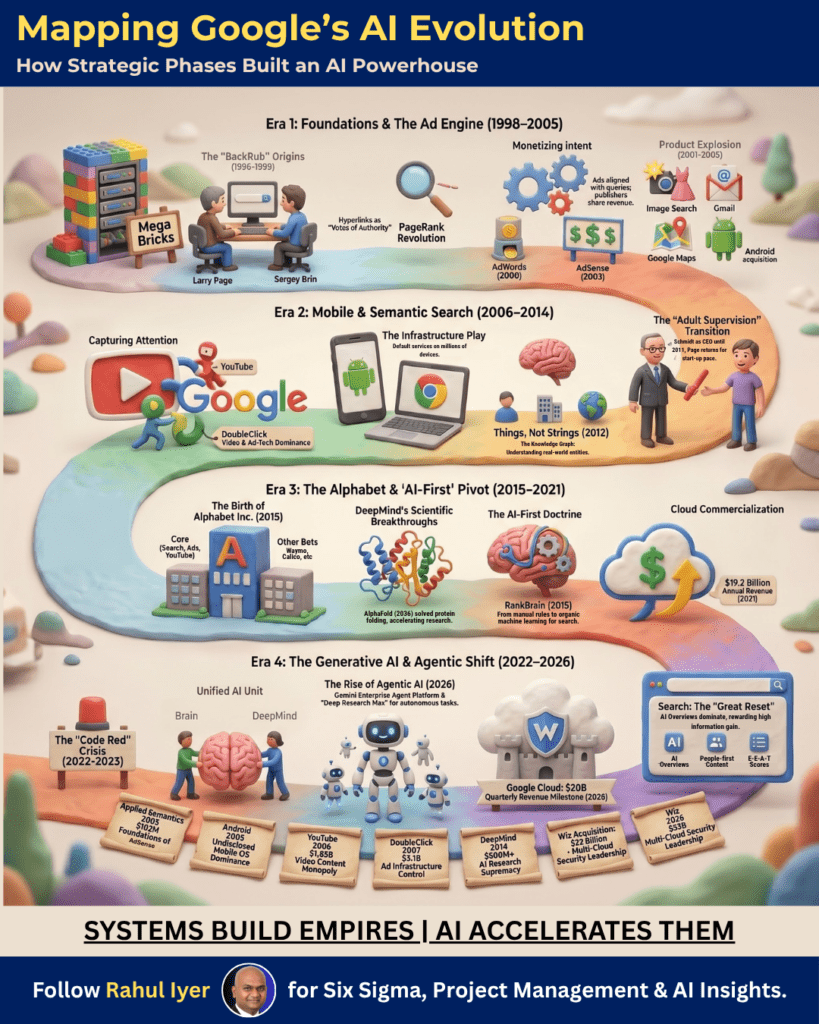
Era 1: The Foundations and the Ad Engine (1998 to 2005)
Before Google officially launched in September 1998, early search engines were clunky and easily manipulated. They simply counted how many times a keyword appeared on a web page.
The real breakthrough began in 1996 as a Stanford University research project known as “BackRub”. Developed by Larry Page and Sergey Brin, the team literally operated from custom-made server enclosures built with LEGO knock-off bricks. From this humble setup, they created a radically different algorithm called PageRank.
PageRank completely revolutionized the internet by treating hyperlinks as votes of confidence. By analyzing the quality and authority of linking pages, Google achieved unparalleled search relevance. This mathematical supremacy rapidly drove massive consumer adoption.
To turn this brilliant tool into a real business, Google launched a series of strategic products:
AdWords (2000): Google introduced a scalable, self-serve, auction-based system for placing highly relevant text advertisements alongside search results.
Applied Semantics (2003): This $102 million purchase provided the advanced semantic software used to launch AdSense. This allowed independent publishers to place relevant Google ads directly on their own websites.
Gmail (2004) and Google Maps (2005): These launches expanded the company into personal communications and digitized physical geography.
Android (2005): Anticipating the eventual shift away from desktop computers, Google quietly acquired a small mobile operating system startup.
During this explosive growth, veteran technology executive Eric Schmidt was appointed CEO in 2001 to provide formal, process-oriented leadership and adult supervision.
Are you ready to see how they took over your mobile phone next?
Era 2: Mobile Dominance and Semantic Search (2006 to 2014)
Having secured a virtual monopoly in desktop search, Google entered a phase of aggressive expansion defined by the mobile computing revolution.
The leadership team recognized early that the future of the internet lay in rich media and mobile ecosystems. To capture this massive shift, Google executed two of the most significant acquisitions in digital history. In 2006, they acquired the video-sharing platform YouTube for $1.65 billion. The very next year, Google purchased DoubleClick for $3.1 billion. This bold move cemented their absolute dominance in programmatic ad serving and enterprise display advertising.
Simultaneously, Google launched the Chrome web browser and the open-source Android Operating System in 2008. Offering Android for free ensured that Google Search, Google Maps, and YouTube remained the inescapable default applications on billions of global mobile devices.
Behind the scenes, the core search product also underwent a fundamental architectural shift. To combat manipulative spam tactics, Google released severe algorithm updates like Panda in 2011 and Penguin in 2012.
However, the most profound change occurred in 2012 with the launch of the Google Knowledge Graph. Moving far beyond simple keyword matching, the Knowledge Graph introduced semantic, entity-based search. By finally understanding the real-world relationships between entities, Google transitioned from an information retrieval system that provided links into an answering engine that provided synthesized facts.
But what happens when a search engine decides it wants to cure diseases and build self-driving cars?
Era 3: Alphabet and the AI-First Pivot (2015 to 2021)
By 2015, Google was generating billions in ad revenue while investing heavily in experimental “moonshot” projects like autonomous vehicles and life sciences. To manage this sprawling complexity and provide financial transparency to Wall Street, the company created a new overarching holding company named Alphabet Inc..
This massive restructuring explicitly separated Google’s highly profitable internet businesses from its speculative ventures. These experimental businesses were spun out into independent subsidiaries like Waymo and Calico. Sundar Pichai was elevated to CEO of Google, while Larry Page became CEO of Alphabet.
Under Pichai’s new leadership, the company formally declared a strategic shift to an “AI-first” operational doctrine. This pivot was deeply felt in the core search algorithm with the deployment of RankBrain in 2015. RankBrain was a sophisticated machine learning system capable of interpreting complex queries by understanding underlying concepts rather than relying on exact lexical matching.
This era was also defined by profound scientific breakthroughs from DeepMind, a premier AI research laboratory acquired in 2014. In November 2020, DeepMind released AlphaFold. This incredible AI system accurately predicted 3D protein structures, solving a 50-year-old grand challenge in biology and accelerating global research into diseases like Alzheimer’s and cancer.
Table: Key Strategic Acquisitions Fueling Google's AI Evolution
| Acquisition Target | Approximate Date | Approximate Value | Strategic Impact |
|---|---|---|---|
| Applied Semantics | April 2003 | $102 Million | Provided the foundational contextual technology for AdSense. |
| Android | August 2005 | Undisclosed | Ensured mobile ecosystem dominance against closed systems. |
| YouTube | November 2006 | $1.65 Billion | Established a monopoly over user-generated video content. |
| DoubleClick | April 2007 | $3.1 Billion | Cemented dominance in enterprise display ad technology. |
| DeepMind | 2014 | $500 Million+ | Secured top-tier artificial intelligence research supremacy. |
| Wiz | March 2026 | $32 Billion | Secured multi-cloud infrastructure and global cybersecurity leadership. |
(Note: All data in this table is derived from verified corporate history records.)
How did a sudden competitive threat change everything overnight?
Era 4: Generative AI and the Agentic Shift (2022 to 2026)
The most recent era of Google’s AI evolution represents a period of extreme volatility, intense panic, and rapid innovation. In late 2022, the viral success of OpenAI’s ChatGPT prompted CEO Sundar Pichai to issue a company-wide “Code Red”. This high-level emergency directive forcefully reoriented Google to counter the generative AI threat.
To eliminate bureaucratic friction and pool intellectual resources, Alphabet executed a historic consolidation in April 2023. They merged Google Brain and DeepMind into a single, highly focused entity called Google DeepMind. To fund enormous AI infrastructure budgets, the company also initiated continuous waves of structural delayering. They ruthlessly removed layers of middle management to create a flatter, faster organization.
By early 2026, Google’s product strategy decisively shifted toward autonomous “Agentic AI”. The company launched the Gemini Enterprise Agent Platform, allowing technical teams to build autonomous AI agents capable of executing complex, multi-step business processes. Furthermore, Google released “Deep Research Max,” an advanced agent built on Gemini 3.1 Pro that executes long-horizon research workflows entirely without human intervention.
The core search engine also experienced a massive “Great Reset” in March 2026. The modern search algorithm now systematically penalizes manipulative SEO practices and heavily filters generic AI-generated text. Instead, it exclusively rewards “people-first” content that demonstrates strict adherence to Experience, Expertise, Authoritativeness, and Trust guidelines.
These powerful enterprise AI solutions dramatically accelerated Google Cloud’s financial performance. In the first quarter of 2026, Google Cloud surpassed a historic $20 billion quarterly revenue milestone. To protect this massive vault of enterprise data, Google completed the $32 billion acquisition of cloud cybersecurity firm Wiz in March 2026. This embedded a proprietary security layer deeply within the operational ecosystems of its primary cloud competitors.
The Final Takeaway on Corporate Transformation
The 28-year history of Google is a definitive, masterclass case study. It shows exactly how an organization can successfully navigate extinction-level technological paradigms.
Today, Google is no longer just a consumer search engine connecting users to blue hypertext links. It has irrevocably evolved into a global AI and cloud computing conglomerate. The financial growth engine of the company has decisively shifted toward the B2B enterprise sector. They are now deploying autonomous agents capable of independently executing your most complex corporate workflows.
Google’s evolutionary arc from a dormant university project housed in LEGO bricks to the foundational infrastructural layer of the global AI economy is absolutely complete.
Master Process Excellence Today
As systems build empires and AI accelerates them, the need for structured, human-led problem-solving has never been greater. You cannot automate a broken process. If you want to build the operational excellence required to navigate the modern digital economy, it is time to master your foundational skills with AIGPE®.
Start your journey today with our globally recognized Lean Six Sigma programs. Learn to optimize flow, eliminate waste, and prepare your business for the Agentic AI future:
Master the Six Sigma Analytics Track:
About the Author
Rahul G. Iyer is an AI-Driven Transformation Leader and Founder and CEO of AIGPE®. With more than 23 years of experience and 700+ personally executed Six Sigma, process-improvement, Operational Excellence and transformation projects, he turns practical expertise into professional courses, corporate training, private AI coaching, keynotes and The M3 Podcast Show. His learning content has generated 1M+ cumulative learner enrollments and reached 198 countries.