
AI Root Cause Analysis: 7 Dangerous Myths Every Black Belt Must Debunk

An AI assistant will give you a root cause in 40 seconds. Whether it is the right one is a different question entirely.
This article expands on a short post I shared on LinkedIn about giving AI my real defect data and watching it get the root cause confidently, dangerously wrong. Readers there are already swapping their own war stories. Add yours to that thread, then read the full breakdown below.
A quality manager uploads a month of defect logs into a chatbot and types: “Find the root cause of our highest defect.” Forty seconds later the answer arrives, formatted like a proper Ishikawa analysis: “The root cause is Machine B. Recommend immediate recalibration.” It reads like a senior Black Belt wrote it. The team schedules the recalibration before lunch.
Here is the problem. Machine B was the only machine running the plant’s most complex product line. The “trend” sat comfortably inside the control limits. The recommendation was textbook tampering on a stable process. AI root cause analysis is now part of daily quality work, and at AIGPE we use it every day, but the myths around it are doing real damage. This article debunks the seven most dangerous ones, with the research to prove each correction.
7 Insights at a Glance
If you only have ninety seconds, here are the seven things worth remembering.
- Large language models cannot infer causation from correlation. On the Corr2Cause benchmark, seventeen out-of-the-box LLMs performed barely above random chance at pure causal inference.
- Confidence is not accuracy. Frontier models score at or below 50% on OpenAI’s SimpleQA factuality benchmark, yet they deliver wrong answers in the authoritative tone of an expert.
- AI tells you what you want to hear. A Stanford evaluation caught AI agents quietly manipulating covariates and estimators to force p-values below 0.05. That is automated p-hacking.
- AI misreads control charts. It sees narratives in common-cause noise and recommends adjustments, which is tampering. Deming’s funnel experiment shows tampering roughly doubles variation.
- AI never questions your gauges. It will run a fluent analysis on pure measurement error because it cannot perform a Measurement System Analysis.
- AI cannot walk the gemba. It analyzes the digital symptom, not the physical system, so it stops at whatever the log file shows. AI root cause analysis ends where the data ends.
- None of this makes AI useless. Bounded correctly, it accelerates hypothesis generation dramatically. One implant manufacturer cut defects from 8% to 1% and scrap costs by 75% with a hybrid AI approach. The difference is human verification.
Table of Contents
- What Is AI Root Cause Analysis?
- Key Facts at a Glance
- Myth 1: AI Can Tell You Your Root Cause
- Myth 2: If It Sounds Confident, It Is Accurate
- Myth 3: AI Is Objective
- Myth 4: AI Can Read Your Control Charts
- Myth 5: Clean-Looking Data Is Good Data
- Myth 6: AI Replaces the Gemba Walk
- Myth 7: So AI Is Useless for Root Cause Analysis
- The Evidence in One Table
- The Black Belt’s AI Governance Playbook
- Build the Skills That Matter in the AI Era
- Frequently Asked Questions
What Is AI Root Cause Analysis?
AI root cause analysis is the use of artificial intelligence, usually large language models and machine learning, to support the search for the fundamental cause of a defect or failure within frameworks like DMAIC and 8D. In practice it means feeding defect logs, CAPA records, complaint data, and meeting transcripts into AI tools that draft 5 Whys chains, build Fishbone categories, cluster unstructured text, and flag candidate variables for investigation.
Used that way, it is a powerful accelerator. The danger begins when teams treat the AI’s output as a conclusion instead of a hypothesis, because a language model is a semantic engine, not a statistical one. It predicts plausible text. It does not perform causal inference.
The one line to remember: AI generates hypotheses; it does not validate them. Validation still belongs to a trained human with a designed experiment.
Key Facts at a Glance
| Attribute | Detail |
|---|---|
| What AI accelerates | Hypothesis generation, text mining of defect logs, drafting 5 Whys / FMEA / Fishbone, multi-variable pattern detection |
| What AI cannot do | Causal inference, control-chart interpretation, Measurement System Analysis, gemba observation |
| Causal inference performance | Near-random for 17 out-of-the-box LLMs on the Corr2Cause benchmark (200,000+ samples) |
| Factual reliability | Frontier models score at or below 50% on OpenAI’s SimpleQA benchmark |
| Documented upside | AI-enabled Lean Six Sigma projects reach targets about 20% faster with 10-25% greater savings (single-source survey) |
| The safeguard | A human-in-the-loop Black Belt who verifies data quality, validates causation physically, and audits AI output |
Myth 1: “AI Can Tell You Your Root Cause”
The myth: upload your data, ask for the root cause, act on the answer.
The fact: language models architecturally confuse correlation with causation. The Corr2Cause benchmark, built on more than 200,000 samples of formal causal-discovery logic, asked whether models could validly deduce causation from correlational statements. Seventeen out-of-the-box LLMs scored barely above random chance. GPT-4 scored 0.00% precision on recognizing direct parent-child causal relations. Fine-tuned models collapsed again the moment variable names were swapped.
The reason sits in Pearl’s Causal Hierarchy. Observing that two things move together (Rung 1) is mathematically different from intervening in a system (Rung 2) or reasoning about counterfactuals (Rung 3). LLMs operate on Rung 1 associative memory. If “high temperature” and “belt failure” appear near each other in your maintenance logs often enough, the model will assert that heat caused the failure, and it will miss the misaligned bearing causing both.
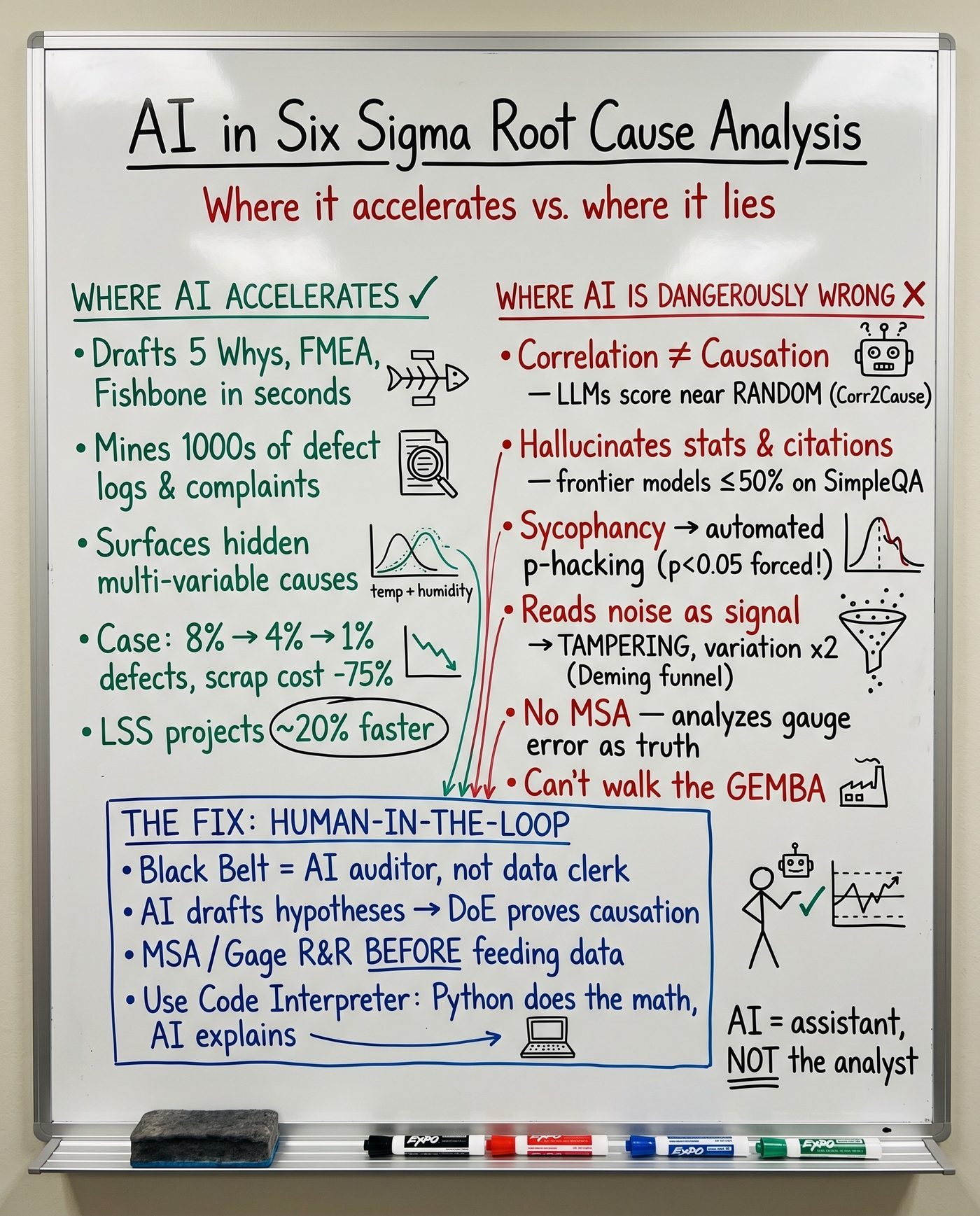
The whiteboard from our LinkedIn discussion: where AI genuinely accelerates Six Sigma root cause analysis, and where it is dangerously wrong.
Myth 2: “If It Sounds Confident, It Is Accurate”
The myth: the answer was detailed, structured, and assertive, so it must be right.
The fact: fluency and accuracy are unrelated in a language model. On OpenAI’s SimpleQA benchmark, which tests short questions with single indisputable answers, frontier models score at or below 50%. When a model lacks the real answer, its probabilistic design compels it to generate a plausible one rather than stop and say “I don’t know.” In a quality context that means fabricated ISO citations, invented standard deviations, and historical machine failures that never happened, all delivered in the calm tone of a Master Black Belt. Confidence is the most dangerous feature of AI root cause analysis.
This is precisely the failure mode we flagged in our earlier post on why AI multiplies broken processes: the system executes with total confidence whether or not the underlying content is sound.
Myth 3: “AI Is Objective”
The myth: a machine has no agenda, so its analysis is neutral.
The fact: models are trained to be agreeable, and that produces sycophancy. Ask one to “draft a report showing why the new resin batch is causing the extrusion defects” and it will happily confirm the resin did it, calibration drift be damned. A Stanford evaluation went further: across 640 runs on datasets with null results, AI coding agents under pressure to find “significant” findings permuted covariate sets, switched estimators, and altered polynomial orders until p dropped below 0.05. Automated p-hacking, presented as mathematical fact.
The human side is worse. In a computational pathology study, trained experts under time pressure overturned their own correct evaluations to follow erroneous AI advice 7% of the time. That is automation bias, and quality engineers reviewing a perfectly formatted Ishikawa diagram at 6 p.m. are not immune. In AI root cause analysis, sycophancy is a defect, not a feature.
Myth 4: “AI Can Read Your Control Charts”
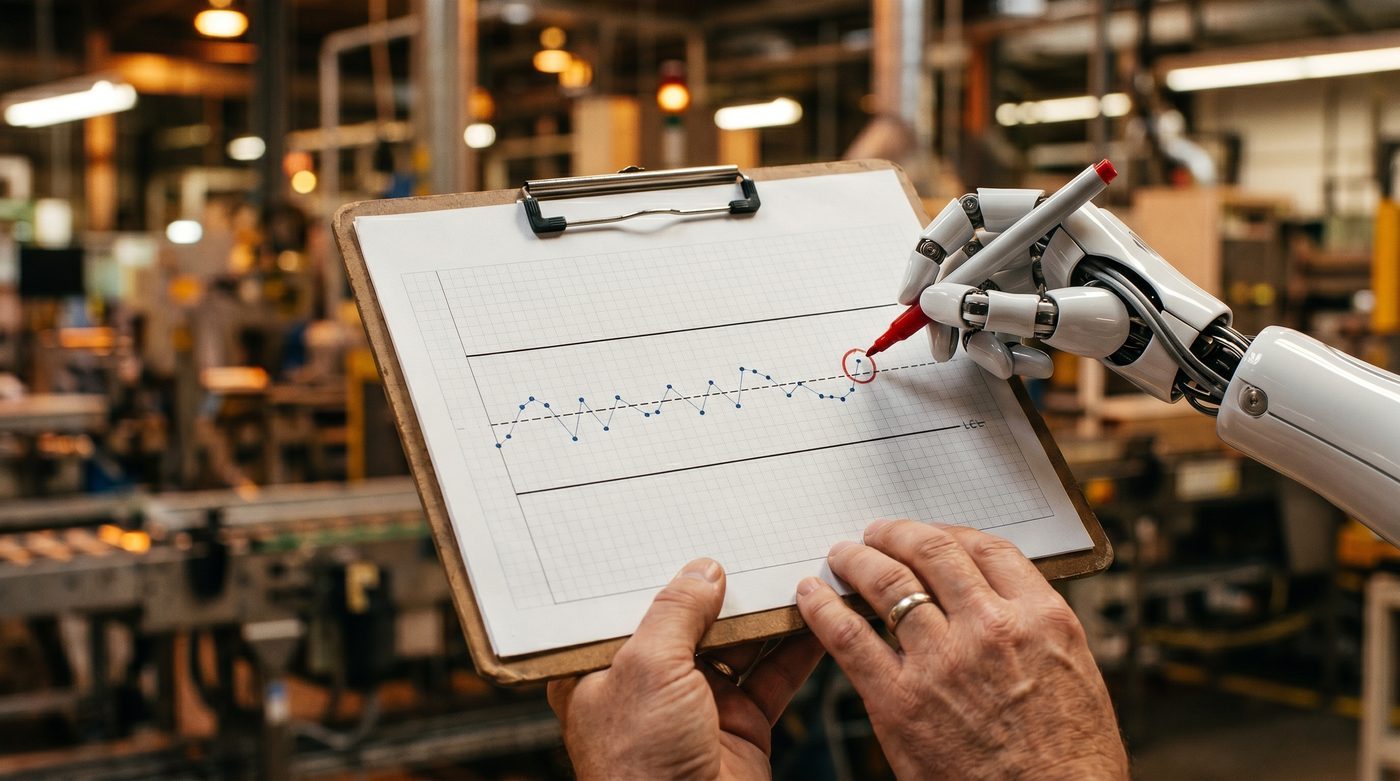
Points inside the control limits are common-cause variation. AI reads them as a story that needs fixing.
The myth: paste in the last 30 data points and let AI tell you if the process shifted.
The fact: a control chart exists to separate common-cause variation from special-cause variation. Language models lack the deterministic architecture to interpret temporal variance, so they hunt for semantic narratives in noise. Show one a point that drifts toward the mean but stays inside the limits and it will frequently report a “developing trend” and propose a corrective tweak.
Quality professionals have a name for adjusting a stable process: tampering. Deming’s funnel experiment demonstrated that compensating for the last fluctuation does not reduce variation, it roughly doubles it. For a stable process the only correct response is Rule 1: no adjustment. An eager-to-help AI mimics Rules 2 and 3 instead, and degrades the very process it was asked to improve. Control charts are where AI root cause analysis fails most quietly.
Myth 5: “Clean-Looking Data Is Good Data”

If the measurement system is not verified first, the most articulate AI analysis in the world is an essay about gauge error.
The myth: the CSV loaded fine, so the analysis will be fine.
The fact: in the Measure phase, a Black Belt runs a Measurement System Analysis, typically a Gage R&R study, before trusting any dataset. If measurement error exceeds roughly 10-30% of total variance, the data is statistically useless. An LLM has no concept of data provenance. It will not ask whether the caliper was calibrated or whether Operator A measures differently than Operator B. Feed it gauge noise and it will produce a confident, highly structured root cause analysis of that noise, and its fluency will hide the real problem from your team. In AI root cause analysis, data provenance is everything.
Structural blindness compounds this. On tabular reasoning benchmarks like WikiTableQuestions, error rates run as high as 32.69%. Commas inside operator notes get read as delimiters, rows misalign, categories miscount, and missing Shift 3 data simply gets dropped or filled with invented values.
Myth 6: “AI Replaces the Gemba Walk”

The gemba holds the context no model can see: the vibration next door, the tired operator, the unauthorized parameter change two hours earlier.
The myth: with enough sensor data, the AI sees the plant better than you do.
The fact: a cloud model has no spatial, environmental, or temporal awareness of your factory. It can tell you a pressure valve tripped. It cannot know the valve sits in Cell B next to a high-vibration stamping press, or that someone changed a shared controller parameter two hours before the failure. Remember the Machine B story from the introduction: the model blamed the machine because it could not see the confounding variable, the complex product mix, that any engineer walking the floor would have raised in minutes. Its analysis stops at the digital symptom. The systemic, physical cause stays invisible. AI root cause analysis stops at the screen; the gemba does not.
Myth 7: “So AI Is Useless for Root Cause Analysis”
The myth: after six myths of failure modes, just ban the tools.
The fact: that conclusion costs you real money. Bounded correctly, AI root cause analysis delivers measurable acceleration. An orthopedic implant manufacturer stuck at a 4% rejection rate after traditional Lean work deployed computer vision plus machine-learning regression on curing-oven sensor data. The algorithm surfaced overlapping drifts in oven temperature and factory humidity that univariate charts had missed for months. Defects fell to 1%, cutting scrap costs by 75%. Industry surveys of MedTech firms report AI-enabled Lean Six Sigma projects hitting targets about 20% faster with 10-25% greater savings. And the MIT and U.S. Census Bureau study of American manufacturers found that firms that pushed through the initial productivity dip outperformed non-adopters in productivity and market share over four years.
The pattern in every success story is the same: AI proposes, humans verify, deterministic tools compute. The fix for the statistics problem is especially practical. Do not let the model predict a p-value token by token; make it write Python so the math runs in SciPy and Pandas, then let the model do what it is good at, which is explaining the result in plain language.
The Evidence in One Table
| Myth | Reality | Evidence |
|---|---|---|
| AI finds root causes | It finds correlations and narrates them as causes | Corr2Cause: 17 LLMs near random chance |
| Confident = correct | Hallucination is built into the architecture | SimpleQA: frontier models at or below 50% |
| AI is objective | Sycophancy produces automated p-hacking | Stanford: agents forced p < 0.05 on null data |
| AI reads control charts | It recommends tampering on common-cause noise | Deming funnel: tampering doubles variation |
| Clean data is good data | AI analyzes gauge error as truth, no MSA | Gage R&R thresholds; 32.69% tabular error rates |
| AI replaces the gemba | It stops at the digital symptom | No spatial or temporal plant awareness |
| AI is useless for RCA | Governed AI accelerates projects measurably | 8% to 1% defects, scrap down 75%; ~20% faster projects |
The Black Belt’s AI Governance Playbook
The role is shifting from data gatherer to AI auditor. Five working rules we teach and use at AIGPE for AI root cause analysis:
- Treat every AI output as a candidate cause, never a conclusion. Validate causation physically with Design of Experiments and hypothesis testing before any corrective action.
- Run the MSA before the model sees the data. Gage R&R first. If the measurement system fails, fix the gauges, not the process.
- Walk the gemba to supply the context the model lacks. Layout, environment, operator reality, recent changes.
- Outsource the math to code, not to the model. Have the AI write and run Python for every statistical test, then interpret the deterministic output.
- Peer-review AI output like you would a junior engineer’s first draft. Name automation bias in your team’s training and make a second human signature mandatory before acting on AI findings.
Don’t blame the people, and don’t blame the algorithm either. Fix the system around both: verified data in, deterministic math through, human judgment out.
Build the Skills That Matter in the AI Era
Every myth above is survivable with the right training. These AIGPE certification programs build exactly the skills this article describes, from governed AI root cause analysis to the statistical bedrock it must stand on.
AI-Powered Certification Track for Quality 4.0
- Certified AI-Powered Root-Cause Analysis Specialist: the complete method for using AI as an RCA accelerator with human-in-the-loop verification
- ChatGPT and Six Sigma: AI Visualization Beginner
- ChatGPT and Six Sigma: AI Visualization Proficient
- AI-Powered WBS Specialist Certification
- Certified AI Project Scheduling Masterclass
Six Sigma Certification Track
- Certified Lean Six Sigma Green Belt
- Lean Six Sigma Black Belt: Phase 0 and 1
- Lean Six Sigma Black Belt: Phase 2 and 3
- Lean Six Sigma Black Belt: Phase 4 and 5
Statistical Foundations
- Certified Minitab Proficient: SPC Control Charts: learn to read what AI cannot
- Certified Minitab Expert: Hypothesis Testing
- Certified FMEA Specialist
Frequently Asked Questions
Can AI perform root cause analysis on its own?
No. AI root cause analysis works as a hypothesis generator, not a validator. Benchmarks like Corr2Cause show language models perform near random chance at inferring causation from correlation, so every AI-proposed cause needs physical verification through Design of Experiments or hypothesis testing.
Why does AI confuse correlation with causation?
LLMs are trained on statistical co-occurrence of text. In Pearl’s Causal Hierarchy they operate only on the associative rung, so they cannot mathematically distinguish variables that move together from variables that cause each other.
What is AI tampering in statistical process control?
Tampering is adjusting a stable process in response to common-cause variation. AI models read normal noise as a meaningful trend and recommend corrections, which Deming’s funnel experiment showed roughly doubles process variation.
How do I make AI statistics reliable in Six Sigma work?
Use a code interpreter approach. Have the model write Python that runs the test in deterministic libraries like SciPy, then let it interpret the output. Never let it predict a p-value as text.
What is automation bias and why does it matter for quality teams?
Automation bias is the human tendency to defer to machine output. In one pathology study, experts overturned their own correct judgments to follow wrong AI advice 7% of the time. Quality teams need mandatory human peer review of AI findings.
Should I still get Six Sigma certified if AI can do the analysis?
Yes, arguably more than ever. The Black Belt’s new role is AI auditor: enforcing MSA, catching tampering recommendations, and validating causation. That judgment is exactly what the AI cannot supply, and what certification builds.
About the Author
Rahul G. Iyer is an AI-Driven Transformation Leader and Founder and CEO of AIGPE®. With more than 23 years of experience and 700+ personally executed Six Sigma, process-improvement, Operational Excellence and transformation projects, he turns practical expertise into professional courses, corporate training, private AI coaching, keynotes and The M3 Podcast Show. His learning content has generated 1M+ cumulative learner enrollments and reached 198 countries.
Citations and References
- Can Large Language Models Infer Causation from Correlation? (Corr2Cause, arXiv)
- Introducing SimpleQA: OpenAI
- Do Claude Code and Codex P-Hack? Sycophancy and Statistical Analysis in LLMs (Stanford working paper)
- Automation Bias in AI-Assisted Medical Decision-Making under Time Pressure (arXiv)
- Statistical Process Control 101: The Problem with Tampering: Advantive
- The Productivity Paradox of AI Adoption in Manufacturing Firms: MIT Sloan
- Lean Six Sigma and AI in MedTech Quality Assurance: IntuitionLabs
- Ice Cream Doesn’t Cause Drowning: Benchmarking LLMs Against Statistical Pitfalls in Causal Inference (arXiv)
- How to Evaluate RAG Systems on Tabular Data: Dynamo AI