
Lean vs Six Sigma: 7 Essential Differences for Process Excellence

If you walk into almost any corporate boardroom today, you will hear professionals using the terms Lean and Six Sigma interchangeably. They treat them as the exact same methodology, assuming that any operational problem can be solved by simply mashing the two frameworks together.
That is a massive mistake.
Recently, I posted a short discussion on LinkedIn about this exact topic, highlighting how organizations constantly try to scale broken processes to meet tight deadlines. The response from the continuous improvement community was overwhelming. It became immediately clear that practitioners everywhere are dealing with this exact same confusion. (By the way, if we are not connected on LinkedIn yet, make sure to find me there so we can continue these daily conversations!)
The truth is, scaling a broken process just means you fail faster. You cannot fix variation with velocity.
Lean and Six Sigma are entirely different tools designed to solve entirely different problems. If you want to transform your organization and achieve true operational excellence, you must understand the exact differences between Lean vs Six Sigma.
What is the Core Difference Between Lean vs Six Sigma?
At the highest level, the debate of Lean vs Six Sigma comes down to your primary objective. Are you trying to make your process faster, or are you trying to make it flawless?
If your process is bogged down with delays, approvals, and massive backlogs, you need to deploy Lean. If your product is wildly inconsistent and you are failing to meet customer specifications, you need to deploy Six Sigma.
Let us break down exactly how these two distinct methodologies operate in the real world.
Lean is Your Process Eraser
When we evaluate Lean vs Six Sigma, Lean is entirely focused on flow efficiency. It acts as an eraser, stripping away anything that does not add direct value to the end customer.
The core philosophy of Lean is the relentless elimination of waste. In the manufacturing and service industries, we categorize this waste into eight distinct buckets (often remembered by the acronym TIMWOODS): Transport, Inventory, Motion, Waiting, Overproduction, Overprocessing, Defects, and Skills underutilized.
When a team deploys Lean, they are looking to achieve the following:
What it attacks: Operational waste and idle time.
How it works: Hunting down process bottlenecks and eliminating unnecessary human motion.
The tools you use: Value Stream Mapping (VSM), 5S Organization, and Kanban pull systems.
The final payoff: Improving your cycle time and clearing the path to create continuous, uninterrupted flow.
Lean is a highly visual, culturally driven framework. It empowers frontline workers to make immediate, common-sense changes on the factory floor or in the office. This grassroots approach to continuous flow is incredibly powerful because it turns every single employee into an active, daily problem solver.
Six Sigma is Your Process Microscope
While Lean focuses on speed, Six Sigma demands technical precision above all else. In the battle of Lean vs Six Sigma, Six Sigma is the heavy analytical machinery you bring in when a problem is complex, hidden, and deeply rooted in data.
Six Sigma operates on the belief that variation is the enemy of quality. If a process fluctuates, it produces defects. To fix this, Six Sigma relies on the rigorous, five-phase DMAIC roadmap: Define, Measure, Analyze, Improve, and Control.
When a team deploys Six Sigma, they are looking to achieve the following:
What it attacks: Process variation and standard deviation.
How it works: Deep statistical analysis to uncover non-obvious root causes.
The tools you use: Statistical Process Control (SPC), Design of Experiments (DOE), and Failure Mode and Effects Analysis (FMEA).
The final payoff: Eliminating defects and ensuring a stable, predictable yield of 99.99966%.
Because Six Sigma is heavily quantitative, it requires structured training and a formal hierarchy of experts. Instead of guessing in a boardroom, certified practitioners rely on deep, data-driven certainty to make high-stakes business decisions.
The AIGPE® Dual-Engine Synergy Framework
The true power of process improvement emerges when you stop looking at Lean vs Six Sigma as a competition and start treating them as complementary gears in the same machine.
To help corporate teams understand exactly when and how to deploy these methodologies together, I developed the AIGPE® Dual-Engine Synergy Framework.
I created this framework because I saw too many companies trying to optimize chaotic processes using advanced statistics, which is a complete waste of time. You must stabilize before you can optimize. The AIGPE® Dual-Engine Synergy Framework follows a strict, two-step operational sequence:
Engine 1: Stabilize with Lean. Before you ever open a statistical software program, you must use Lean to clean the process. You deploy 5S to organize the workspace, map the value stream to find massive bottlenecks, and remove all obvious physical waste. You create a baseline flow. You cannot measure a process that is constantly stopping and starting.
Engine 2: Optimize with Six Sigma. Once Lean has established a smooth, continuous flow, you turn on the Six Sigma engine. You begin collecting highly accurate data on your new, stable process. You use statistical analysis to find the hidden variations that are causing microscopic defects. You then lock the process in using rigid control charts.
By using Lean to clear the clutter and Six Sigma to refine the precision, you build an unstoppable, world-class operation.
The Lean vs Six Sigma Comparison Matrix
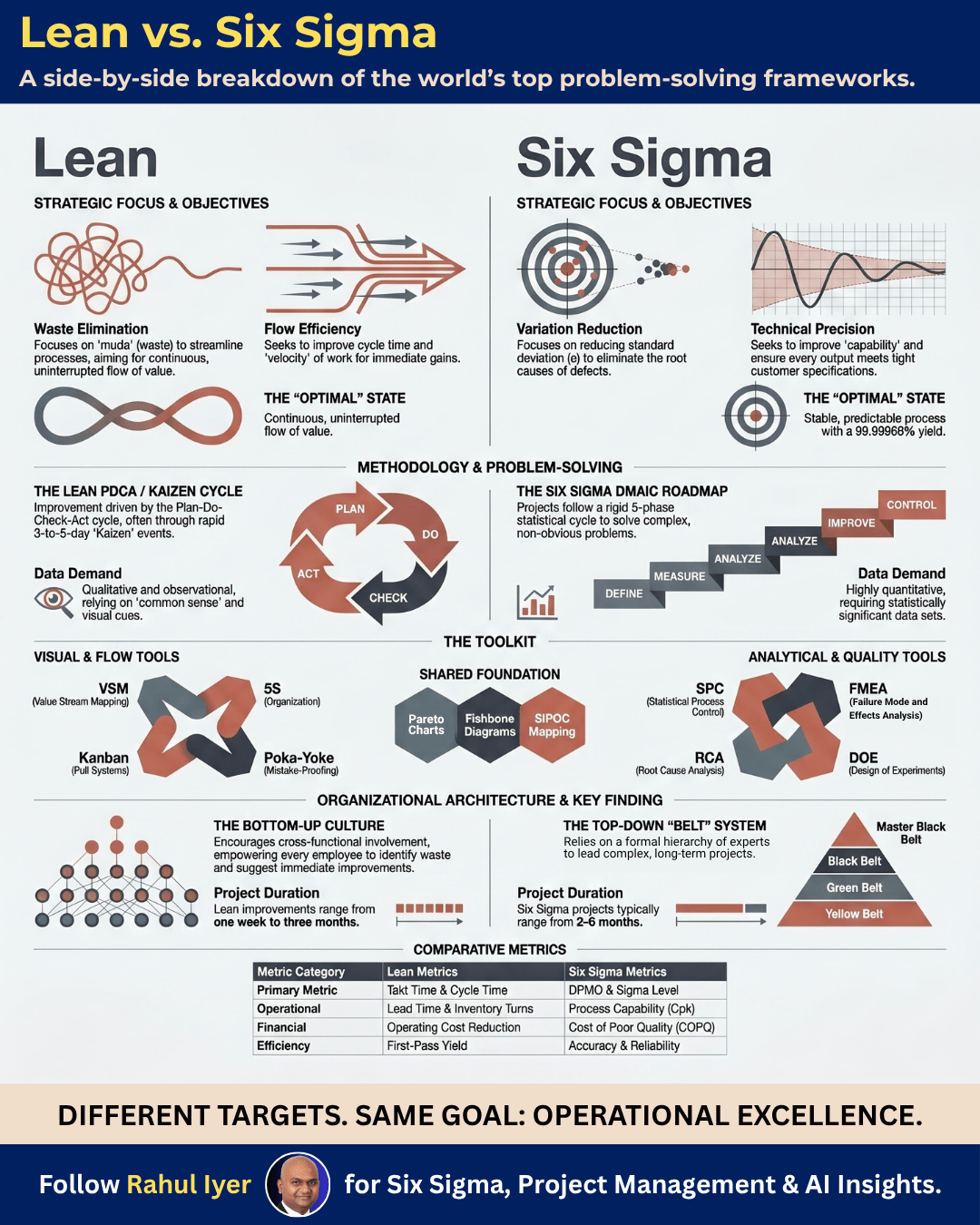
To make this even clearer, I have built a side-by-side comparison matrix. Review this table to instantly understand the strategic differences between the two frameworks.
| Core Category | Lean Methodology | Six Sigma Methodology |
|---|---|---|
| Primary Focus | Waste Elimination (Muda) | Variation Reduction |
| Ultimate Goal | Flow Efficiency and Speed | Technical Precision and Yield |
Data Demand | Qualitative, visual, and observational | Highly quantitative and statistical |
| Problem Solving Cycle | PDCA (Plan, Do, Check, Act) | DMAIC (Define, Measure, Analyze, Improve, Control) |
| Project Duration | Rapid Kaizen events (1 week to 3 months) | Complex, long-term projects (2 to 6 months) |
| Primary Metric | Takt Time and Cycle Time | DPMO and Sigma Level |
| Organizational Culture | Bottom-up empowerment | Top-down formal "Belt" hierarchy |
5 Essential Lean vs Six Sigma Questions: The Definitive FAQ
When continuous improvement professionals research Lean vs Six Sigma, the exact same critical questions consistently arise. To provide absolute clarity, here are the top five definitive expert answers regarding these two frameworks.
1. Should I learn Lean or Six Sigma first?
There is a definitive sequence you must follow, and it removes all the guesswork. You should absolutely start with Six Sigma. I designed the globally recognized AIGPE® Quality Champion Roadmap to give professionals a completely frictionless path to success. Your journey must always begin by mastering structured problem-solving. By starting with your Six Sigma White Belt, you build the essential analytical foundation required to understand how a process truly works. Once that structured foundation is locked in, you immediately layer on Lean Specialist training to accelerate your speed. Do not overcomplicate your career path. Start the Six Sigma track today to build your analytical baseline, and then add Lean to make your execution unstoppable.
2. Can you use Lean vs Six Sigma in non-manufacturing industries like IT or healthcare?
Yes, absolutely. In fact, service and corporate environments often need these methodologies even more than manufacturing plants. Why? Because in a factory, waste is highly visible. You can see a pile of defective car parts sitting in the corner. In an IT department or a hospital, waste is completely invisible. A backlog of 5,000 unread support tickets or a delayed patient discharge approval process is hidden inside a computer system. I constantly emphasize in my AIGPE® training that successfully applying Lean Six Sigma in service industries requires specialized tools to force these invisible digital bottlenecks into plain sight so you can finally eliminate them.
3. Do I need to be a math genius to learn Six Sigma?
Absolutely not. This is the single biggest fear that holds great professionals back from advancing their careers. While Six Sigma relies on statistics, modern software handles all the heavy mathematical lifting for you. You are not going to be sitting at a desk doing manual algebra. I specifically designed the AIGPE® curriculum to focus on logical translation rather than manual math. Your true job as a Six Sigma professional is to understand the physical business problem, feed the correct data into the software, and then translate the software’s output into a practical, real-world solution that your team can actually understand and execute.
4. What is the difference between a Lean Expert and a Six Sigma Black Belt?
The easiest way to understand this is to look at a busy highway. A Lean Expert acts like the traffic cop and the highway engineer. Their job is to remove the stop signs, clear the accidents, and redesign the lanes so that traffic can flow as fast as possible without stopping. A Six Sigma Black Belt acts like a master mechanic. Their job is to look under the hood of a specific car that keeps stalling out, analyze the engine data, and fix the microscopic misfire. Inside the AIGPE® certification paths, I teach that Lean Experts build the architecture for speed, while Black Belts build the capability for flawless precision. Both are highly respected, lucrative career paths.
5. Will Artificial Intelligence replace Lean Six Sigma professionals?
Generative AI is an incredible tool, but it will never replace the human element of process improvement. AI is a fantastic digital assistant. It can crunch numbers, draft project charters, and analyze massive datasets in seconds. However, AI cannot walk the factory floor and build trust with a frustrated machine operator. It cannot read the defensive body language of a department head during a difficult meeting, and it cannot convince a stubborn executive board to fund your project. I frequently remind AIGPE® practitioners that AI will not replace Lean Six Sigma experts, but a human expert who uses AI will absolutely replace an expert who does not.
The AIGPE® Quality Champion Roadmap: Your Career Blueprint
Once you understand the difference between Lean vs Six Sigma, the next logical question is usually: How do I actually build a long-term, lucrative career out of this?
To give practitioners a clear path, I designed the AIGPE® Quality Champion Roadmap. This is not just a random list of courses. It is a highly structured, five-tier career blueprint designed to take you from a total beginner to an elite, undisputed operational leader.
When you follow this roadmap, you are joining a proven global community. Over 1,000,000 professionals across 193 countries have used this exact framework to accelerate their careers, generating over 250,000 stellar reviews.
Notice how Lean and Six Sigma are not just stepping stones. They form the absolute core of your professional foundation:
Level 1: The Gold Standard. This is your Six Sigma foundation. Over 125,000 professionals have started their journey right here with the White Belt, and nearly 50,000 elite experts have pushed all the way through to the Black Belt. You will master the analytical data and learn exactly how to eliminate process variation.
Level 2: The Diamond Standard. This is your Lean Management foundation. Well over 30,000 practitioners have secured their Lean Specialist and Expert credentials here, with thousands more mastering highly specific flow tools like Value Stream Mapping, Just-In-Time, Kaizen Event, 5S, and Mistake Proofing. You will master how to eliminate waste and build visual flow.
You cannot build a house without a strong foundation. Mastering the Gold and Diamond levels gives you the complete AIGPE® Dual-Engine framework. Once your foundation is rock solid, you elevate into the upper tiers of leadership. You conquer the Platinum Standard for advanced Minitab analytics and Artificial Intelligence, the Titanium Standard for comprehensive project management, and finally, the ultimate Plutonium Standard.
Reaching the Plutonium level earns you the official title of an AIGPE® Quality Champion. Professional-credit eligibility and values vary by activity. Confirm any current SHRM PDC value in the SHRM provider directory before relying on it for recertification.
What is Your Next Step?
Stop guessing which tool to use. Stop trying to solve complex quality issues with basic speed exercises. Save the infographic at the top of this post for your next strategy session and share it with your project managers. Keep it readily available.
🚨 FREE DOWNLOAD: The Six Sigma AI Playbook
Before you dive into the statistical tools, make sure you are maximizing your AI Cognitive Co-Pilot. I have put together a free 50-page PDF playbook designed specifically for continuous improvement professionals.
Click here to download The Six Sigma AI Playbook instantly.
Unlock 50 custom AI prompts to automate the DMAIC cycle and strip busywork out of your projects today.
Now, I want to hear from you. Take a hard look at your current operation.
What is the biggest bottleneck holding your team back right now? Are you fighting a battle for flow and speed, or are you fighting a battle for strict precision? Let me know in the comments below!
Master Lean and Six Sigma Today
If you are ready to stop managing chaos and start leading true organizational excellence, it is time to build your foundational skills. Join over one million professionals and start your journey today with our globally recognized certification programs.
Master the Six Sigma Analytics Track:
Master the Lean Flow Track:
Value Stream Mapping (VSM) Specialist Certification (Accredited)
Mistake-Proofing (Poka-Yoke) Specialist Certification (Accredited)
High Impact Six Sigma Mini Courses:
- Failure Mode and Effects Analysis (Accredited)
- Seven Basic Tools of Quality (Accredited)
- Process Mapping Specialist (Accredited)
- Pareto Analysis Specialist (Accredited)
- Five Forces Analysis Specialist (Accredited)
- Quality Function Deployment (QFD) Specialist (Accredited)
- Kano Analysis Specialist (Accredited)
- VOC Techniques Specialist (Accredited)
Project Management Courses:
- Project Charter Specialist (Accredited)
- Brainstorming Proficient & Brainstorming Expert (Accredited)
- Project Schedule: Monitor & Control Specialist (Accredited)
- SWOT Analysis Specialist (Accredited)
- Business Case Specialist (Accredited)
Enterprise Artificial Intelligence Courses:
AI-Powered Project Scheduling Specialist Certification (Accredited)
AI-Powered Business Case Specialist Certification (Accredited)
- AI-Powered Root-Cause Analysis Specialist Certification (Accredited)
About the Author
Rahul G. Iyer is an AI-Driven Transformation Leader and Founder and CEO of AIGPE®. With more than 23 years of experience and 700+ personally executed Six Sigma, process-improvement, Operational Excellence and transformation projects, he turns practical expertise into professional courses, corporate training, private AI coaching, keynotes and The M3 Podcast Show. His learning content has generated 1M+ cumulative learner enrollments and reached 198 countries.
What is Your Next Step?
What does your process improvement tech stack look like today? Are you leaning more heavily on AI, or do you still rely strictly on traditional statistical tools? Let me know in the comments below.
🚨 FREE DOWNLOAD: The Six Sigma AI Playbook Before you dive into the statistical tools, make sure you are maximizing your AI Cognitive Co-Pilot. I have put together a free 50-page PDF playbook designed specifically for continuous improvement professionals. Click here to download The Six Sigma AI Playbook instantly. Unlock 50 custom AI prompts to automate the DMAIC cycle and strip busywork out of your projects today.
If you are ready to master the “Mathematical Engine” and build audit-ready analytical skills, it is time to take action.