
Will AI Replace Minitab? The Proven 2-Engine Six Sigma Strategy

The landscape of continuous improvement is currently undergoing a massive transformative shift. Over the past year, as Large Language Models like ChatGPT, Claude, and Gemini have dominated business headlines, practitioners are constantly asking: Will AI replace Minitab in Six Sigma?
In fact, when I recently shared a snippet of this discussion on LinkedIn, the overwhelming response from our community proved just how pressing this debate has become:
Will AI replace Minitab and other traditional, expensive statistical tools like Minitab for Green Belt and Black Belt projects?
The short answer is no. AI will not replace Minitab.
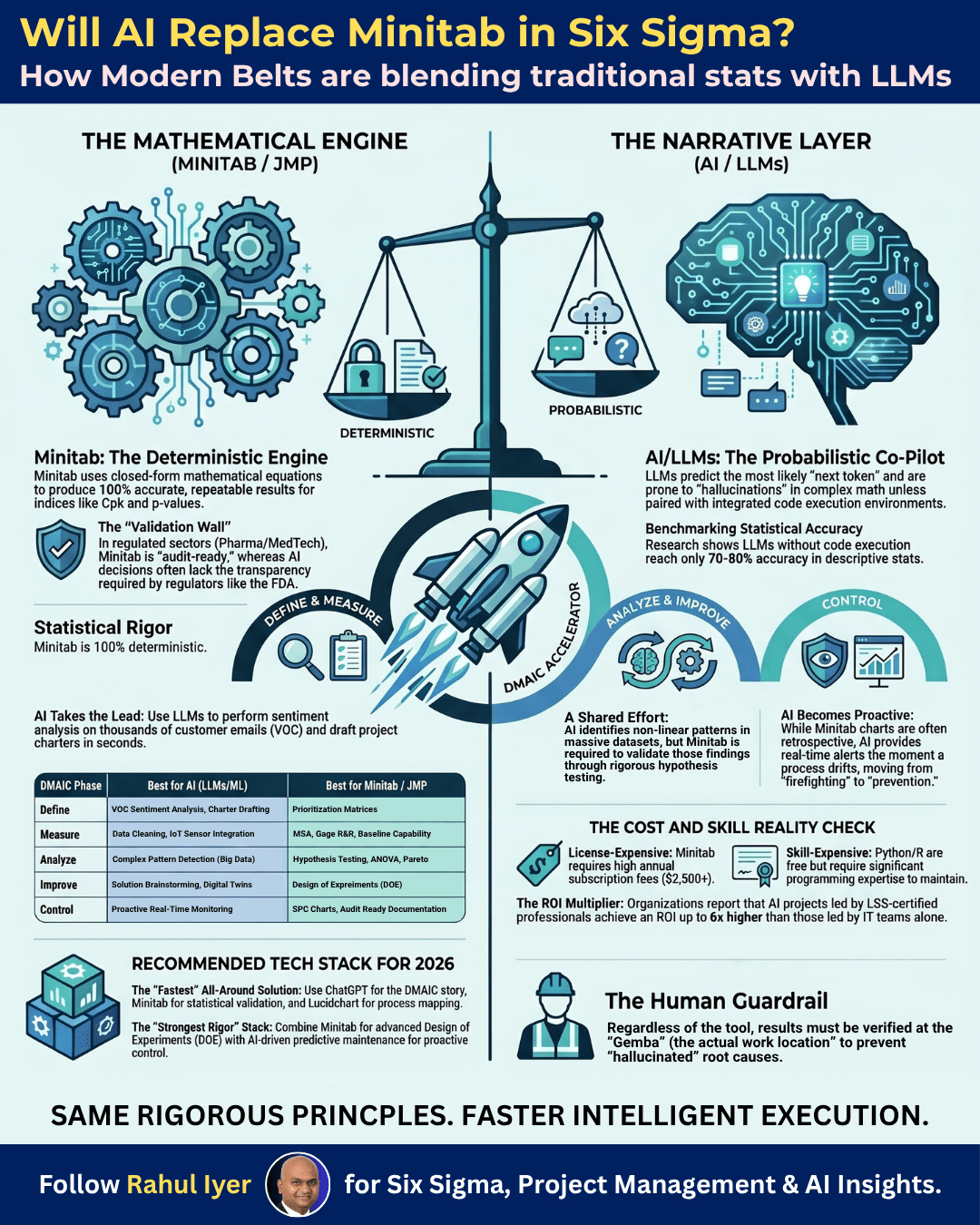
Instead, the future of Lean Six Sigma relies on a powerful synergy. AI is stepping into the role of a “cognitive co-pilot,” while Minitab remains your indispensable “deterministic mathematical engine.”
As a practitioner and educator navigating process excellence, I want to break down exactly how these technologies differ, where their limitations lie, and how you can combine them to future-proof your career.
Why Won't AI Replace Minitab? The Unshakable Mathematical Engine
When asking the question, “Will AI replace Minitab?”, we have to look at the foundational architecture of traditional statistical software. Minitab has been the industry standard for decades because of three core strengths:
Deterministic Algorithms: Minitab operates on frequentist statistics. When you run an Analysis of Variance (ANOVA), a Design of Experiments (DOE), or a Gage R&R, it uses closed-form mathematical equations to calculate exact, repeatable P-values and capability indices like Cp and Cpk.
Regulatory Compliance: This rigorous mathematical proof is non-negotiable in highly regulated industries like pharmaceutical manufacturing, automotive, or MedTech. Regulatory bodies demand that your software be fully validated and audit-ready, as outlined by FDA regulations on software validation.
Root Cause Traceability: If a quality deviation occurs, you must be able to prove exactly how your data led to your conclusion.
I see this realization happen all the time with our AIGPE® students. When professionals first start their White Belt or Yellow Belt journey, the math can feel intimidating. However, as they progress into Green Belt and Black Belt training, they experience a breakthrough. They realize that Minitab does the heavy lifting, allowing them to focus on interpreting the data rather than memorizing formulas. The software gives them the confidence to stand in front of stakeholders and defend their solutions with hard, undeniable facts. This level of certainty is exactly why we won’t see AI replace Minitab anytime soon.
Enter AI: The Optimal Cognitive Co-Pilot
While Minitab excels at structured, numerical data, AI shines when handling unstructured, unbounded text. Integrating generative AI introduces a powerful narrative layer to the DMAIC framework that used to take project managers weeks to compile. But can AI replace Minitab here? No, they handle completely different tasks.
Define Phase: AI can process thousands of unstructured customer emails, survey comments, and complaint logs in seconds to extract the Voice of the Customer (VOC). It can instantly draft your Project Charter and SIPOC diagrams based on your raw notes.
Analyze Phase: AI can rapidly detect non-linear themes in massive datasets that might elude traditional brainstorming sessions.
Improve Phase: Generative AI serves as an exceptional brainstorming partner. By prompting an AI with specific project constraints, you can generate multiple process redesign scenarios based on Lean principles like Poka-Yoke or 5S in a matter of minutes.
The AI "Black Box" Paradox and Its Risks
Despite these incredible capabilities, relying solely on AI for Six Sigma statistics, and attempting to let AI replace Minitab completely, introduces severe risks that every practitioner must understand:
Probabilistic Token Predictors: AI models are not actual calculators. They predict the next most likely word in a sequence based on their training data. Because of this, an AI might generate a Cpk or Sigma level value that sounds highly plausible but is mathematically incorrect.
The “Black Box” Accountability Crisis: In regulated environments, an AI system that rejects a batch of medical devices without explaining its underlying mathematical logic is a massive liability. Auditors will never accept “the AI determined it” as a valid root cause.
Data Privacy Risks: Feeding proprietary company data or confidential manufacturing metrics into a public AI model exposes your organization to data leakage.
The AIGPE® Dual-Engine Analytics Framework
To help professionals navigate the complex intersection of generative AI and traditional statistical analysis, I developed the AIGPE® Dual-Engine Analytics Framework.
Instead of trying to have AI replace Minitab, this framework establishes exactly how you should allocate your DMAIC workflows to maximize efficiency without ever compromising statistical integrity.
| Engine Type | Primary Function | Ideal DMAIC Workflows | Strict Guardrails |
|---|---|---|---|
| Cognitive Co-Pilot (AI) | Qualitative Heavy-Lifting & Ideation | Processing VOC text, drafting SIPOCs, generating Fishbone root causes, summarizing meeting notes. | Never upload proprietary numerical datasets or Personally Identifiable Information (PII). |
| Mathematical Engine (Minitab) | Audit-Ready Statistical Validation | Executing Gage R&R, calculating Cp/Cpk, running Hypothesis Tests, performing Design of Experiments. | Data must be clean, structured, and validated prior to analysis. |
Seeing the Framework in Action
Let us ground this with a real-world example. Imagine you are a Green Belt optimizing a regional pizza chain suffering from late delivery times:
Step 1: The AI Cognitive Co-Pilot. You export thousands of customer reviews and feed them into ChatGPT. Within seconds, the AI categorizes the unstructured complaints, revealing that 80% of bad reviews mention “cold pizza” rather than the driver’s attitude. It drafts a Project Charter and helps you brainstorm potential root causes.
Step 2: The Human-in-the-Loop Governance Bridge. You go to the Gemba (the actual place of work), measure oven temperatures, and track delivery driver routes.
Step 3: The Mathematical Engine. You take this structured numerical data and plug it into Minitab. Minitab runs an ANOVA, proving with absolute deterministic certainty that the oven temperature fluctuation across different branches is the statistically significant root cause of the delays.
For those still asking, “can AI replace Minitab?”, this scenario proves the answer is no. AI pointed you in the right direction; Minitab gave you the undeniable mathematical proof needed to secure the budget for a costly equipment upgrade.
To act as that critical Governance Bridge, your foundational statistical skills must be razor-sharp. AI cannot run the mathematical validation for you. That is why our specialized Minitab courses at AIGPE® focus purely on mastering this analytical engine. We build this competency systematically:
Minitab Beginner: Focuses entirely on mastering Graphical Tools.
Minitab Proficient: Dives deep into Statistical Process Control (SPC).
Minitab Expert: Tackles advanced Hypothesis Testing tools.
By mastering these pure Minitab applications, our students learn exactly how to take an ambiguous, real-world problem and extract the indisputable truth from their data.
The Cost vs. Value Conversation
A common argument for having AI replace Minitab stems from software costs, leading professionals to explore open-source alternatives or force ChatGPT to do their analytics. However, when evaluating true cost versus value, several distinct realities emerge:
The Open-Source Learning Curve: Free tools like Python and R demand extensive programming skills. Most continuous improvement professionals simply do not have the time to master these complex languages while managing active projects.
The AI Accuracy Gap: While AI is highly accessible, it lacks the deterministic accuracy and proven mathematical rigor required for specialized Six Sigma tasks.
The Minitab Value Bridge: Minitab delivers immense value by bridging this technical gap perfectly. Its pre-built procedures and intuitive Assistant feature make advanced statistical concepts accessible to everyone without writing a single line of code.
Future-Proof Evolution: Minitab is not ignoring the AI revolution. The platform has heavily integrated Machine Learning, offering proprietary methods like predictive analytics and gradient boosting in a secure, fully validated environment.
The Optimal Tech Stack for Process Improvement
If your goal is to deliver flawless Lean Six Sigma project documentation with control charts and process maps, the best tool is not a single software. It is a synergistic stack.
Industry experts increasingly agree that the optimal, most practical tech stack for practitioners today looks like this:
ChatGPT, Claude, or Gemini: Handles the document structure, formatting, narrative writing, and qualitative interpretation.
Minitab: Generates credible, publication-quality control charts, regression models, and statistical analyses.
Lucidchart or Visio: Creates professional value stream maps and process flowcharts.
Final Thoughts: A Synergistic Future
As we look toward the future, Artificial Intelligence will act as a massive force multiplier that accelerates your project timelines and expands your analytical reach. But it will not replace the need for mathematical proof. So, will AI replace Minitab? The most successful continuous improvement professionals know the answer is no.
By leveraging my AIGPE® Dual-Engine Analytics Framework, you can use AI to navigate the ambiguity of process discovery while relying on Minitab for the unshakable mathematical validation required to solve complex problems.
Ultimately, Lean Six Sigma provides the steering, while AI provides the horsepower. When you learn to integrate both, you transform your operations into a resilient, predictive, and optimized system of quality.
About the Author
Rahul G. Iyer is an AI-Driven Transformation Leader and Founder and CEO of AIGPE®. With more than 23 years of experience and 700+ personally executed Six Sigma, process-improvement, Operational Excellence and transformation projects, he turns practical expertise into professional courses, corporate training, private AI coaching, keynotes and The M3 Podcast Show. His learning content has generated 1M+ cumulative learner enrollments and reached 198 countries.
What is Your Next Step?
What does your process improvement tech stack look like today? Are you leaning more heavily on AI, or do you still rely strictly on traditional statistical tools? Let me know in the comments below.
🚨 FREE DOWNLOAD: The Six Sigma AI Playbook Before you dive into the statistical tools, make sure you are maximizing your AI Cognitive Co-Pilot. I have put together a free 50-page PDF playbook designed specifically for continuous improvement professionals. Click here to download The Six Sigma AI Playbook instantly. Unlock 50 custom AI prompts to automate the DMAIC cycle and strip busywork out of your projects today.
If you are ready to master the “Mathematical Engine” and build audit-ready analytical skills, it is time to take action.
Master the Tools (Specialized Minitab Certifications): Explore our step-by-step Minitab training programs to secure your competitive edge in statistical analysis:
Master the Full Framework (Lean Six Sigma Belt Certifications): Looking for the complete package? Our bestselling Lean Six Sigma certification programs have Minitab training built directly into the courseware. This ensures you learn the overarching theory and the software engine simultaneously: